
By: Staff Writer
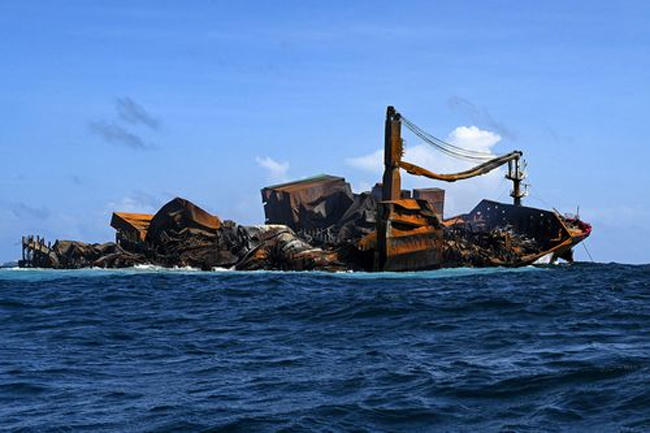
December 23, Colombo (LNW): The sinking of the MV X-Press Pearl off Sri Lanka’s western coast in June 2021 marked a defining moment for the country’s maritime history. What began as a shipboard fire escalated into an environmental catastrophe, releasing toxic substances, oil residue and billions of plastic pellets into the sea. Coastal ecosystems were damaged, fishing communities were disrupted and the long-term environmental consequences remain only partially understood.
In the years since, Sri Lanka’s legal system has sought accountability through domestic judicial processes, culminating in a Supreme Court ruling that ordered compensation in relation to the disaster. Yet responses from Singaporean public relations agencies—acting on behalf of maritime stakeholders—have made clear that Singapore does not accept an obligation to pay compensation under that ruling. Their position, however, is not framed as defiance, but as a reflection of how Singapore interprets international law, commercial risk and its role within global shipping.
A Legal Divide Between National Justice and International Enforcement
At the core of Singapore’s position is a clear distinction between judicial authority and enforceability. While the Sri Lankan court’s ruling is acknowledged as valid within Sri Lanka, Singapore’s response stresses that such decisions do not automatically carry weight beyond national borders. From this perspective, enforcement is not a matter of sympathy or morality, but of legal process.
Singapore’s agencies argue that international shipping operates within a framework where liability must be determined through globally recognised mechanisms—such as arbitration, international conventions or treaty-based cooperation. Accepting a domestic court ruling as enforceable abroad, they contend, would blur the lines between national sovereignty and international jurisdiction, introducing uncertainty into a system that depends on legal clarity.
Fear of Unintended Consequences in a High-Stakes Industry
More than legal theory is at stake. Shipping is an industry governed by risk calculation, insurance modelling and long-term confidence. Singapore’s communications reveal a strong concern that accepting unilateral compensation demands could alter how risk is priced across global maritime trade.
If operators believe they may be exposed to large, foreign-imposed liabilities without predictable legal pathways, the consequences could extend beyond a single case. Insurance premiums could rise, vessel routing decisions could change, and registration under certain flags could become less attractive. Singapore, positioning itself as a stable maritime hub, is acutely sensitive to any development that might weaken that perception.
Responsibility Beyond a Single Shoreline
Singapore’s narrative also reframes the X-Press Pearl disaster as a cumulative failure rather than a singular event confined to Sri Lankan waters. By highlighting earlier missed opportunities to intervene when the vessel was already experiencing hazardous cargo issues elsewhere, the response places the disaster within a broader regional context.
This framing does not deny the damage suffered by Sri Lanka, but it questions whether accountability can reasonably be assigned without examining decisions made across multiple ports and jurisdictions. In Singapore’s telling, the tragedy exposes a systemic weakness in how the global maritime system handles vessels in distress—particularly the absence of binding obligations on ports to provide assistance when risks are identified early.
Reputation, Confidence and the Indian Ocean Shipping Corridor
The Singaporean response also touches on reputational risk—not just for Singapore, but for the wider region. Prolonged uncertainty surrounding the X-Press Pearl dispute, they suggest, reinforces perceptions of instability in the Indian Ocean shipping corridor. This matters at a time when ports across South Asia are competing for transshipment traffic, investment and strategic relevance.
From this viewpoint, unresolved legal battles do not merely seek justice for past harm; they actively shape future commercial decisions. Singapore’s position implies that without internationally aligned solutions, compensation disputes risk becoming signals of unpredictability rather than instruments of reform.
Retrospective Penalties or a Call for Structural Solutions?
Rather than focusing solely on compensation, Singapore’s communications emphasise prevention and systemic reform. The disaster, in their assessment, highlights the absence of enforceable global standards governing port responsibility, emergency refuge and early intervention. Without these, similar incidents are likely to recur—regardless of how compensation disputes are resolved after the fact.
This emphasis shifts the conversation away from individual blame towards institutional failure. Singapore’s refusal to pay, as framed by its PR agencies, is thus presented not as rejection of accountability, but as resistance to addressing global problems through fragmented national actions.
Conclusion
Singapore’s stance on the X-Press Pearl compensation reflects a broader philosophy about how international shipping should be governed. It prioritises legal consistency, risk predictability and systemic reform over case-by-case enforcement of domestic rulings beyond national borders. While Sri Lanka continues to seek redress for one of its worst maritime disasters, Singapore’s response underscores the limitations of existing global frameworks—and the unresolved tension between national justice and international commerce. The tragedy of the X-Press Pearl, in this sense, has become as much a test of global maritime governance as it is a question of compensation.