
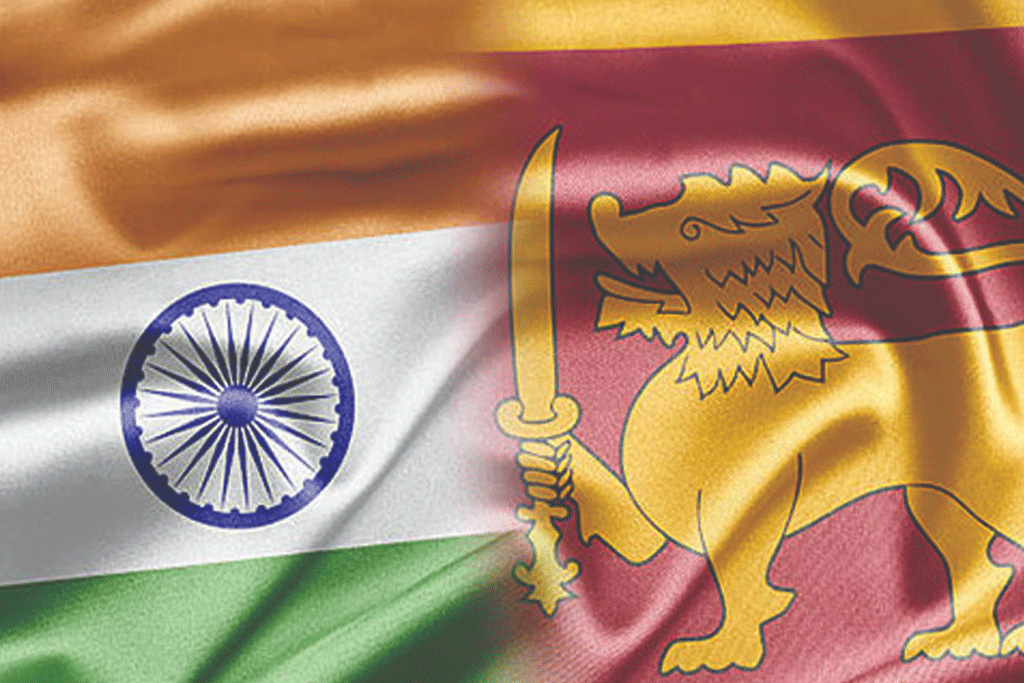
India’s decision to extend a USD 450 million financial assistance package to Sri Lanka in the aftermath of Cyclone Ditvah goes far beyond humanitarian relief, reflecting New Delhi’s broader strategic, economic, and geopolitical calculus in the Indian Ocean region.
Announced by Indian External Affairs Minister Dr. S. Jaishankar, the package consists of a USD 350 million concessionary line of credit and USD 100 million in outright grants, targeted at rebuilding cyclone-ravaged infrastructure and livelihoods. The commitment was formally conveyed through a letter from Indian Prime Minister Narendra Modi to President Anura Kumara Dissanayake, underlining the political significance attached to the initiative.
The assistance is being structured in close coordination with the Sri Lankan government and focuses on five critical areas: restoring road, rail, and bridge connectivity; rebuilding fully and partially damaged housing; rehabilitating health and education facilities; supporting agriculture to avert short- and medium-term food shortages; and strengthening disaster preparedness mechanisms.
India’s rapid response under Operation Sagar Bandhu reinforced its role as Sri Lanka’s first responder. Naval assets INS Vikrant and INS Udayagiri, Indian Air Force Mi-17 helicopters, an 80-member National Disaster Response Force unit, and a field hospital near Kandy with 85 medical personnel were deployed within hours of the cyclone’s landfall. Emergency care was provided to over 8,000 affected persons, supported by two modular BHISHM emergency care units airlifted to the island.
Material assistance was equally extensive. More than 1,100 metric tons of relief supplies—ranging from dry rations and tents to hygiene kits, water purification units, and essential clothing—were delivered, along with 14.5 tons of medicines and medical equipment. India also moved quickly to restore transport links, constructing a Bailey bridge in Kilinochchi and initiating another in Chilaw.
Economically, the assistance helps Sri Lanka manage post-disaster reconstruction at a time when fiscal space remains limited following the 2022 economic collapse. The heavy reliance on grants and concessional credit reduces immediate debt stress, a key consideration as Colombo remains under IMF-supported reforms.
Politically and strategically, the package reinforces India’s “Neighbourhood First” policy and its intent to remain the most reliable partner in South Asia during crises. By linking disaster relief with longer-term support for tourism, investment, and connectivity, New Delhi is embedding humanitarian assistance within a wider framework of economic integration and regional stability.
For Sri Lanka, the aid offers immediate relief. For India, it consolidates influence in a strategically vital island at the heart of the Indian Ocean—where humanitarian diplomacy and geopolitical interests increasingly intersect.