
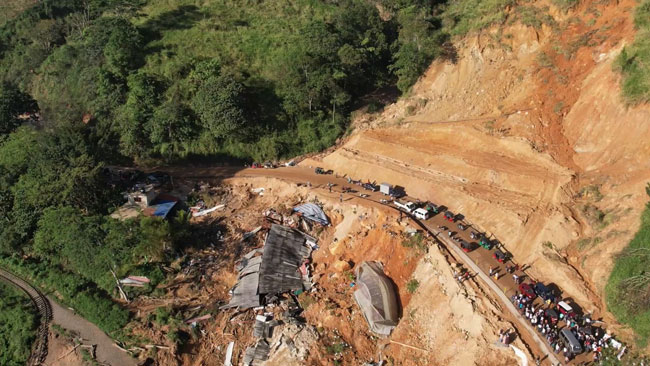
Cyclone Ditwah did not merely flood towns and uproot livelihoods—it exposed the fragile intersection between climate vulnerability and institutional weakness in Sri Lanka’s disaster response architecture. According to the International Labour Organisation (ILO), economic activity equivalent to $16 billion, or 16% of GDP, was placed at risk, revealing how deeply disasters now penetrate the country’s productive core.
Unlike conventional damage estimates, the ILO relied on remote sensing and night-time light intensity to assess economic exposure, capturing real-time disruption across districts. This contrasts sharply with the World Bank’s $4.1 billion estimate, which focuses narrowly on physical damage while excluding employment losses, informal sector disruptions, and long-term recovery costs. The divergence reflects not inconsistency, but the absence of a coordinated, multi-agency assessment framework.
The labour market consequences are particularly alarming. The ILO estimates that 374,000 workers were operating in directly affected areas, risking income losses of $48 million per month. Plantation workers, smallholder farmers, and fisheries communities face extended job insecurity due to delayed rehabilitation and weak access to formal safety nets.
UNDP assessments have long warned that Sri Lanka’s social protection systems lack shock-responsiveness, especially for informal and rural workers. Ditwah reinforced this vulnerability, as relief efforts struggled to align welfare delivery with employment recovery, leaving many households dependent on short-term aid rather than sustainable income restoration.
The IMF has repeatedly highlighted that climate disasters now represent a macro-critical risk for Sri Lanka, capable of derailing fiscal consolidation and growth targets. From this standpoint, weak coordination between disaster management agencies, line ministries, and provincial authorities magnifies economic losses and raises future borrowing needs.
Although the ILO recommends employment-intensive recovery programmes and MSME support, implementation remains the key challenge. Without institutional accountability, real-time data sharing, and decentralised execution, recovery risks becoming uneven and politically mediated.
Cyclone Ditwah’s aftermath is therefore not only a test of resilience, but of governance. Unless structural coordination failures are addressed, future climate shocks will continue to extract escalating economic and social costs.