
By Faraz Shauketaly
Khaleda Zia, who has died at the age of 80, was one of the most consequential and contentious figures in the political history of Bangladesh, a nation whose post‑independence trajectory she helped shape for decades. 
A Pioneer in Politics
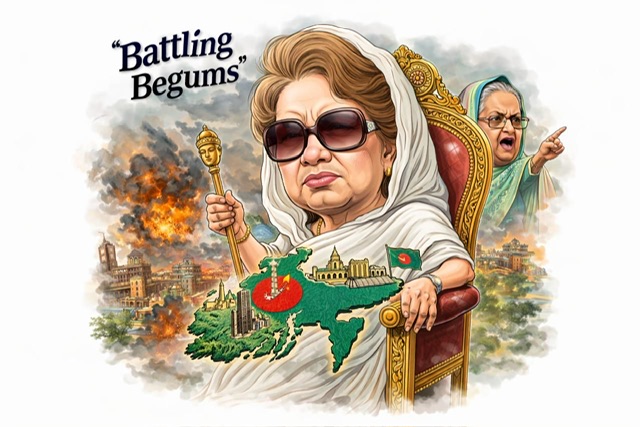
Born in 1945, Zia entered politics after the assassination of her husband, former army chief and president Ziaur Rahman. She rose to prominence as a leader of the Bangladesh Nationalist Party (BNP) and became the country’s first female prime minister in 1991, a post she held through periods of intense political rivalry, most notably with Sheikh Hasina of the Awami League. Her leadership helped steer Bangladesh through its first parliamentary government after years of military rule. 
She is credited by supporters with re‑establishing parliamentary democracy following military rule, stabilising the political system in the early 1990s, and promoting market‑oriented economic policies that appealed to the business community. 
Controversies and Criticism
Zia’s career was also marked by deep controversy and significant allegations:
Corruption Charges:
She and members of her family were prosecuted for corruption, including cases involving the alleged misuse of funds meant for charitable causes. Zia was sentenced to long prison terms in multiple cases, though in early 2025 the Bangladesh Supreme Court acquitted her and her son, Tarique Rahman, overturning those convictions. Her supporters maintained the prosecutions were politically motivated.
Political Violence and Human Rights Concerns:
Her time in power — especially in coalition with the Islamist Jamaat‑e‑Islami party — was shadowed by rising political violence and accusations of impunity. Critics say her government failed to curb extremism and contributed to a climate of political brutality. The long‑running rivalry with Sheikh Hasina’s Awami League was punctuated by bomb attacks and street violence, including a deadly grenade assault on an Awami League rally in 2004 that left several party members dead, for which political opponents initially held her government’s inner circle responsible. 
The “Dark Prince” and Parallel Power:
Her elder son, Tarique Rahman, often referred to by critics as the “dark prince” of BNP politics, was accused of wielding influence behind the scenes and of corruption and political violence during BNP’s tenure — allegations that have become part of his controversial legacy, even though courts have recently cleared him of some charges.
Legacy and National Impact
Zia’s legacy is deeply polarising in Bangladesh. To her supporters and many in the BNP, she was a trailblazer who fought for democratic governance and stood resilient against repression. Her leadership offered a counterweight to the Awami League’s dominance and helped institutionalise multi‑party contestation in Bangladeshi politics. 
To her detractors, she was a figure whose government presided over political violence, pro‑Islamist alliances, and governance failures. Her periods in power were also associated with deep political polarisation that has persisted through subsequent decades.
A Life Reflecting Bangladesh’s Turbulence
Khaleda Zia’s story cannot be told without acknowledging both her pioneering role as a female leader in a predominantly male political landscape and the deeply contentious chapters of her career involving corruption accusations and political strife. Her passing marks the end of a dramatic era in Bangladesh’s modern political life — one defined by relentless rivalry as much as by electoral breakthroughs.
She is survived by her son, Tarique Rahman, acting chairman of the BNP, and other family members.