
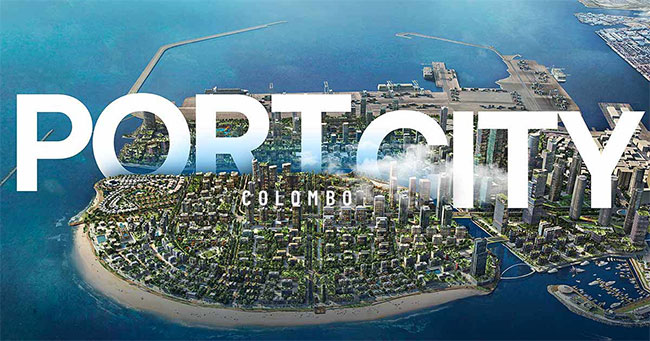
China Harbour Engineering Company (CHEC) has doubled down on Sri Lanka with a fresh USD 300 million foreign direct investment into Port City Colombo, even as serious doubts grow over whether the country’s new Marxist JVP-led National People’s Power (NPP) government can convert concrete into cash flows.
The investment, earmarked for Phase II development, follows an earlier USD 1.25 billion sunk into land reclamation and infrastructure making Port City one of the largest single Chinese-backed urban developments in South Asia.
CHEC’s message is one of confidence. The company describes Port City as a “generational project,” not a speculative real-estate play. Phase II funding will expand internal infrastructure, utilities, and core services within Sri Lanka’s first multi-services Special Economic Zone (SEZ), theoretically laying the groundwork for a global financial and services hub.
But behind the optimistic statements lies a more uncomfortable reality: Sri Lanka has built the city, but not the system to run it.
The NPP government, dominated by the Marxist Janatha Vimukthi Peramuna (JVP), has no track record in international investment promotion, financial-services regulation, or SEZ governance.
Its historical hostility toward foreign capital, privatization, and offshore finance directly contradicts the very business model Port City depends on. Investors are not blind to ideology, and early signals from Colombo have raised alarms rather than reassurance.
The Board of Investment (BOI), still operating with decades-old procedures and a manufacturing-era mindset, remains the primary interface for investors.
In an age where competing hubs like Dubai, Abu Dhabi, and India’s GIFT City offer regulatory certainty, tax stability, and autonomous financial courts, Sri Lanka continues to offer delays, discretion, and political interference.
CHEC’s USD 300 million commitment may reflect long-term strategic patience but private global capital is far less forgiving.
Financial institutions, offshore service providers, and multinational firms demand clarity on tax regimes, capital repatriation, dispute resolution, and regulatory independence.
To date, the NPP government has failed to clearly articulate how Port City will be insulated from domestic politics and ideological experimentation.
There is also a deeper geopolitical subtext. China’s continued investment positions Beijing as the only player willing to absorb Sri Lanka’s political risk premium. While this keeps Port City alive, it risks narrowing the project’s investor base turning what was meant to be a global financial hub into a lopsided, single-partner venture.
Port City Colombo stands at a dangerous inflection point. The infrastructure is world-class. The funding is real.
But unless the government rapidly modernizes investment policy, empowers an independent Port City regulator, and distances the project from ideological posturing, Sri Lanka may discover that billions in Chinese capital cannot compensate for policy paralysis.