
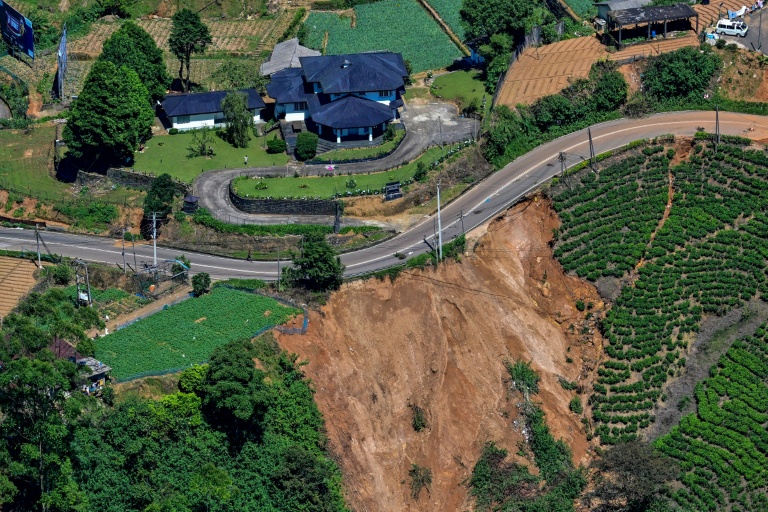
Sri Lanka’s corporate leadership has sought to reassure investors following the recent cyclone, with Ceylon Chamber of Commerce Chairman and John Keells Holdings Chairman Krishan Balendra insisting that the economic impact has been “moderate” and largely contained. However, a closer examination of official assessments and sector-level data suggests a more complex and uneven economic reality.
Speaking at the Asia Securities Investor Conference, Balendra pointed to post-disaster assessments indicating that only about 10% of cultivated agricultural land was fully damaged, with another 5% partially affected. He noted that agricultural operations resumed quickly and argued that fears of prolonged food inflation had not materialised. While retail food prices initially surged by around 40%, particularly in urban supermarkets, supply chains stabilised within weeks.
Yet, macro-level estimates paint a starker picture. A World Bank rapid assessment places total cyclone-related damage at approximately US$4.1 billion, equivalent to 4% of Sri Lanka’s GDP. This figure far exceeds early private-sector estimates and underscores the scale of losses to infrastructure, livelihoods, and public assets costs that are not immediately visible in supermarket shelves or short-term consumption data.
Balendra also downplayed financial sector risks, stating that banks estimate only about 1% of total loan portfolios were affected. However, analysts note that such averages mask stress among smallholder farmers, informal enterprises, and regional borrowers, where repayment capacity has weakened despite system-wide stability.
In tourism, Balendra cited resilience, noting infrastructure damage of roughly Rs. 500 million and a rapid rebound in arrivals. Tourist numbers in the first 25 days of January reportedly exceeded last year’s record levels by 10%. While this reflects strong demand, economists caution that headline arrival figures do not capture revenue losses from discounted pricing, shortened stays, or postponed investments in affected regions.
Consumption indicators, including supermarket volumes, have indeed recovered. However, critics argue that consumption alone is an incomplete measure of economic health, especially in a post-disaster context where households may be drawing down savings or increasing debt.
Balendra’s optimism on 2026 growth driven by tourism, construction, ICT, and consumption—aligns with broader forecasts. Yet reconstruction spending, while stimulative, also increases fiscal pressure at a time when public finances remain fragile.
In sum, while the cyclone did not derail Sri Lanka’s short-term recovery narrative, independent assessments suggest its economic footprint is far larger than “moderate.” The challenge lies not in denying resilience, but in acknowledging hidden vulnerabilities that could resurface without targeted policy support.