
By: Faraz Shauketaly
Sri Lanka has finally discovered a new unit of measurement in criminal law: the overnight transit.
Not a Bond scam. Not a vanished port. Not a procurement that evaporated billions.
A stopover.
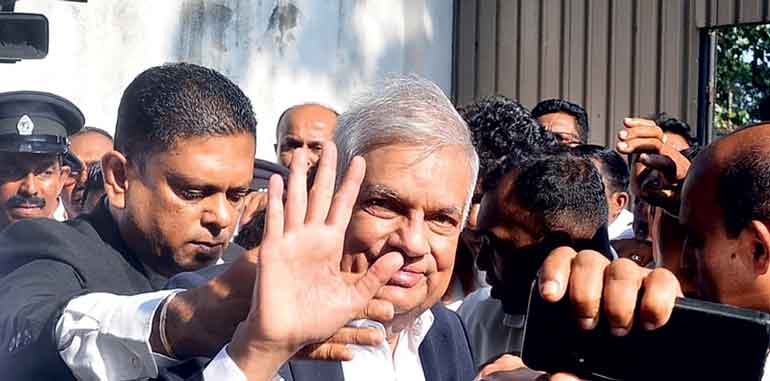
At the centre of this legal theatre is Ranil Wickremesinghe, arrested, remanded, hospitalised, ICU-warded, passport impounded—and now hovering in the legal purgatory between prosecution and political performance.
The charge? Misuse of public funds.
The alleged crime? Accepting an invitation, while already in transit, to attend a luncheon.
Let’s slow this down. Carefully. Because facts, inconveniently, still matter.
The letter that started it all
The University of Wolverhampton sent a formal invitation to the President of Sri Lanka and the First Lady, routed through the High Commission of Sri Lanka. The purpose was explicit: a luncheon at which the First Lady would receive an honorary degree—same date, same function, same venue.
No subterfuge. No surprise cameo. No “by the way, your wife is being honoured”.
The invitation did not arrive via WhatsApp. It arrived through diplomatic channels.
Havana, London, Colombo — geography intrudes on criminal law
At the time, the President was returning from Havana, where he had attended a separate official engagement. There are no direct flights from Havana to Colombo.
This is not a policy choice. It is aviation.
A stopover in London is not indulgence; it is logistics.
On receipt of the invitation, the President informed his Secretary that he was minded to accept—precisely because he would be transiting London overnight in any event. He directed the Chief Accounting Officer of the Presidential Secretariat—that is, the Presidential Secretary—to handle the formalities.
Which is exactly how the system is supposed to work. Process, not impulse
The arrangements were made with the assistance of the High Commission in London, in concurrence with the Ministry of Foreign Affairs. Expenses relating to transport and security—from the stopover hotel to Wolverhampton and back to London—were met through official channels.
No additional flights.
No extended stay.
No deviation from the return route.
“In other words, the state paid for movement that would have occurred anyway—unless one believes the President should have slept upright on a Heathrow baggage carousel to preserve fiscal purity.”
Enter the CID, stage left
The Criminal Investigation Department in Colombo investigated and decided to file charges—not only against the former President, but also to charge his Secretary for aiding and abetting.
Bail was opposed. Bail was refused. The former President was remanded.
His health deteriorated. He was admitted to the General Hospital Colombo, then transferred to the Intensive Care Unit. Only at the next hearing was bail granted—passport impounded, exit barred.
One might ask whether this sequence reflects prosecutorial necessity or prosecutorial enthusiasm.
The London expedition that wasn’t quite legal
A CID team travelled to the UK. Notably, they did not invoke the Mutual Legal Assistance Treaty—the very mechanism designed for such investigations.
Without MLA cover, they interviewed officials at the High Commission.
They reportedly did not visit the University.
Unconfirmed—but widely circulating—accounts suggest that some High Commission officials expressed the view that the visit was “private”, despite the invitation being addressed to the President of Sri Lanka and routed through diplomatic channels.
Views, however, are not evidence. And diplomacy does not operate on vibes.
The missing witness: the University itself
Because MLA was not invoked, the CID was reportedly unable to formally verify the invitation directly with the University or with its then Chancellor, Lord Swaraj Paul. Now deceased.
So we have a prosecution contemplating indictment without examining the issuing institution, relying instead – apparently – on internal opinion and inference.
That is not an investigation. That is improvisation.
The Attorney General’s dilemma
Inside the Attorney General’s Department, opinion is split.
Politically, an indictment would be a trophy.
Legally, it is—at best—a thin reed.
The President had to stop in London anyway.
The invitation was official in form and channel.
The expenses were coordinated by the High Commission and Foreign Ministry.
There is no evidence of route manipulation, personal enrichment, or fabricated classification.
To prosecute on this basis is to argue that a stopover becomes criminal if a luncheon intervenes.
So, what is this really about?
Officially, the Government has no role in the Attorney General’s decision.
Unofficially, Sri Lanka has never met a high-profile prosecution; it didn’t enjoy auditioning.
The real question is not whether the law can be stretched—but whether it should.
If this becomes an indictment, it will establish a remarkable precedent:
that a President, in transit, may not accept a formally conveyed invitation without risking arrest—unless he first confirms that gravity, distance, and airline timetables have been cleared by the CID.
That would not be accountability.
That would be absurd, wearing the wig of legality.
And Sri Lanka, already short on credibility, can afford neither.
(The author is broadcaster and investigative journalist can be reached at [email protected] and www.shauketaly.com)