LISTEN TO STORY
WATCH STORY
By Adolf
The issue at hand with the former President’s UK Travel Expenditure is not about personalities or political loyalty; it is about public accountability, financial propriety, and the dignity of the Sri Lankan state. When public funds are expended in the name of the Head of State, there must be absolute clarity, documentation, and responsibility—especially by those entrusted as custodians of public money.
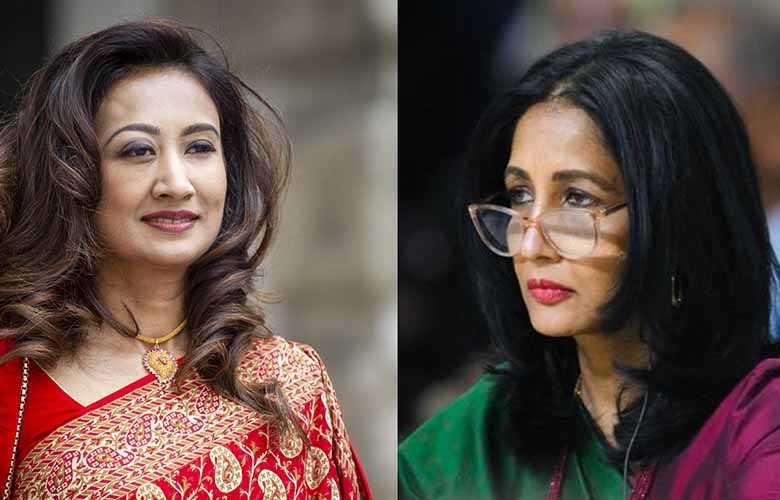
Saroja Sirisena and Aruni Wijewardana
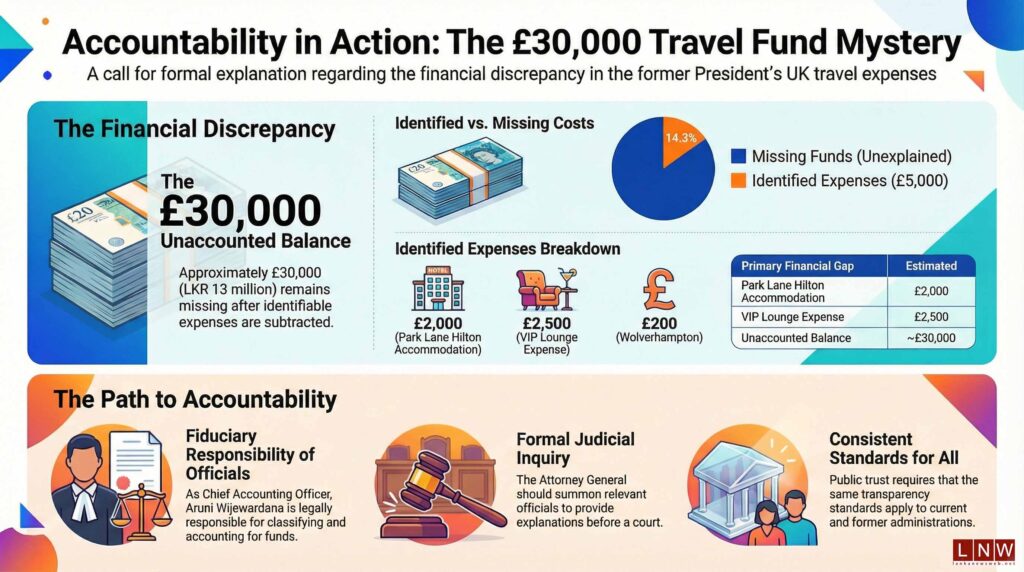
In this context, Saroja Sirisena and Aruni Wijewardana must be answerable. At the time, Aruni Wijewardana served as Secretary to the Ministry of Foreign Affairs and, by definition, was the Chief Accounting Officer. That role carries not ceremonial authority, but fiduciary responsibility. It is therefore legitimate to ask: how were funds allocated, classified, and accounted for during the overseas visit in question? Available information suggests that former President Ranil Wickremesinghe was provided with a vehicle and security cover by the British government while in the UK. Accommodation costs reportedly amounted to approximately GBP 200 in Wolverhampton, GBP 2,000 at the Park Lane Hilton, and a VIP lounge expense of around GBP 2,500—bringing total identifiable expenses to under GBP 5,000. This raises a simple and unavoidable question: what happened to the remaining balance of approximately GBP 30,000, or nearly LKR 13 million?
Material discrepancy
These are not accusations; they are questions that arise naturally when there is a material discrepancy between reported expenditure and allocated funds. In such circumstances, it is entirely appropriate for the Attorney General to summon the relevant officials—specifically the Chief Accounting Officer and those responsible for processing and authorising payments—to provide explanations before a court of law. One principle must be clearly stated. A Head of State is never a private citizen. Even when travelling for mixed purposes, the office carries constitutional dignity. The notion that a sitting President could be treated as a private individual—walking the streets or staying in informal accommodation—is not only unrealistic, it diminishes the standing of the country itself. If any expenses were deemed “private,” who made that determination? Was the President formally informed that certain costs would not be borne by the state? If so, where is the written record? If not, on what authority were distinctions drawn?
Independent Judiciary
Equally important is the integrity of the judicial process. Courts must not be drawn into political vendettas between a former President and a current President. Political disputes belong in civil proceedings, funded by private resources, not transformed into proxy battles through criminal or quasi-criminal processes. The credibility of institutions depends on restraint as much as action.
Finally, consistency matters. Public confidence requires that standards applied to one leader apply to all. It is therefore fair to ask—without malice or insinuation—whether the government can confirm if the current President’s mother was flown to Colombo in a government helicopter for medical treatment, or whether government vehicles and aircraft were used for the current President to visit outside Colombo. Transparency on such matters strengthens, rather than weakens, democratic governance. In the end, this is not about politics. It is about stewardship, accountability, and respect for the public trust. The political cycle of witch-hunting created by the current administration could return to haunt it many times over in the event of a future electoral defeat. However, if actions are taken in the right spirit, public support is more likely to remain with the administration—particularly if it applies the same standards to its own members. According to analysts, this consistency is currently lacking.