

LISTEN TO STORY
WATCH STORY
By: Isuru Parakrama
February 17, World (LNW): Jesse Jackson, the veteran American civil rights campaigner who carried the struggle for racial justice from the streets into the heart of presidential politics, has died peacefully at the age of 84 following a long battle with Progressive Supranuclear Palsy, a rare neurodegenerative condition.
His family confirmed that he passed away early on Tuesday morning, surrounded by loved ones.
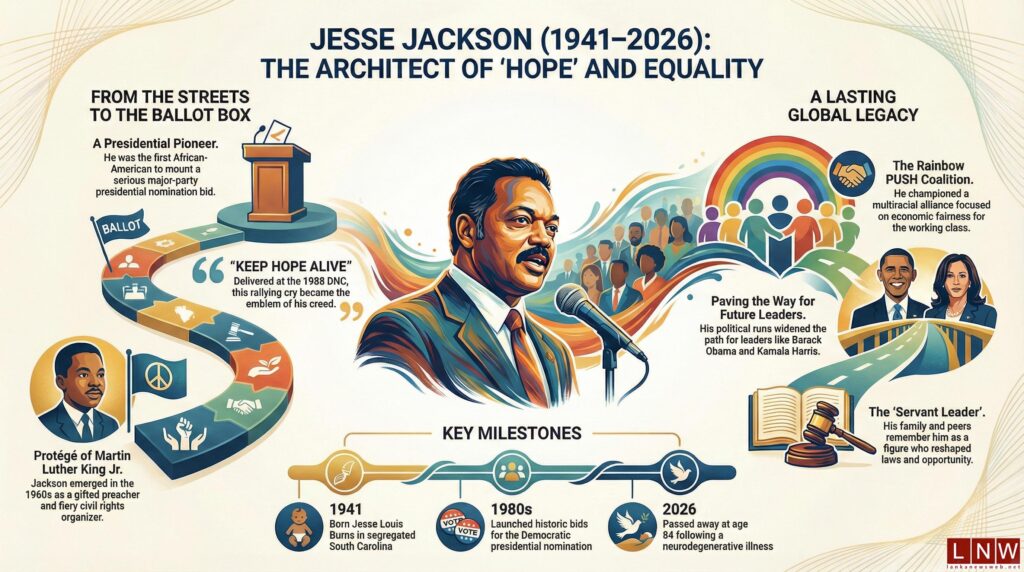
A protégé of Martin Luther King Jr., Jackson emerged in the turbulent 1960s as a fiery organiser and gifted preacher. Over subsequent decades he transformed himself into a formidable national figure, becoming the first African-American to mount a serious campaign for a major party’s presidential nomination.
His bids for the Democratic nomination in the 1980s did not succeed, yet they fundamentally altered the landscape of American politics and widened the path for future leaders such as Barack Obama and Kamala Harris.
Through his organisation, the Rainbow PUSH Coalition, Jackson championed a broad, multiracial alliance grounded in economic fairness. He consistently argued that the promise of American democracy would remain unfulfilled unless it embraced the poor and working class of every background.
His rallying cry, “Keep hope alive,” delivered memorably at the 1988 Democratic National Convention, became emblematic of his political creed and echoed through later generations of reformers.
In a statement, his family described him as a “servant leader” whose commitment to equality and human dignity left an indelible mark across the globe. They urged supporters to honour his legacy by continuing the work to which he devoted his life. Public commemorations are expected to take place in Chicago, a city central to his activism and political base.
Born Jesse Louis Burns on October 08, 1941 in Greenville, South Carolina, he grew up in the segregated American South. The son of Helen Burns, who later married Charles Henry Jackson, he was raised within the Black church — an institution that long served as both sanctuary and organising ground for resistance to racial oppression. As a young man, he experienced first-hand the daily humiliations of segregation, shaping the moral urgency that would define his career.
Jackson’s later years were marked by illness and controversy. Initially diagnosed with Parkinson’s disease in 2017, his condition was subsequently identified as Progressive Supranuclear Palsy. He gradually withdrew from public life as his health declined. Personal and political scandals also tested his reputation, including well-publicised family difficulties. Yet even critics acknowledged the scale of his contribution.
Tributes have poured in from across the political spectrum. The Reverend Al Sharpton, who worked alongside Jackson for decades, described him as a transformative figure who reshaped laws and expanded opportunity. “He taught young people from the most difficult beginnings that their spirits were not broken,” Sharpton said.
For many, Jackson represented a bridge between eras — from the marches of the 1960s to the ballot boxes of the 21st century. His voice, resonant and insistent, pressed America to confront its contradictions while imagining a fairer future. Though the man has gone, the cadence of his message — hopeful, defiant, inclusive — continues to reverberate.
Photos: Internet