

LISTEN TO STORY
WATCH STORY
By: Ovindi Vishmika
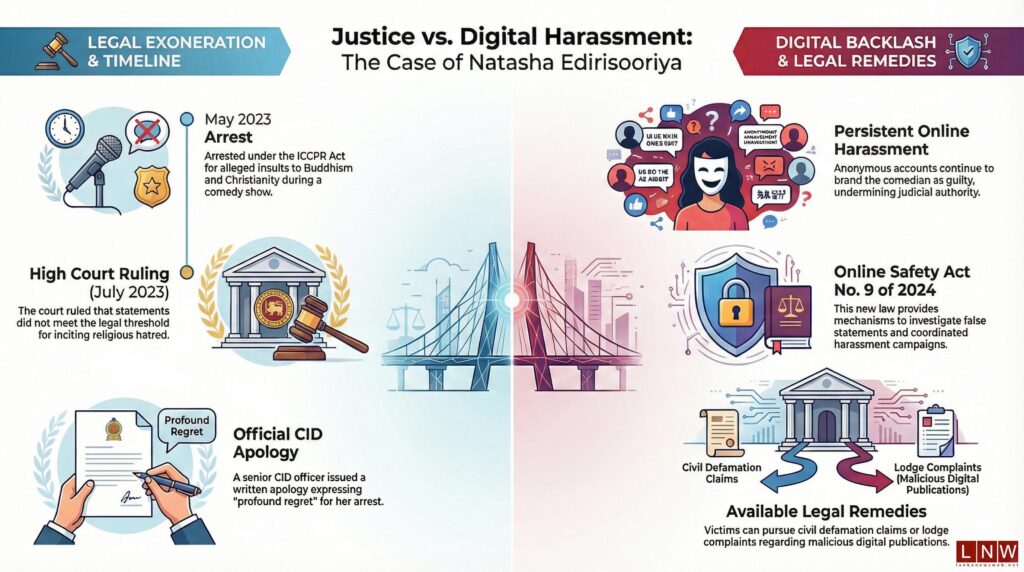
February 23, Colombo (LNW): Although stand-up comedian Natasha Edirisooriya has been legally cleared by the Colombo High Court and received a formal written apology from a former senior officer of the Criminal Investigation Department (CID), she continues to face a wave of online harassment, defamatory accusations and hostile commentary across social media platforms.
The controversy began in May 2023 when Edirisooriya was arrested over remarks made during her comedy show “Modibhimanaya,” with allegations that she had insulted Buddhism and Christianity. She was charged under Sections 291A and 291B of the Penal Code as well as Section 3(1) of the ICCPR Act No. 56 of 2007, which deals with advocacy of national, racial or religious hatred amounting to incitement.
In July 2023, however, the Colombo High Court ruled that the alleged statements did not, on their face, meet the legal threshold required under the ICCPR Act. High Court Judge Aditya Patabendige emphasized that the Act must be interpreted consistently with the constitutional guarantee of freedom of speech and expression. The Court noted that no evidence had been presented to establish hostility or violence resulting from her performance. She was granted bail accordingly.
The matter later reached the Supreme Court through a Fundamental Rights petition filed by Edirisooriya, challenging the legality of her arrest and detention. During those proceedings, a former Officer-in-Charge of the CID’s Cyber Crimes and Intelligence Analysis Unit tendered a written apology expressing “profound regret” for her arrest and remand. The Attorney General’s Department also undertook to issue a special circular clarifying guidelines to prevent improper arrests under the ICCPR Act in the future. Chief Justice P. Padman Surasena commended the resolution in open court, and the matter was concluded.
Online Harassment After Judicial Clearance
Despite these judicial findings and the official acknowledgment of error, segments of the public have continued to post abusive commentary online. Social media platforms have seen repeated allegations portraying the comedian as guilty, questioning the legitimacy of the High Court ruling, and attacking her character. Many such posts are reportedly circulated through anonymous or fake accounts, amplifying harassment while avoiding accountability.
Legal experts note that while citizens have the right to disagree with court decisions, repeatedly branding a person as a criminal after a competent court has ruled otherwise may amount to defamation if such statements are false and harmful to reputation.
Freedom of expression is constitutionally protected in Sri Lanka, but it is not absolute. Publishing false allegations with malicious intent, spreading misinformation about a court verdict, or engaging in sustained harassment may expose individuals to civil liability or other legal consequences.
Contempt of Court and Judicial Authority
There is also the question of whether certain forms of online commentary may undermine the authority of the judiciary.
Under Article 105(3) of the Constitution, the Supreme Court has the power to punish for contempt of itself and other courts.
Where commentary goes beyond fair criticism and deliberately scandalises a court, misrepresents a judicial decision, or seeks to erode public confidence in the administration of justice, such conduct could potentially amount to contempt.
While reasoned criticism of judgments is lawful in a democratic society, malicious campaigns that distort court findings or encourage hostility toward the judiciary may cross legal boundaries.
The Role of the Online Safety Act No. 9 of 2024
In addition to existing defamation and contempt provisions, Sri Lanka’s recently enacted Online Safety Act No. 9 of 2024 may provide a legal mechanism where online conduct crosses into unlawful territory.
The Act establishes the Online Safety Commission and addresses “prohibited statements” communicated online. These may include false statements made with intent to cause harm, communications amounting to harassment, and content that could constitute contempt of court.
If individuals knowingly spread false claims that contradict judicial findings, deliberately misrepresent court decisions, or engage in coordinated harassment campaigns intended to intimidate or degrade, such actions may fall within the scope of the Act. The use of fake or anonymous accounts for harmful purposes does not automatically shield individuals from investigation if legal thresholds are met.
Under the Act, complaints may be made to the Online Safety Commission, which has the authority to investigate, issue removal directives, and in serious cases refer matters for prosecution. However, the law must be applied carefully to avoid infringing legitimate freedom of expression. Mere disagreement with a judgment would not automatically amount to an offence; the key factors are falsity, intent and demonstrable harm.
Legal Remedies Available
Where online speech crosses from criticism into harassment or defamation, several legal remedies may be available. Affected individuals may pursue civil defamation claims for reputational damage. Complaints can be lodged with cybercrime authorities regarding malicious digital publication. In cases where judicial authority is undermined, contempt proceedings may be considered. Additionally, the Online Safety Commission may act where content meets the statutory definition of prohibited statements.
A Broader Democratic Concern
This situation reflects a broader challenge in the digital era. In a constitutional democracy, the determination of criminal liability rests with the courts. Public debate is vital, but it must operate within legal boundaries.
When a High Court has ruled that legal thresholds were not met, and a state official has formally apologized for procedural wrongdoing, continued vilification based on unproven or false allegations risks shifting from democratic expression to unlawful harassment. Such conduct not only harms the individual concerned but may also erode public confidence in the rule of law and the authority of judicial institutions.
As legal analysts observe, respecting court verdicts does not require silence or agreement — but it does require that public discourse remain truthful, responsible and within the limits of the law.