LISTEN TO STORY
WATCH STORY
By: Isuru Parakrama
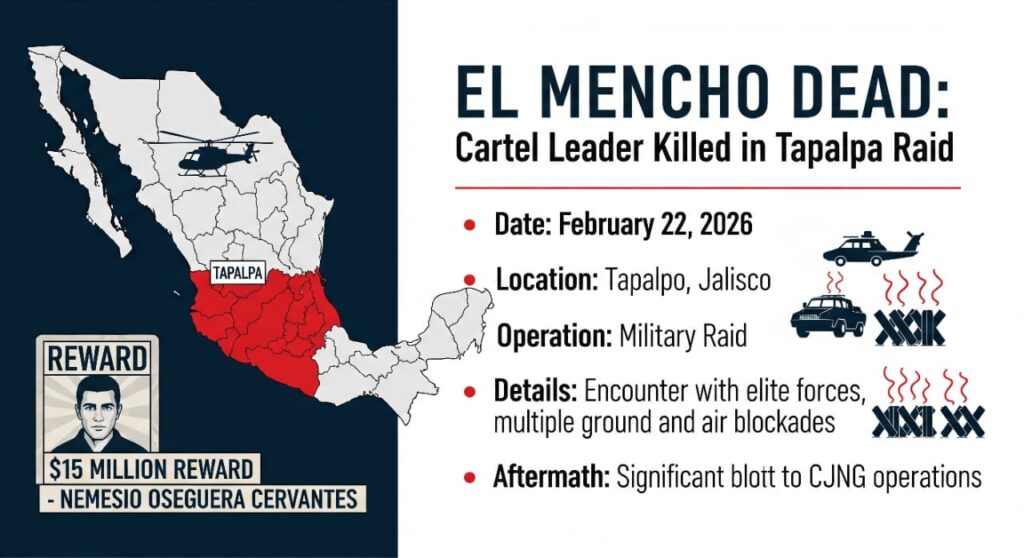
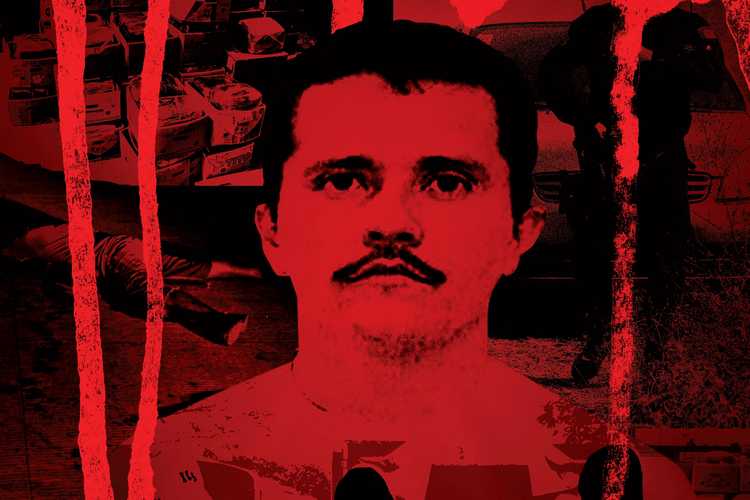
February 24, World (LNW): The death of Nemesio Oseguera Cervantes — better known as “El Mencho” — marks a watershed moment in Mexico’s long and bloody struggle against organised crime. The feared leader of the Jalisco New Generation Cartel (CJNG) was killed on February 22, 2026 during a Mexican military operation in the western state of Jalisco, marking a close to a manhunt that had spanned more than a decade.
For years, El Mencho stood amongst the most wanted men in the world. Both Mexican and United States authorities had placed multimillion-dollar bounties on his head, accusing him of overseeing a vast criminal empire responsible for trafficking cocaine, methamphetamine and fentanyl across several continents. His organisation grew into one of the most powerful and violent drug cartels operating in the Americas.
From Rural Poverty to Criminal Power
Born on July 17, 1966 in rural Michoacán, Oseguera Cervantes emerged from stark poverty. He reportedly left school early to labour in avocado fields and guard marijuana plantations. In the 1980s, he illegally entered the United States, where he was arrested multiple times on drug-related charges before being deported to Mexico in the early 1990s following a five-year prison sentence.
Back in his homeland, he joined the Milenio Cartel and forged alliances that would later prove decisive. After internal fractures within Mexico’s criminal underworld around 2010, he founded the CJNG, transforming it from a regional faction into a global trafficking powerhouse.
The cartel rapidly expanded its footprint across key Mexican states including Jalisco, Colima and Guanajuato, while establishing supply and distribution networks stretching into the United States, Europe, Asia and Africa.
A Reign Defined by Violence
El Mencho’s ascent was defined by ruthless violence and strategic intimidation. Under his command, the CJNG adopted paramilitary tactics rarely seen even in Mexico’s cartel wars. In 2015, cartel gunmen shot down a Mexican military helicopter, killing nine soldiers — a brazen act that shocked the nation.
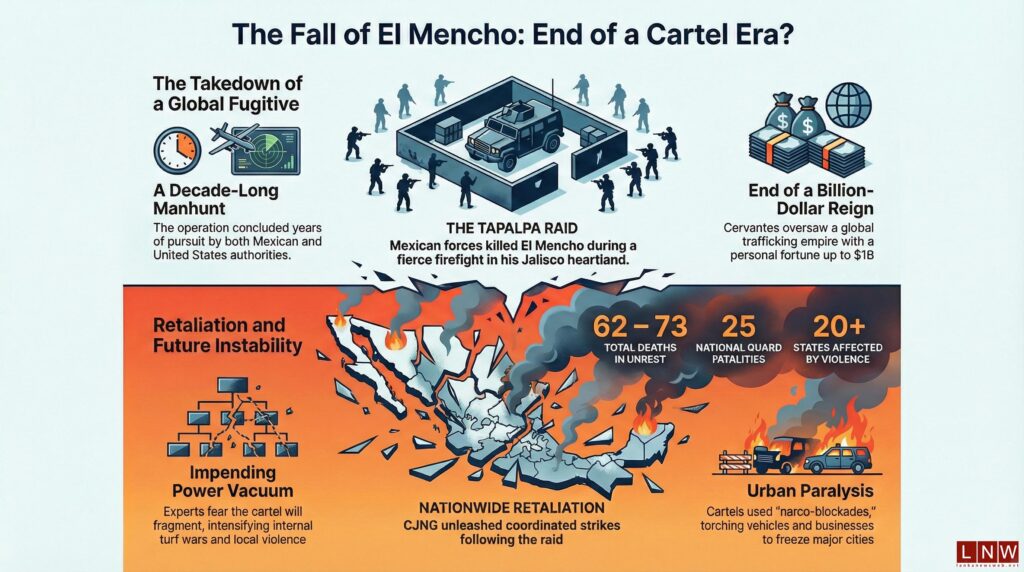
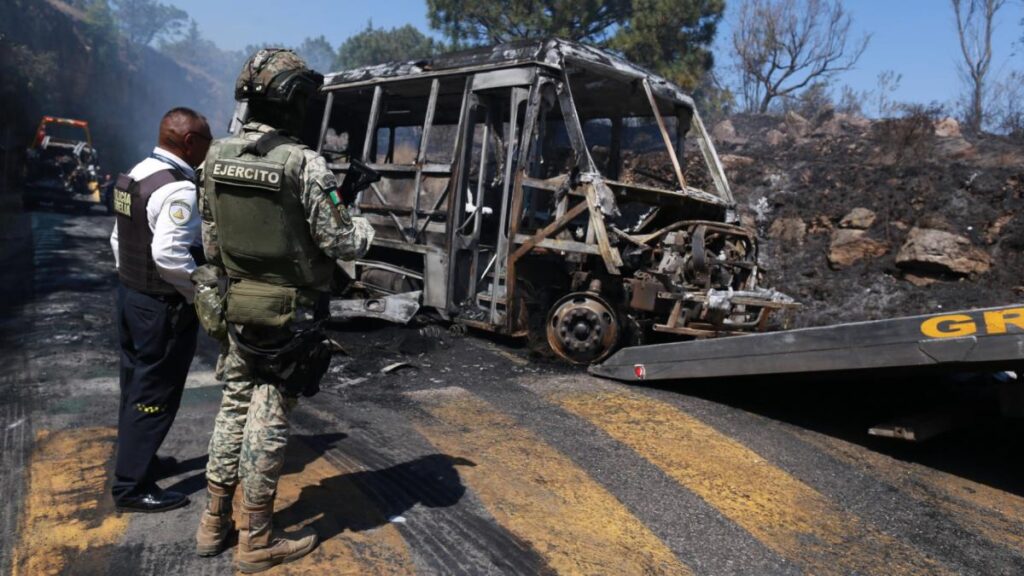
Ambushes on police patrols, mass killings and coordinated “narco-blockades” — in which vehicles were hijacked and set ablaze to paralyse cities — became hallmarks of the organisation’s operations.
While no precise figure exists for the number of killings directly attributable to Oseguera Cervantes, the cartel he led has been linked to thousands of deaths in turf wars and retaliatory attacks. United States authorities alleged that CJNG played a significant role in fuelling the fentanyl crisis north of the border. Estimates placed El Mencho’s personal fortune between $500 million and $1 billion, while the cartel’s broader assets were believed to run into tens of billions.
The Final Raid
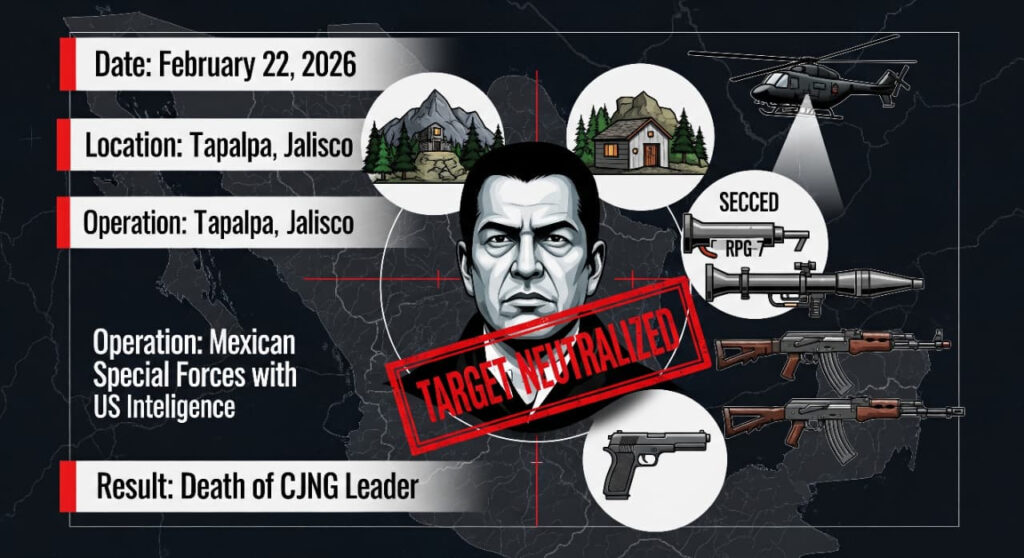
His downfall came in Tapalpa, a mountainous area within Jalisco considered part of CJNG’s heartland. Acting on intelligence reportedly assisted by US agencies, Mexican Army forces launched a raid that triggered a fierce firefight. El Mencho was wounded during the clash; four of his gunmen were killed at the scene, with others captured. He died while being transported to Mexico City. Three soldiers were injured in the operation.
Retaliation and Nationwide Unrest
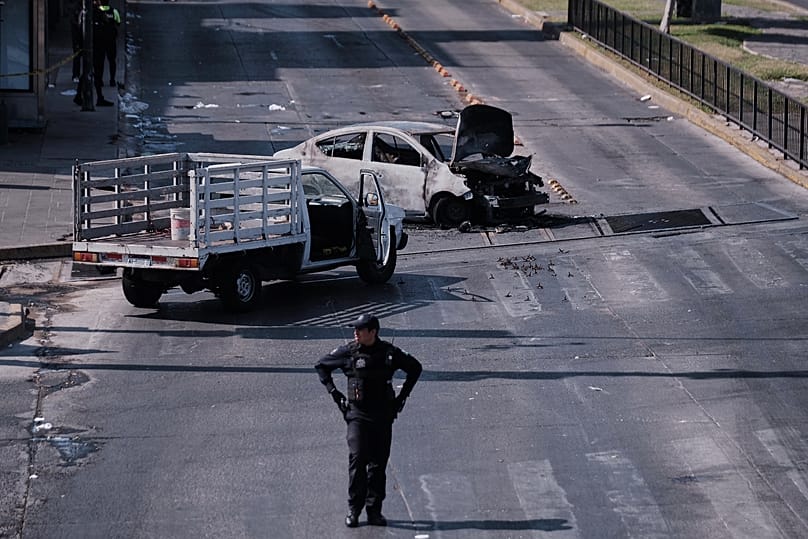
Yet his death did not bring immediate calm. Within hours, the CJNG unleashed a wave of retaliatory violence across more than 20 Mexican states. Buses, lorries and private vehicles were hijacked and torched to create fiery roadblocks. Gas stations and businesses were attacked, and gun battles erupted in several regions. Early reports indicate that between 62 and 73 people were killed in the unrest, including at least 25 members of the National Guard.
Authorities responded by deploying thousands of troops and arresting scores of suspects. Schools were temporarily closed in affected areas, and public transport was suspended. The United States issued shelter-in-place warnings for its citizens in several Mexican states.
A Power Vacuum and Uncertain Future
The immediate question now facing Mexico is who, if anyone, will succeed him. His son, known as “El Menchito”, is imprisoned in the United States, and no clear heir has publicly emerged. Analysts suggest the CJNG may fragment along regional lines, triggering internal power struggles among senior commanders.
History suggests that the removal of a cartel leader can produce as much instability as it resolves. Mexico’s homicide rate has hovered near 30,000 annually in recent years, and security experts fear the power vacuum could intensify turf wars, extortion rackets and kidnappings.
For many Mexicans, however, the killing of El Mencho represents a symbolic victory — the fall of a man who embodied the brutality and impunity of modern cartel power. Whether it marks a genuine turning point or merely the beginning of another violent chapter remains to be seen.