
LISTEN TO STORY
WATCH STORY
By: Isuru Parakrama
March 02, World (LNW): The dramatic escalation of hostilities between United States–Israel forces and Iran since 28 February 2026 marks one of the most perilous geopolitical ruptures in decades. What began as coordinated “pre-emptive” airstrikes has rapidly evolved into a multi-theatre confrontation with profound implications for global security, diplomatic stability and economic resilience.
Approximately 200 fighter jets were deployed in initial operations targeting more than 500 Iranian missile sites, air defence systems and nuclear facilities. Among those reportedly killed was Iran’s Supreme Leader, Ali Khamenei, alongside around 40 senior officials.
The announcement by Donald Trump confirming direct American involvement — and framing the strikes as an opportunity for regime change — signalled that Washington’s objectives extend well beyond deterrence.
Israeli forces under Prime Minister Benjamin Netanyahu have simultaneously intensified operations, with the Israel Defense Forces striking command centres and air defences in Tehran. US actions reportedly expanded to more than 1,000 targets, including naval assets. This scale of destruction indicates a campaign designed not merely to degrade capabilities but to dismantle the Islamic Republic’s strategic infrastructure.
Tehran’s response has been swift and regionally expansive. Missile and drone barrages have targeted Israel and American installations across Qatar, Bahrain, Kuwait, United Arab Emirates, Jordan, Iraq and Saudi Arabia. The involvement of Iran-backed Hezbollah, which launched rockets from Lebanon, further widens the theatre of conflict.
Israel’s retaliatory strikes on Beirut and evacuation orders affecting dozens of Lebanese villages underscore the risk of a fully fledged northern front.
At sea, the vulnerability of the Strait of Hormuz — through which roughly a fifth of global oil supplies transit — has already sent tremors through energy markets. Iran’s threats to disrupt shipping lanes, coupled with warnings from the Houthis in the Red Sea, create the prospect of sustained maritime instability.
Insurance premiums for shipping are likely to surge, freight routes may be rerouted, and oil prices could spike sharply if tanker traffic is impeded.
The conflict’s trajectory now hinges on three overlapping dynamics.
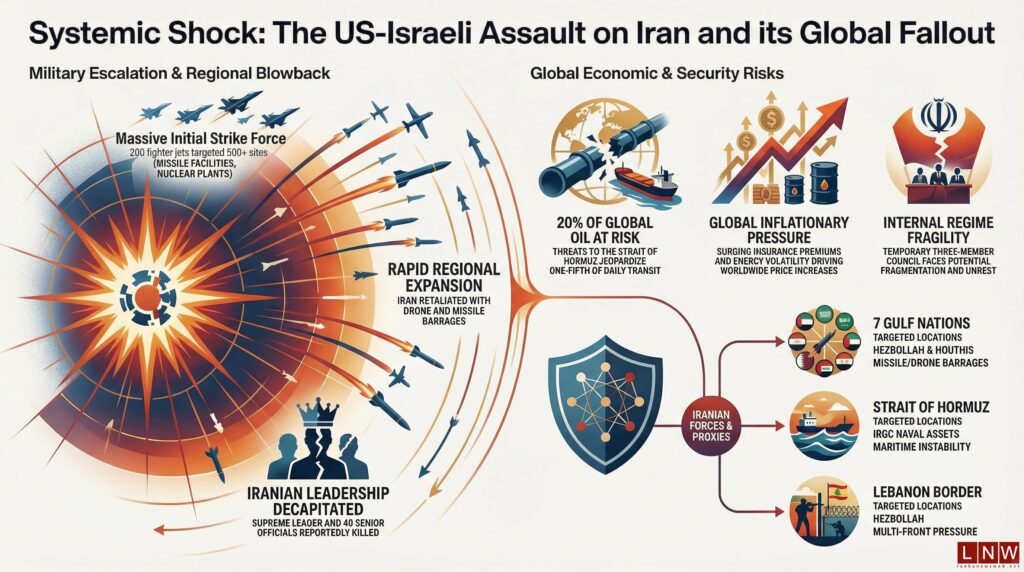
First, regime durability in Tehran. Following Khamenei’s death, Iran reportedly established a temporary three-member leadership council. Should internal fragmentation intensify, the power vacuum may embolden hardliners within the Islamic Revolutionary Guard Corps to consolidate authority.
Conversely, prolonged instability could generate domestic unrest, especially amid reported civilian casualties exceeding 200 deaths and hundreds of injuries across multiple provinces. Either scenario carries risk: authoritarian retrenchment would sustain hostilities, while state fragility could unleash uncontrolled militia activity.
Second, the risk of proxy proliferation. Washington has demanded an end to Iranian support for groups such as Hamas and regional militias. Yet these actors may perceive escalation as existential. If they intensify asymmetric operations, Israel could face sustained multi-front pressure. In turn, further Israeli or American strikes might draw additional regional actors into the fray.
Third, the global diplomatic response. The United Nations and several world leaders have called for de-escalation, warning of a slide towards wider war. However, the declared aim of regime change from Washington reduces the space for negotiated compromise.
President Trump’s assertion that objectives could be achieved within a month suggests an expectation of rapid collapse in Tehran — a projection that may underestimate Iran’s capacity for protracted resistance.
Economically, the ramifications are likely to be severe even absent further escalation. Energy market volatility will feed inflationary pressures worldwide, particularly in import-dependent economies. Financial markets may react with risk aversion, strengthening safe-haven currencies and driving capital flight from emerging markets.
Should Gulf infrastructure be directly targeted, global liquefied natural gas supplies could also be disrupted, compounding Europe and Asia’s energy vulnerabilities.
From a security standpoint, the most dangerous trajectory would involve miscalculation: a mass-casualty strike on US personnel, direct Israeli hits on Iranian leadership figures beyond the initial assault, or accidental engagement with another major power’s assets. In such a scenario, containment would become increasingly elusive.
Yet there remains a narrow path towards managed de-escalation. Back-channel diplomacy, possibly mediated by non-aligned states, could explore limited ceasefires tied to inspections or phased sanctions relief. The challenge is that both sides have publicly framed the confrontation in existential terms.
As matters stand, the conflict has already shifted from a bilateral showdown to a systemic shock. Its trajectory will determine not only the future of Iran’s political order but the stability of global energy markets, the credibility of international law, and the fragile architecture of Middle Eastern peace. The coming weeks may well define the geopolitical landscape of the next decade.