
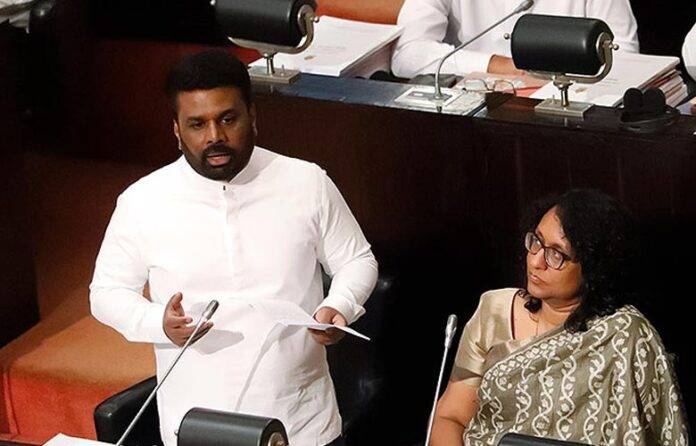
March 03, Colombo (LNW): President Anura Kumara Dissanayake has appealed for an immediate and peaceful end to the escalating conflict in the Middle East, warning that the repercussions of continued hostilities could reverberate far beyond the region and significantly affect Sri Lanka’s fragile recovery.
Addressing Parliament today (03), the President stressed that modern warfare, powered by increasingly advanced military technology, poses grave risks not only to those directly involved but to the wider global community. Sri Lanka’s official stance, he said, is clear: all sides must demonstrate genuine commitment to de-escalation and work towards a negotiated settlement without delay.
He cautioned that Sri Lanka cannot insulate itself from the economic and social consequences of the crisis. Disruptions to global oil and gas supplies, he noted, could drive up energy costs, while Sri Lankans employed in the Middle East may face uncertainty. The knock-on effects could extend to tourism, remittances, maritime trade and aviation — sectors that remain critical to national stability.
To mitigate potential fallout, the government is formulating a coordinated national response. The Central Bank has undertaken a rapid assessment of possible economic impacts, with findings expected imminently, while the Ministry of Finance is preparing a parallel review focused on implications for public welfare. Measures are also being devised to safeguard essential services both for citizens at home and those working overseas.
The President acknowledged public anxiety, observing that memories of previous crises remain fresh. He underlined that reassurance must be matched by practical action, insisting that stability cannot be secured through rhetoric alone. Although the current administration has navigated a number of serious challenges since assuming office, he described the unfolding Middle East situation as uniquely unpredictable.
Energy security featured prominently in his remarks. Sri Lanka’s petroleum storage capacity, he explained, is limited, with facilities at Kolonnawa and Muthurajawela holding around 150,000 metric tonnes, excluding additional capacity in Trincomalee. Stocks are managed in line with scheduled shipments rather than maintained as a large emergency reserve.
At present, diesel supplies are projected to last approximately 33 days, supported by ongoing refinery output. Petrol stocks are sufficient for nearly four weeks, with an incoming consignment expected to extend coverage to roughly 40 days. Aviation fuel reserves are estimated to be adequate for close to seven weeks, while crude oil supplies on hand, combined with an imminent delivery, should enable refinery operations to continue for more than six weeks.
Several fuel shipments are already scheduled throughout March to ensure continuity of supply. Based on current projections, the President assured lawmakers that there is no immediate shortage of petroleum products, though vigilance remains essential.
Concluding his address, President Dissanayake called for unity across political lines, emphasising that navigating the uncertainty ahead will require cooperation between the government, Parliament and the public. The responsibility for steering the country through potential turbulence, he said, rests not with individuals alone but with the nation as a whole acting with shared purpose.