LISTEN TO STORY
WATCH STORY
By: Isuru Parakrama
March 03, World (LNW): As tensions in the Middle East spiral following the killing of Iran’s Supreme Leader in February 2026, one man has emerged at the forefront of Tehran’s response. Ali Larijani, a veteran conservative power broker and long-time security insider, has promised that the United States and Israel will receive an “unforgettable lesson” for what he describes as illegitimate aggression against Iran.
Larijani’s rhetoric has been fierce and unambiguous. In public statements and televised appearances, he has warned that Washington and Tel Aviv “will regret their actions”, insisting that Iran’s response will be calibrated but devastating. Framing the strikes as a direct assault on Iran’s sovereignty, he has declared that the Islamic Republic did not initiate the conflict but will respond in self-defence with measures that its adversaries “will never forget”.
A Power Broker, Not a Populist
Born on June 03, 1958 in Najaf, Iraq, into a prominent clerical family originally from northern Iran, Larijani is widely regarded as part of a political dynasty. His father was a respected Shi’a cleric, and his brothers have held senior roles within the judiciary and foreign policy apparatus. Unlike firebrand ideologues who cultivate mass appeal, Larijani’s influence stems from decades embedded within the Islamic Republic’s security and legislative institutions.
Educated to doctoral level in philosophy at the University of Tehran, he combines intellectual credentials with revolutionary experience. During the Iran–Iraq War, he served as a commander in the Islamic Revolutionary Guard Corps (IRGC), forging ties within the military establishment that would underpin his later ascent.
Throughout the 1990s and early 2000s, Larijani occupied senior bureaucratic posts before heading the state broadcaster, Islamic Republic of Iran Broadcasting (IRIB), from 1994 to 2004. In that role, he tightened the regime’s grip over media output, reinforcing his reputation as a staunch guardian of the system’s ideological boundaries.
Architect of Nuclear Policy
Larijani’s prominence grew further when he became secretary of Iran’s Supreme National Security Council between 2005 and 2007, serving as the country’s chief nuclear negotiator with European powers. He later returned to the post in 2025 amid rising tensions with Washington and Tel Aviv.
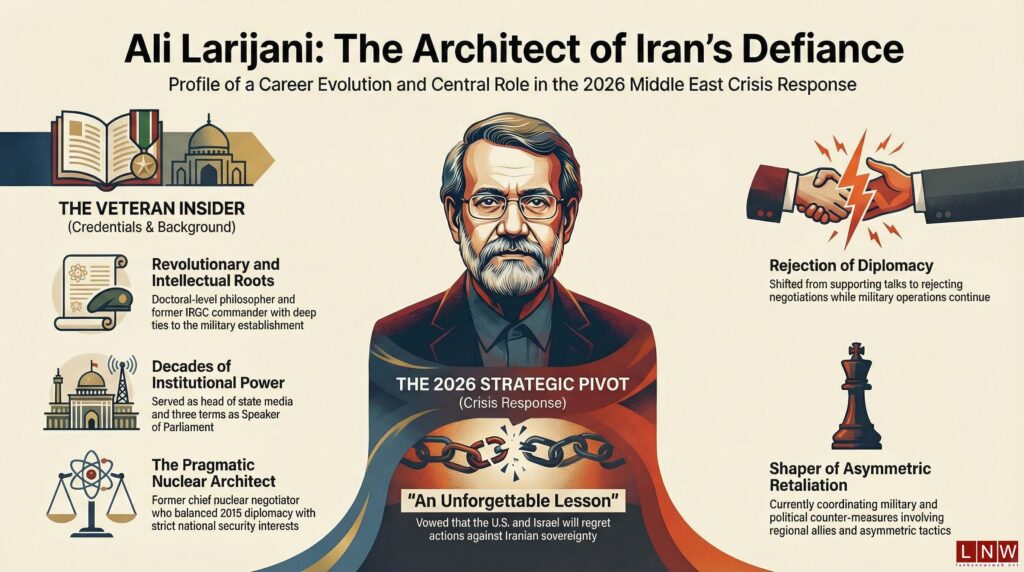
He played a key role in shaping Iran’s approach to the 2015 nuclear agreement, the Joint Comprehensive Plan of Action. While firmly aligned with the red lines set by the late Supreme Leader, he demonstrated a pragmatic streak, supporting diplomacy when it could relieve sanctions without, in his view, compromising national security.
From 2008 to 2020, Larijani served three consecutive terms as Speaker of Parliament, consolidating his status as a central figure in legislative and security circles. He backed the nuclear deal through parliament but also supported stringent domestic controls, including measures against protest movements — a dual approach that has defined his political identity as a “pragmatic conservative”.
The 2026 Crisis and a Hardening Tone
Following the death of the Supreme Leader in February 2026, Larijani rapidly positioned himself as a coordinating voice within the regime’s response architecture. Iranian outlets describe him as deeply involved in shaping both military and political counter-measures.
His recent comments suggest a sharp pivot away from any near-term diplomacy. Whereas he had previously characterised Iran’s stance towards talks with Washington as “positive” under certain conditions, he now rejects negotiations outright. Speaking to regional media, he has argued that dialogue is meaningless while the United States and Israel continue military operations.
Larijani has gone further, accusing Washington of subordinating its own national interests to Israeli strategy. He has criticised President Donald Trump’s “America First” slogan as having become “Israel First”, alleging that American forces are being drawn into a broader regional conflict at Israel’s behest.
Calibrated Retaliation or Escalation?
Despite the combative language, analysts note that Larijani’s career reflects more than ideological rigidity. He has historically balanced hard-line rhetoric with tactical flexibility. His background in nuclear diplomacy and legislative negotiation suggests he understands the costs of uncontrolled escalation.
Yet his promise of an “unforgettable lesson” has resonated domestically, particularly among conservative constituencies demanding retaliation. He has signalled that Iran’s response could extend beyond conventional military action, potentially involving regional allies and asymmetric measures.
Whether this marks a slide towards full confrontation or a calculated strategy designed to strengthen Iran’s bargaining position remains uncertain. What is clear is that Larijani’s words carry weight. As a seasoned insider trusted within security circles, he is not merely issuing slogans; he is helping shape the direction of Iran’s next move.
At a moment of acute instability, Ali Larijani stands as both symbol and strategist of Iran’s defiance — a man who blends intellectual pedigree, revolutionary credentials and political endurance. His vow that the United States will “regret” its actions may prove either the prelude to wider escalation or the opening gambit in a new phase of high-stakes brinkmanship.