LISTEN TO STORY
WATCH STORY
By: A Special Correspondent
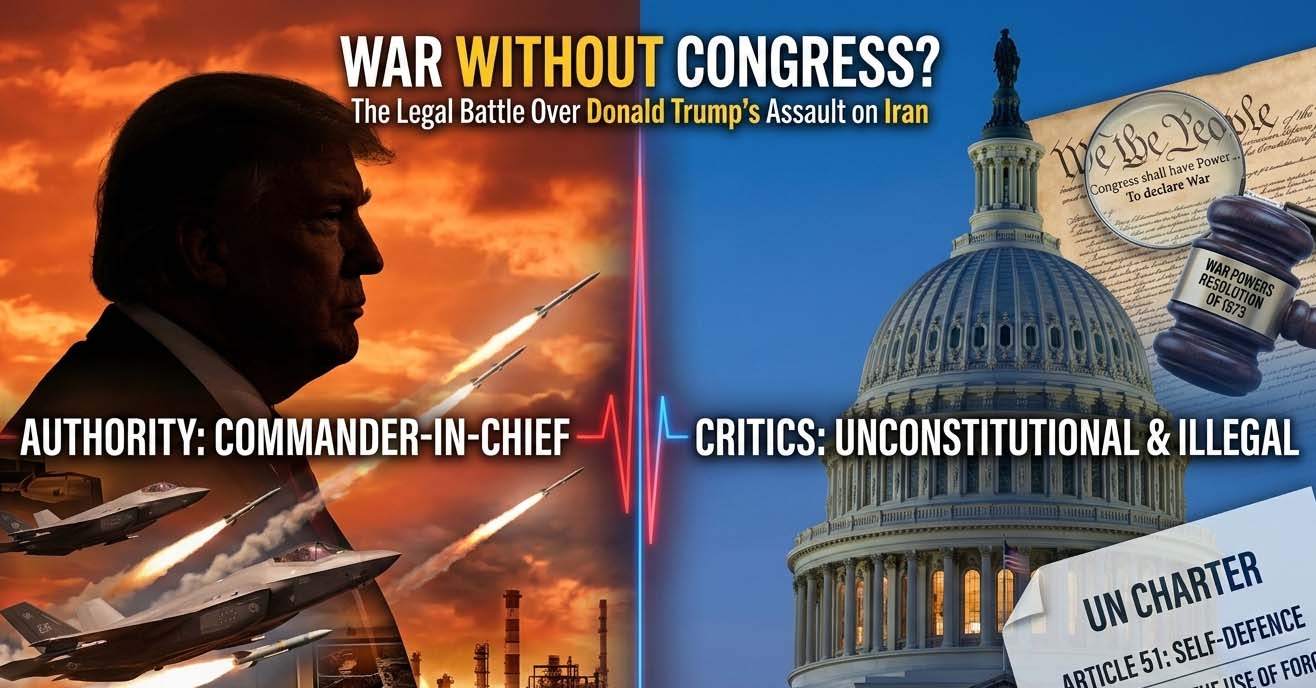
March 05, World (LNW): The military campaign launched by Donald Trump against Iran has triggered an intense legal debate both within the United States and across the international community. Critics argue that the strikes—conducted in coordination with Israel—may lack a solid legal basis under both American constitutional law and international law.
According to legal scholars and analysts, the operation raises two fundamental questions: whether the U.S. president possessed constitutional authority to launch the attacks without congressional approval, and whether the campaign itself complies with the rules governing the use of force under international law.
Presidential Power vs Congressional Authority
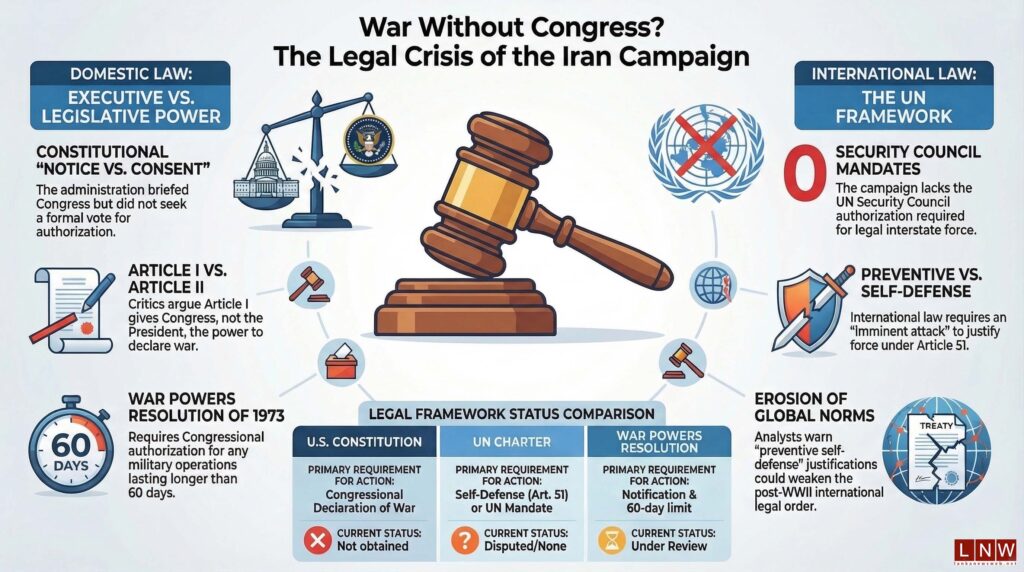
The United States Constitution divides war-making authority between Congress and the president. Article I grants Congress the power to declare war, while the president serves as commander-in-chief of the armed forces under Article II.
In practice, American presidents have frequently ordered limited military operations without formal war declarations. They often justify such actions through inherent presidential authority or through earlier legislation such as the Authorisations for Use of Military Force (AUMFs) adopted in 2001 and 2002 after the September 11 attacks and the Iraq War.
However, the military campaign against Iran has been described by many constitutional lawyers as far exceeding the scope of a limited defensive strike. The operation reportedly involved sustained bombardments of Iranian command centres, missile installations and leadership compounds—actions that critics say resemble a full-scale war rather than a short-term defensive measure.
The administration reportedly briefed senior members of Congress before the strikes but did not request a vote authorising the operation. This practice—sometimes referred to as the “notice rather than consent” model—has become increasingly common in modern U.S. foreign policy, but it remains controversial among constitutional scholars.
Many lawmakers argue that the scale and duration of the Iran campaign should have required explicit congressional approval under both the Constitution and the War Powers Resolution of 1973, which attempts to limit unilateral presidential military actions.
The War Powers Resolution Controversy
The War Powers Resolution was enacted after the Vietnam War to prevent presidents from committing the United States to prolonged conflicts without legislative oversight.
The law requires a president to notify Congress within 48 hours of deploying armed forces into hostilities and generally limits such operations to 60 days without congressional authorisation, with a possible 30-day withdrawal period.
Critics argue that the Iran operation appears inconsistent with these requirements, particularly if the campaign becomes prolonged or escalates further. Some members of Congress have introduced resolutions seeking to restrict the president’s ability to continue military operations without formal legislative approval.
International Law and the Use of Force
Beyond the constitutional debate, the attack also raises serious questions under international law.
The cornerstone of modern international legal order—the United Nations Charter—prohibits states from using force against other states except in two circumstances: self-defence under Article 51 or when authorised by the United Nations Security Council.
In the case of the U.S.-Israeli strikes on Iran, no Security Council mandate was obtained. This means the primary legal justification available to Washington is the claim of self-defence.
For such a claim to succeed, international law generally requires evidence of an actual or imminent armed attack. Many international law specialists argue that the strikes were framed as preventive or pre-emptive measures rather than responses to an immediate Iranian attack. As a result, they contend that the operation fails to meet the strict criteria required for lawful self-defence.
Disputed Justifications: Nuclear Threats and Regime Change
U.S. and Israeli officials have offered several explanations for the campaign, including preventing Iran from developing nuclear weapons and protecting civilians in the region.
However, legal experts note that these objectives—while politically significant—do not automatically justify unilateral military action under international law. Human-rights concerns, nuclear non-proliferation goals, or aspirations for regime change cannot legally justify armed attacks unless they receive approval from the UN Security Council.
United Nations experts have also argued that the legal justifications presented by the United States and Israel appear inconsistent and insufficient under the UN Charter’s framework governing the use of force.
Implications for the Global Legal Order
Legal analysts warn that the controversy surrounding the Iran campaign may have broader consequences for the international system established after the Second World War.
If powerful states increasingly rely on broad interpretations of “preventive self-defence” to justify military operations, the prohibition on the use of force could gradually erode. This could encourage other states to launch similar pre-emptive attacks, thereby weakening the legal norms designed to prevent interstate wars.
For now, the strikes on Iran stand as one of the most contentious legal disputes in contemporary international politics. Domestically, the debate centres on whether presidential war powers have expanded beyond constitutional limits. Internationally, the question remains whether the operation represents a legitimate act of self-defence—or a breach of the global rules governing war and peace.