
LISTEN TO STORY
WATCH STORY
By: Pramod Chinthaka Peiris
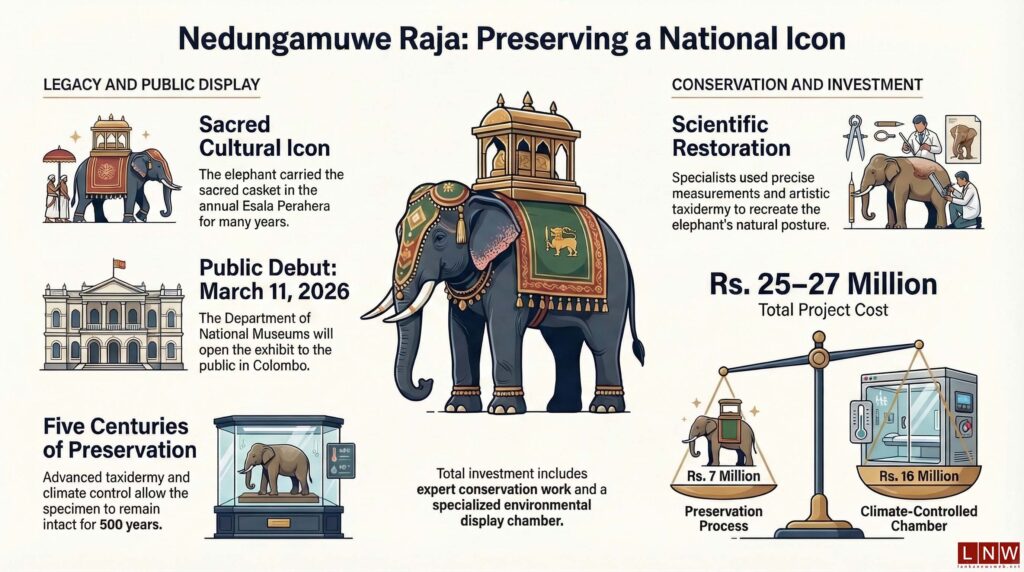
March 09, Colombo (LNW): The preserved remains of the celebrated elephant Nedungamuwe Raja will be opened to the public from March 11, 2026, with museum authorities stating that the specimen could remain intact for centuries if maintained under proper conditions.
The announcement was made during a media briefing at the Government Information Department, where officials explained the extensive conservation work carried out to restore the elephant after its death in 2022. The animal, widely admired across the country and later declared a national treasure, had been entrusted to the Department of National Museums for preservation on the day it died.
Retired leather conservation specialist Chamalka Kothalawala, who was involved in the restoration effort, said the preservation of such a large animal is a highly intricate undertaking that blends scientific methodology with craftsmanship. According to her, the process began with a careful examination of the elephant’s measurements, body structure and posture in order to accurately recreate its original form.
She explained that specialists then used recognised taxidermy and conservation techniques to reconstruct the body and preserve the hide. If the specimen is kept in controlled environmental conditions, she noted, it could potentially remain undamaged for hundreds of years, possibly up to five centuries.
Director General of the Department of National Museums Sanoja Kasthuriarachchi said the project was carried out under a heritage preservation initiative aimed at safeguarding historically significant animals. She added that the work had now been completed using modern conservation practices designed to prevent deterioration.
Kasthuriarachchi also revealed that the department received the elephant’s body following a request from the Diyawadana Nilame of the Temple of the Sacred Tooth Relic, with the consent of veterinarian Dr. Harsha Dharmawijaya, who had been responsible for the animal during its lifetime.
Nedungamuwe Raja had been a familiar and much-loved figure in Sri Lanka’s cultural landscape, having carried the sacred casket in the annual Esala Perahera procession in Kandy for many years. Because the elephant was so widely recognised, museum experts faced the challenge of recreating its appearance in a way that accurately reflected its distinctive stance and features.
Officials said the department’s craftsmen successfully reproduced the elephant’s natural posture through a combination of scientific study and skilled artistic work.
Deputy Director of the Zoology Division, Lankani Somaratne, disclosed that the preservation process itself cost approximately Rs. 7 million. A further Rs. 16 million was spent on constructing a specially designed display chamber fitted with climate control and humidity-regulation systems to protect the specimen over the long term. In total, the project required an investment of roughly Rs. 25 to 27 million.
Meanwhile, museum authorities also outlined plans to upgrade Sri Lanka’s national museum network in the coming years. New technology-driven exhibitions and interactive programmes are expected to be introduced in an effort to attract younger visitors and encourage greater public interest in the country’s museums and heritage collections.