
LISTEN TO STORY
WATCH STORY
By: Isuru Parakrama
March 12, World (LNW): During a recent visit to a logistics hub in Kentucky, US President Donald Trump reflected on the escalating maritime warfare between American forces and Iran, revealing a candid exchange with his military advisors regarding the destruction of enemy assets.
As the conflict enters its second week, the US President disclosed that he had initially challenged his commanders over the decision to sink an Iranian warship off the coast of Sri Lanka—an engagement that resulted in significant casualties.
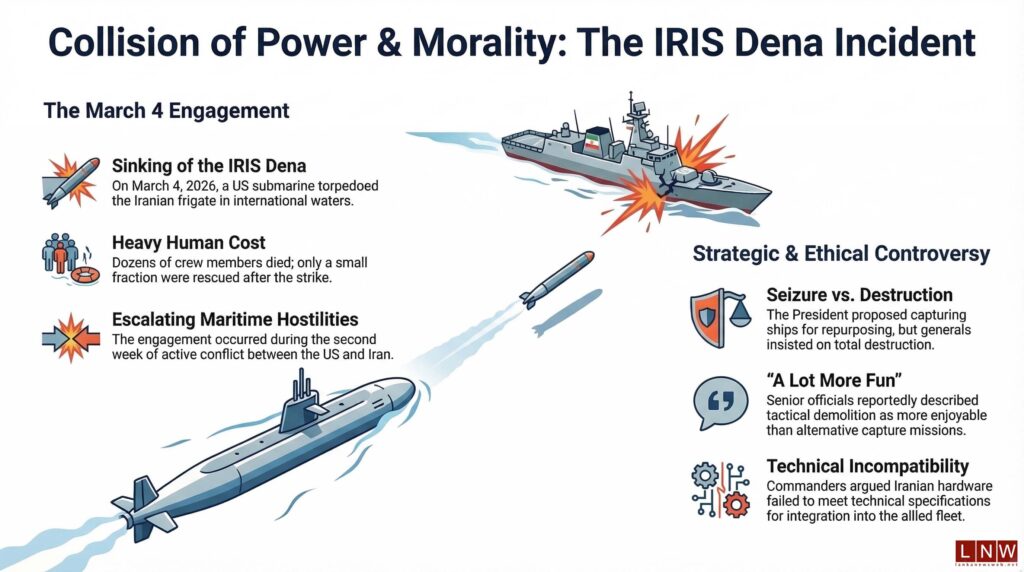
Addressing a crowd of supporters, the President explained that he had pushed for the seizure of the vessels rather than their total destruction, suggesting that the ships could have been repurposed for the British-allied American fleet.
However, he noted that his generals dismissed the idea, arguing that the Iranian hardware failed to meet the rigorous technical specifications required for modern naval integration.
According to Trump, one high-ranking official went as far as to suggest that the tactical demolition of the fleet was “a lot more fun” than a capture mission.
Power Versus Morality
These revelations come as the administration attempts to project confidence regarding global market stability, despite the hostilities now reaching their thirteenth day. While the President’s remarks highlighted a potential disconnect between civilian oversight and the “gung-ho” attitude of some military brass, he remained steadfast in his support of the campaign’s progress, noting that dozens of vessels had been neutralised in a remarkably short window of time.
The recent sinking of an Iranian warship by a United States Navy submarine off the coast of Sri Lanka stands as a stark reminder of the perils of an American military posture that, in too many instances, appears to value spectacle over the sanctity of human life. On March 04, 2026, the Iranian frigate IRIS Dena was struck and sunk by a US‑launched torpedo in international waters near Sri Lanka, resulting in the deaths of dozens of crew members and the rescue of only a fraction of those on board.
More troubling still have been some of the remarks attributed to senior US officials about the engagement, with suggestions that personnel involved described the act of sinking the vessel as “more fun” than alternative courses of action. Whether or not such comments were intended as flippant banter, they nonetheless betray a chilling indifference to the real human cost of war and to the basic decencies that ought to govern the conduct of any nation that claims to uphold civilisation.
War inevitably involves grim decisions, but there are fundamental principles that should never be discarded: respect for non‑combatants, adherence to international law, and a sober acknowledgement that every life extinguished is irreplaceable. To reduce the killing of sailors — many of whom may have been simply returning from a naval exercise — to a matter of amusement or convenience is to forget these principles entirely.
This episode serves as a sobering lesson that military might must always be balanced with moral restraint. Nations must resist the allure of dehumanising rhetoric and remember that beyond the strategic calculus are families grieving for loved ones lost, communities shattered by violence, and the enduring obligation to treat all human beings with dignity — even in times of conflict.