
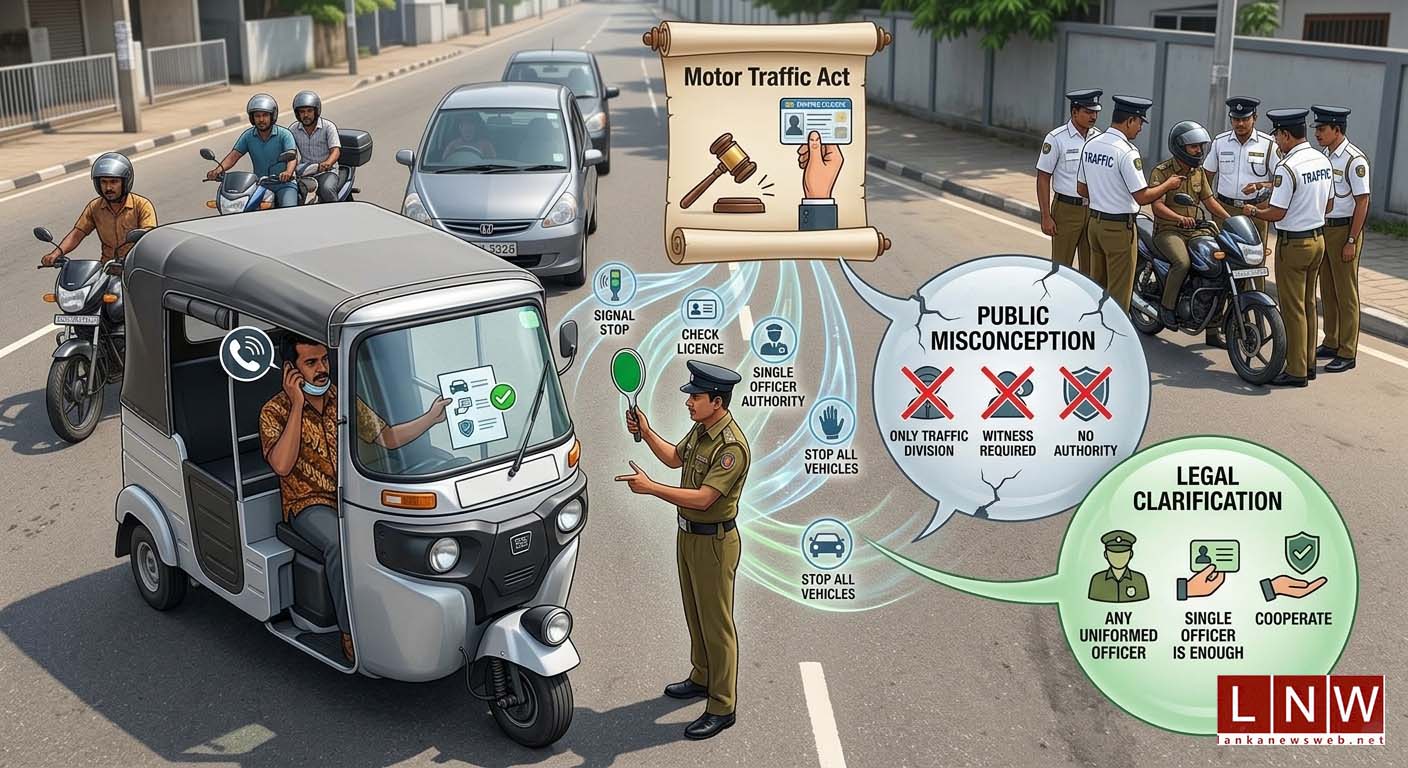
March 16, Colombo (LNW): Sri Lanka Police have issued a clarification outlining the legal provisions that empower officers to stop vehicles and request documentation from motorists, addressing several misconceptions circulating among the public.
According to the police, the authority to signal a driver to halt is primarily granted under Section 162 of the Motor Traffic Act. This provision requires motorists to comply with any verbal instruction or hand signal issued by a police officer who is in uniform and carrying out official duties. Such directions may include orders to stop, slow down, reverse, or move to a particular side of the road in order to maintain safe traffic flow.
Police officials also dismissed the widespread belief that only officers attached to the Traffic Division have the power to stop vehicles. They emphasised that any police officer wearing the official uniform has the legal right to do so. While the Traffic Division specialises in road-related enforcement, the broader mandate of the police service includes preventing offences and identifying individuals who may be involved in unlawful activity.
As part of this authority, officers may request drivers to produce essential documents such as their driving licence, National Identity Card and proof of vehicle insurance, particularly when there is a suspicion that a traffic rule has been violated.
The police further clarified that a single officer is legally sufficient to stop a vehicle and initiate legal proceedings if an offence is detected. There is no requirement under the Motor Traffic Act for another officer to be present as a witness during such an encounter.
Nevertheless, police personnel often conduct roadside checks in teams for operational efficiency and safety reasons.
Motorists have also been reminded that ignoring or refusing to comply with a lawful order from a police officer constitutes an offence. Authorities noted that obstructing an officer in the execution of their duties could result in fines or legal action before a Magistrate’s Court.
Police urged drivers to cooperate during routine checks, stressing that such measures are intended to improve road safety and assist in the detection of traffic violations and other criminal activities.