
By: Staff Writer
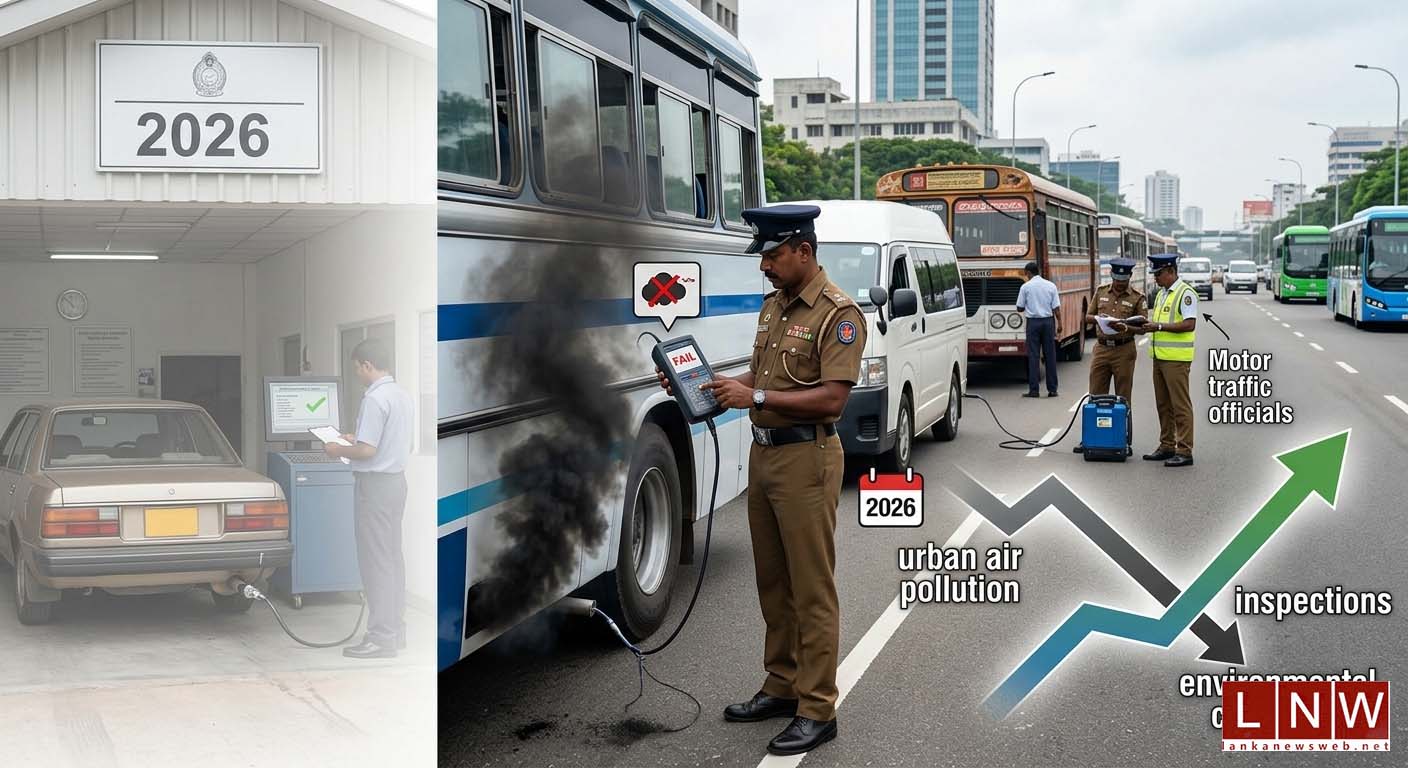
March 17, Colombo (LNW): Vehicle owners across Sri Lanka are encountering an increasingly visible form of pollution enforcement: random roadside emission inspections.
The move comes as the government tightens environmental regulations and restructures the country’s vehicle emission monitoring system, signaling a shift toward more aggressive compliance measures.
Officials from the Department of Motor Traffic and the Sri Lanka Police have intensified surprise roadside checks to identify vehicles exceeding emission limits.
Authorities say the inspections are necessary as Sri Lanka reforms its emission testing framework and addresses longstanding issues of malpractice in the certification process.
Transport Minister Bimal Rathnayake acknowledged that some testing centers had previously issued fraudulent emission certificates, undermining the integrity of the system.
“Emission testing remains a legal requirement and an essential environmental safeguard. We are strengthening enforcement to eliminate malpractice and ensure compliance,” the minister said.
Sri Lanka’s emission testing programme requires all vehicles to obtain a valid emission certificate before receiving their annual revenue license. The tests are currently conducted through private operators contracted by the government.
Two major companies involved in the programme LAUGFS Eco Sri and CleanCo Lanka—operate testing centers across the country. Their contracts are scheduled to expire at the end of 2026, with new agreements expected to introduce tighter oversight and improved monitoring systems.
In the meantime, enforcement authorities are filling regulatory gaps with direct field inspections.
Vehicle owners report that police checkpoints now include portable emission analyzers capable of detecting excessive pollutants on the spot.
Officials say the increased monitoring is also linked to new environmental regulations taking effect in 2026.
Among them are proposed monthly quality inspections for passenger transport vehicles, particularly buses and vans operating long-distance routes exceeding 100 kilometers. Under new rules being considered, such vehicles may be required to obtain updated emission certificates within 48 hours of major trips.
The government has also introduced stricter internal controls. A circular issued in February 2026 mandates annual fuel efficiency testing and detailed logbook inspections for all government-owned vehicles, aimed at reducing public sector fuel consumption and emissions.
At the same time, Sri Lanka is restructuring the Vehicular Emission Test Trust Fund (VETTF) under the Public Financial Management Act No. 44 of 2024, transferring its financial assets to the Treasury to improve fiscal oversight.
Some vehicle owners, however, view the rise in roadside inspections as a sign that authorities are moving away from relying solely on testing centers.
Environmental experts say a combination of stricter regulations, improved technology, and stronger enforcement could significantly reduce urban air pollution.
But whether the new system will deliver cleaner ai or simply more inspections remains to be seen as Sri Lanka reshapes its emission control strategy.