
By: Staff Writer
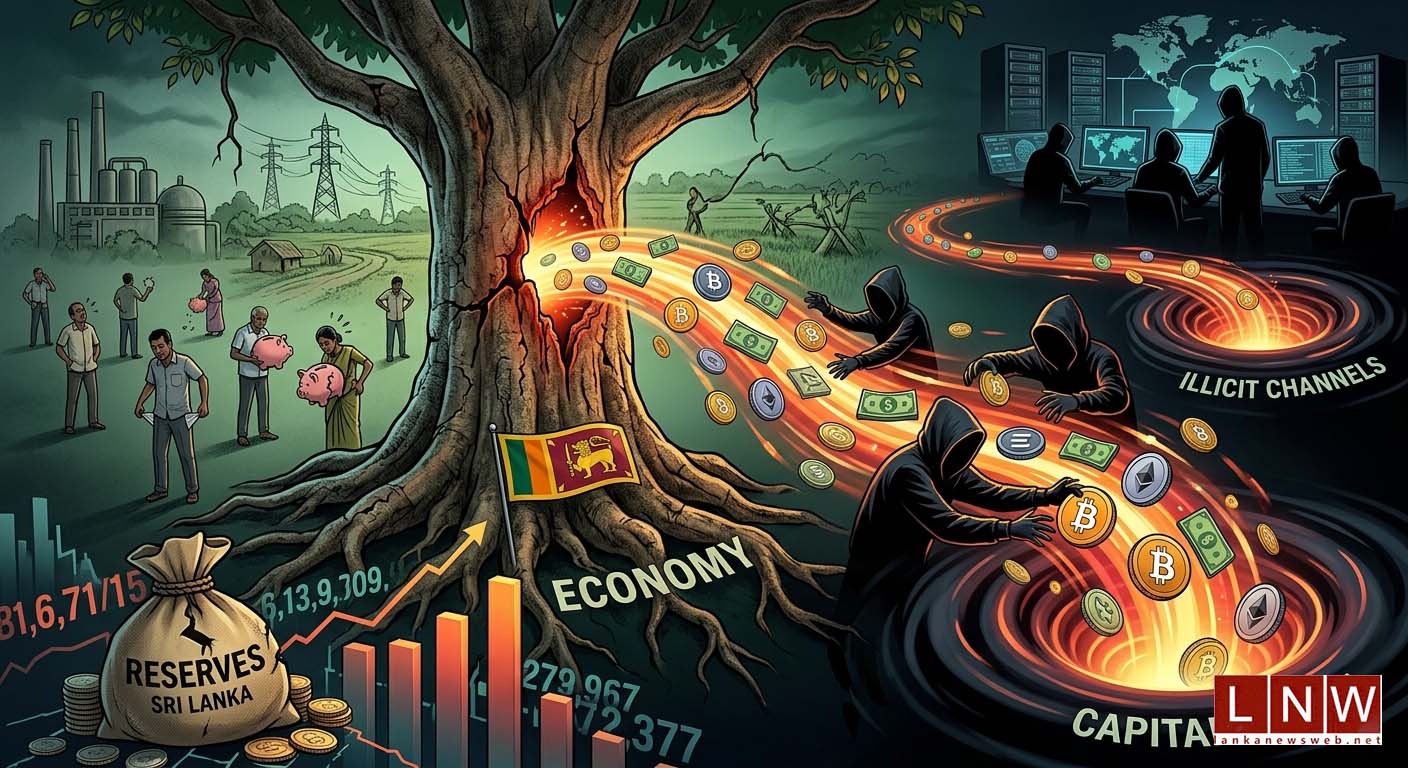
March 24, Colombo (LNW): Sri Lanka’s fragile economy is facing a new and largely invisible threat: the rapid rise of crypto currency linked financial fraud and capital flight. While digital currencies promise innovation, recent investigations reveal a darker reality billions siphoned out of the country through loosely regulated channels.
Authorities have uncovered multiple large-scale frauds, including a high-profile case involving the disappearance of Rs. 290 million, allegedly laundered through global platforms such as Binance. The case, now under investigation by the Criminal Investigation Department (CID), has already implicated 19 suspects accused of exploiting loopholes in Sri Lanka’s foreign exchange framework.
Officials say this is only the tip of the iceberg. Another ongoing probe involves a staggering Rs. 14 billion scam affecting nearly 8,000 victims one of the largest financial frauds linked to digital assets in the country’s history. Investigators believe these schemes often lure investors with promises of high returns before funneling funds into crypto wallets beyond regulatory reach.
The Central Bank of Sri Lanka has long maintained a cautious stance. While citizens are not explicitly banned from investing in crypto, financial institutions are prohibited from facilitating such transactions. This effectively blocks direct conversion of Sri Lankan rupees into digital currencies through formal banking systems.
However, criminals appear to have adapted quickly. Law enforcement sources indicate that alternative payment systems and informal networks are being used to bypass restrictions, allowing illicit funds to move offshore undetected. This has contributed to significant capital flight at a time when Sri Lanka is struggling to stabilize its economy.
Beyond individual losses, the broader economic implications are severe. Experts warn that unchecked crypto outflows weaken foreign exchange reserves, distort financial transparency, and undermine investor confidence. The lack of regulatory oversight also leaves ordinary citizens exposed to scams, with little recourse for recovery.
In response, the government is accelerating efforts to tighten oversight. Plans are underway to introduce a legal framework recognizing virtual assets as a distinct financial class, alongside stricter compliance requirements for digital service providers.
However, analysts caution that regulation alone may not be enough. Public awareness remains low, and enforcement agencies face challenges in tracking decentralized, cross-border transactions.
As Sri Lanka prepares for an international evaluation on money laundering controls in 2026, the stakes are high. The outcome will not only determine the country’s financial credibility but also its ability to contain a fast-evolving digital threat.
For now, crypto currency remains a double-edged sword offering opportunity on one side, and on the other, a growing channel for fraud draining billions from an already strained economy.