LISTEN TO STORY
WATCH STORY
By: Isuru Parakrama
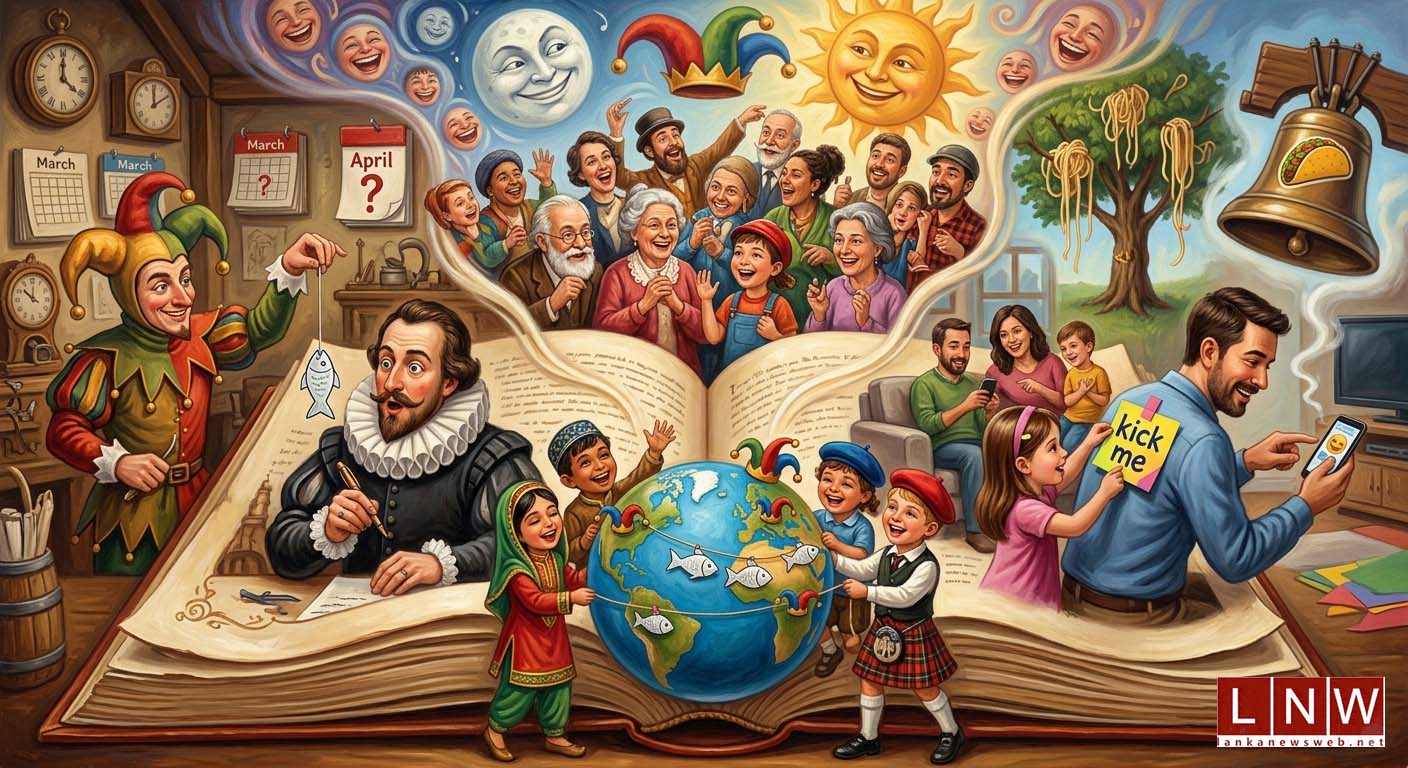
April 01, World (LNW): Every year on April 01, much of the world collectively indulges in a peculiar yet enduring custom: the art of the prank. Known widely as April Fool’s Day—or All Fools’ Day—this annual tradition invites people to engage in harmless deception, only to reveal the trick with the familiar cry, “April Fool!”.
While it is a day marked by laughter and mischief, its origins remain surprisingly elusive, rooted in a blend of historical conjecture and cultural evolution.
A Day Defined by Harmless Deception
At its core, April Fool’s Day revolves around practical jokes, hoaxes, and playful pranks. These can range from simple tricks—such as pointing out an untied shoelace—to elaborate fabrications, including fake news stories published by reputable media organisations. In the United Kingdom and cultures influenced by it, tradition dictates that such pranks must end by noon; those who attempt them later risk becoming the “fool” themselves.
Despite its light-hearted nature, the day carries a surprisingly structured set of customs, many of which have been preserved across centuries.
The Mystery of Its Origins
The true beginnings of April Fool’s Day are uncertain, with historians unable to pinpoint a definitive source. However, the most widely accepted explanation traces its roots to 16th-century France.
In 1564, King Charles IX introduced the Edict of Roussillon, which standardised the start of the new year to January 01. Prior to this reform, New Year celebrations were linked to Easter and often fell between late March and early April. Those who either resisted or were unaware of the change continued celebrating around April 01 and were subsequently mocked as “April fools”. Over time, this ridicule evolved into a tradition of pranking.
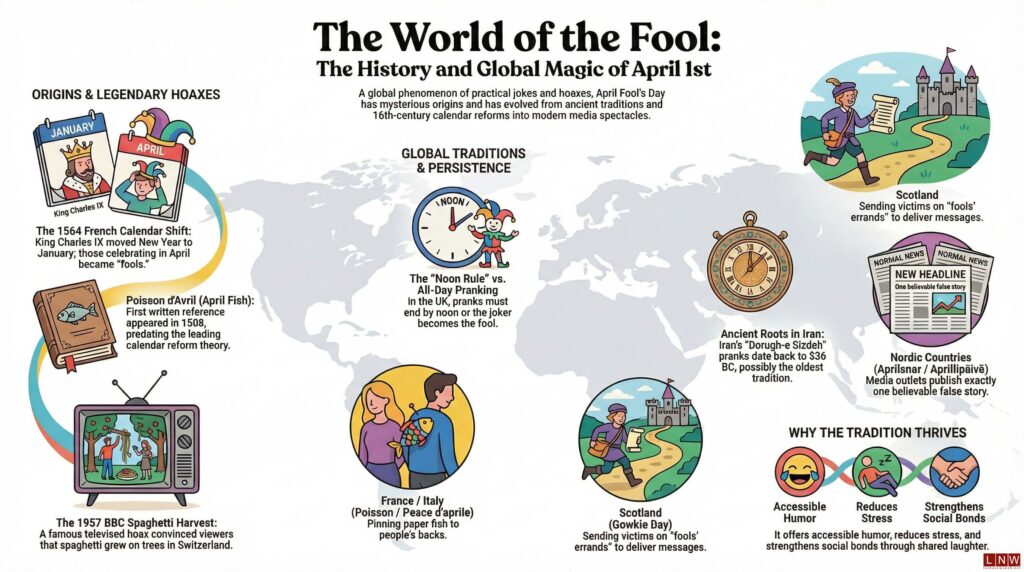
There is evidence suggesting that the custom predates the reform. A French reference to “poisson d’avril” (April fish) appears as early as 1508, while a 1561 Flemish poem describes sending individuals on foolish errands on April 01. These hints indicate that the spirit of the day may have existed even before it was formally recognised.
Other theories—ranging from ancient Roman festivals like Hilaria to interpretations of Chaucer’s Canterbury Tales—have been proposed, but none carry strong historical support. Ultimately, while the French calendar reform offers the most convincing explanation, the true origin of April Fool’s Day remains unknowable.
A Global Tapestry of Traditions
What makes April Fool’s Day particularly fascinating is its global reach and local variation. In France, Italy, and Belgium, the day is associated with the “April fish”, where people attach paper fish to others’ backs. Scotland celebrates “Gowkie Day”, sending victims on pointless errands, followed by “Tailie Day”, involving “kick me” signs.
In Poland, elaborate hoaxes are often orchestrated by institutions and media outlets, while Nordic countries traditionally publish a single false news story. Meanwhile, in Iran, a similar tradition known as Dorugh-e Sizdah takes place during Sizdah Be-dar, with roots dating back to around 536 BC—possibly making it the oldest prank-related celebration in the world.
Even outside April 01, similar customs exist. Spanish-speaking countries observe a comparable day of pranks on December 28, known as Día de los Santos Inocentes.
The Rise of Media Hoaxes
April Fool’s Day has also been shaped by the involvement of major institutions and corporations. Some of the most memorable pranks have come from trusted organisations, blurring the line between reality and fiction.
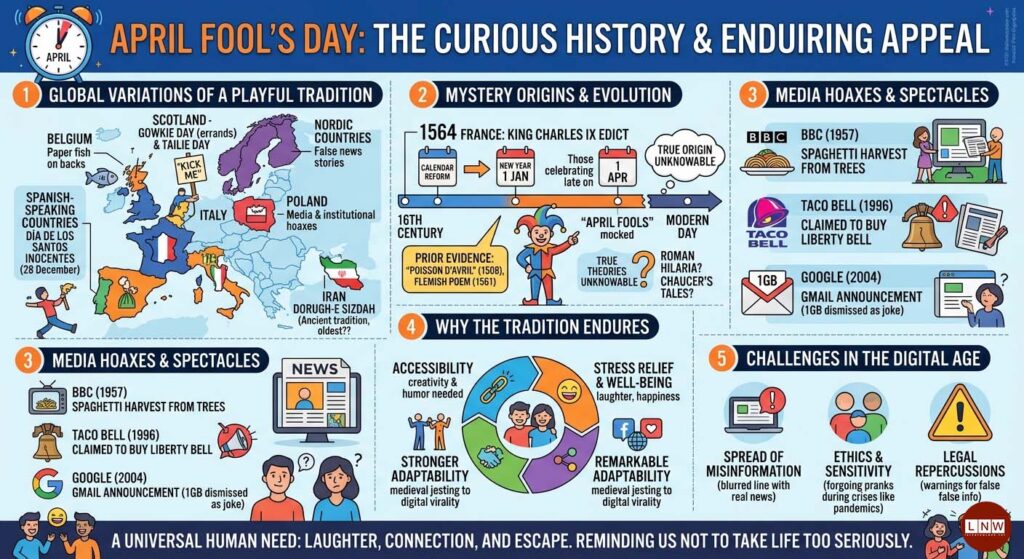
In 1957, the BBC famously aired a segment showing Swiss farmers harvesting spaghetti from trees, convincing many viewers. Decades later, in 1996, Taco Bell claimed it had purchased the Liberty Bell, prompting public outrage before the truth was revealed. Even technology giants have joined in; Google’s 2004 announcement of Gmail—with an unprecedented 1GB of storage—was initially dismissed as a joke.
These high-profile hoaxes have contributed significantly to the day’s modern identity, elevating it from personal pranks to large-scale spectacles.
Why the Tradition Endures
Despite its ambiguous origins, April Fool’s Day continues to thrive for several compelling reasons. Its accessibility is perhaps its greatest strength—participation requires nothing more than creativity and a sense of humour, making it inclusive across cultures, classes, and backgrounds.
Psychologically, the day offers a release from routine and stress. Laughter is widely recognised for its positive effects on mental well-being, while shared pranks can strengthen social bonds and create lasting memories. In an increasingly fast-paced and demanding world, such moments of levity are particularly valuable.
Moreover, the tradition has demonstrated remarkable adaptability. From medieval jesting to digital-age virality, April Fool’s Day has evolved alongside communication technologies. Social media now allows pranks to reach global audiences instantly, amplifying their impact.
Challenges in the Modern Era
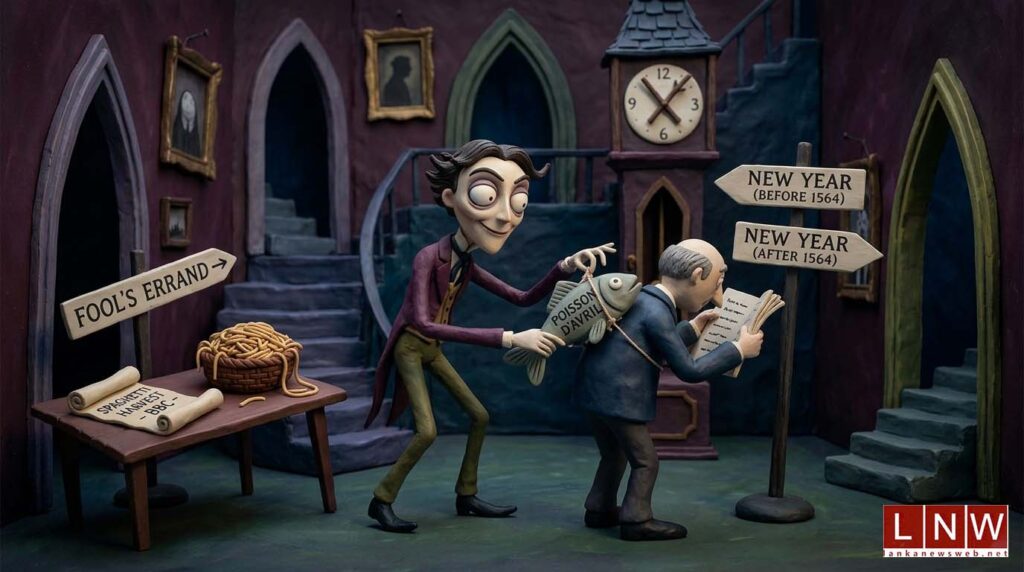
However, the digital age has also introduced complications. The rapid spread of information online means that April Fool’s pranks can sometimes blur into misinformation. There have been instances where genuine news events were dismissed as jokes, with serious consequences.
Concerns over ethics and sensitivity have also emerged. During times of crisis—such as the COVID-19 pandemic—many organisations chose to forgo April Fool’s pranks altogether as a mark of respect. In some countries, authorities have even warned of legal repercussions for spreading false information under the guise of humour.
A Tradition That Refuses to Fade
From its uncertain beginnings in early modern Europe to its present-day global manifestations, April Fool’s Day has proven remarkably resilient. Its continued relevance lies not in its history, but in its ability to fulfil a universal human need: the desire for laughter, connection, and a temporary escape from seriousness.
As long as people value humour and creativity, April Fool’s Day is likely to endure—reminding us, if only for a moment, not to take life too seriously.
References:
https://www.euronews.com/culture/2025/04/01/april-fools-day-what-are-its-origins-and-how-do-europeans-celebrate
https://clockzone.net/blog/april-fools-day-2026-pranks-around-world-2026-04-01
https://www.oneworldnews.com/culture-festivals/april-fool-day-2026/
https://www.britannica.com/topic/April-Fools-Day
https://en.wikipedia.org/wiki/April_Fools’_Day
https://study.com/academy/lesson/april-fools-day-history-facts.html
https://blogs.loc.gov/folklife/2016/03/april-fools/
https://www.latestly.com/lifestyle/festivals-events/april-fools-day-2026-when-and-why-is-it-celebrated-7373362.html
https://www.nationalgeographic.com/history/article/april-fools-day-origins
https://www.bluewin.ch/en/news/switzerland/april-fools-day-but-why-are-we-taking-the-piss-today-3171146.html