
By: Staff Writer
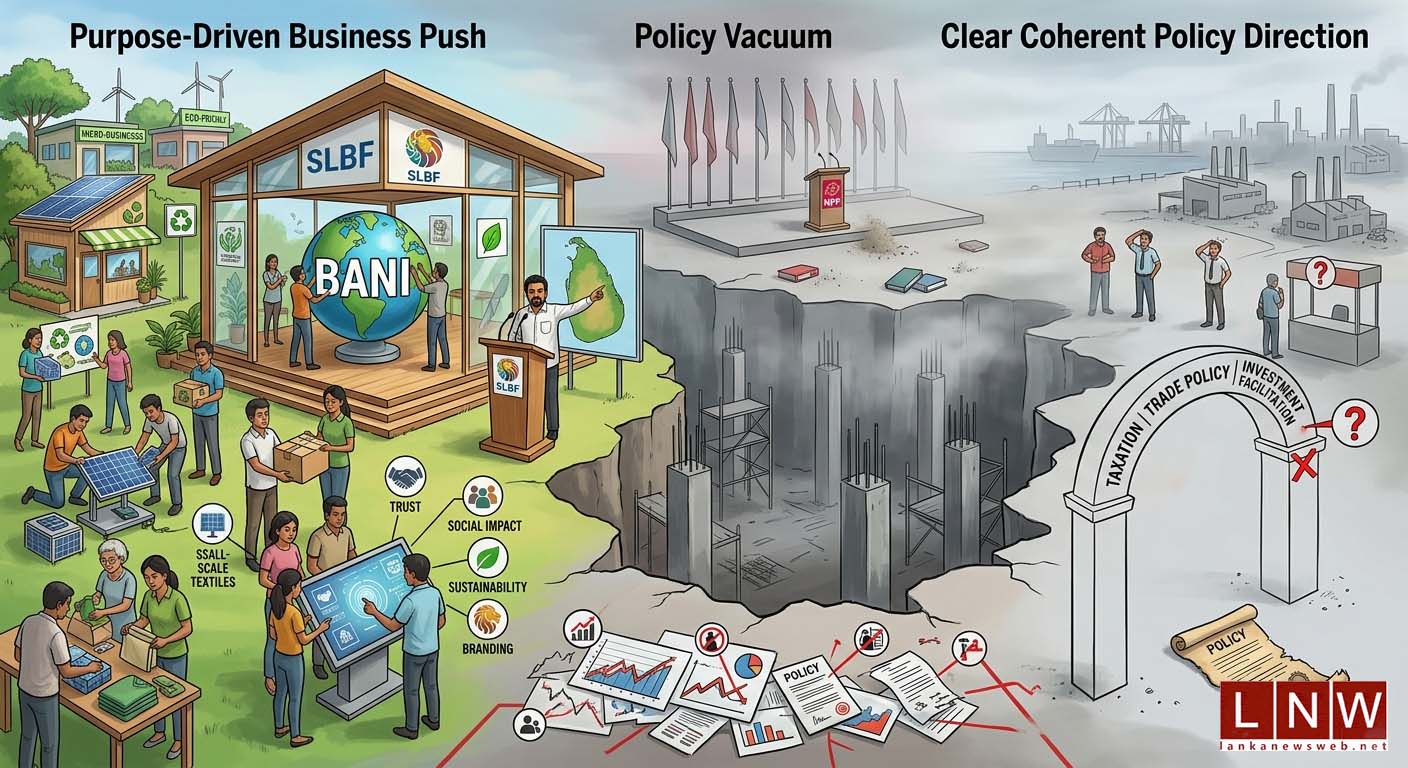
April 05, Colombo (LNW): Sri Lanka’s latest push toward a “purpose-driven” business model, highlighted by the launch of the Sri Lanka Brand Forum (SLBF), is being framed as a forward-looking response to global economic disruption. Yet beneath the rhetoric lies a more uncomfortable reality: the absence of a clear, coherent policy direction for the private sector under the current administration.
The SLBF, an extension of the Bangladesh-based initiative led by Shariful Islam, positions itself as a platform to reshape how businesses operate in an increasingly volatile global environment. Describing today’s landscape as a “BANI world” brittle, anxious, nonlinear, and incomprehensible Islam argued that traditional business models are no longer sufficient. Companies, he said, must integrate sustainability, trust, and social impact into their core strategies.
However, this vision raises a critical question: who is setting the national economic direction? While the forum promotes purpose-driven capitalism, the Government led by President Anura Kumara Dissanayake has yet to articulate a detailed roadmap for private sector development. The emphasis on values such as sustainability and inclusivity, though important, risks becoming abstract without corresponding regulatory clarity and investment incentives.
SLBF Co-Founder Rohan Somawansa acknowledged that Sri Lanka’s challenge goes beyond recovery, calling for a redefinition of the country’s economic future. Yet such a transformation typically requires strong state guidance something analysts argue is currently lacking.
Historically, Sri Lanka’s private sector has operated within a framework shaped by shifting policy priorities, inconsistent regulations, and political uncertainty. The transition to a purpose-driven model would require not only corporate adaptation but also structural reforms in taxation, trade policy, and investment facilitation. So far, these elements remain under the National People’s Power (NPP) government.
The SLBF’s focus on leadership, innovation, sustainability, and branding reflects global trends, particularly the growing importance of national identity and credibility in attracting investment. But critics note that branding alone cannot compensate for policy gaps. Without a stable and predictable business environment, efforts to position Sri Lanka as a competitive global player may struggle to gain traction.
The initiative’s emphasis on youth engagement and evolving consumer expectations particularly among Gen Z adds another layer of complexity. While empowering younger voices is vital, it also underscores the urgency of creating real economic opportunities, something that requires concrete policy action rather than conceptual frameworks.
Ultimately, the SLBF represents both an opportunity and a warning. It highlights the private sector’s willingness to adapt and innovate, but also exposes the lack of a unified national strategy to guide that transformation. In the absence of clear direction, Sri Lanka’s journey toward a purpose-driven business future risks becoming fragmenteddriven more by individual initiatives than by a cohesive economic vision.