
By: Staff Writer
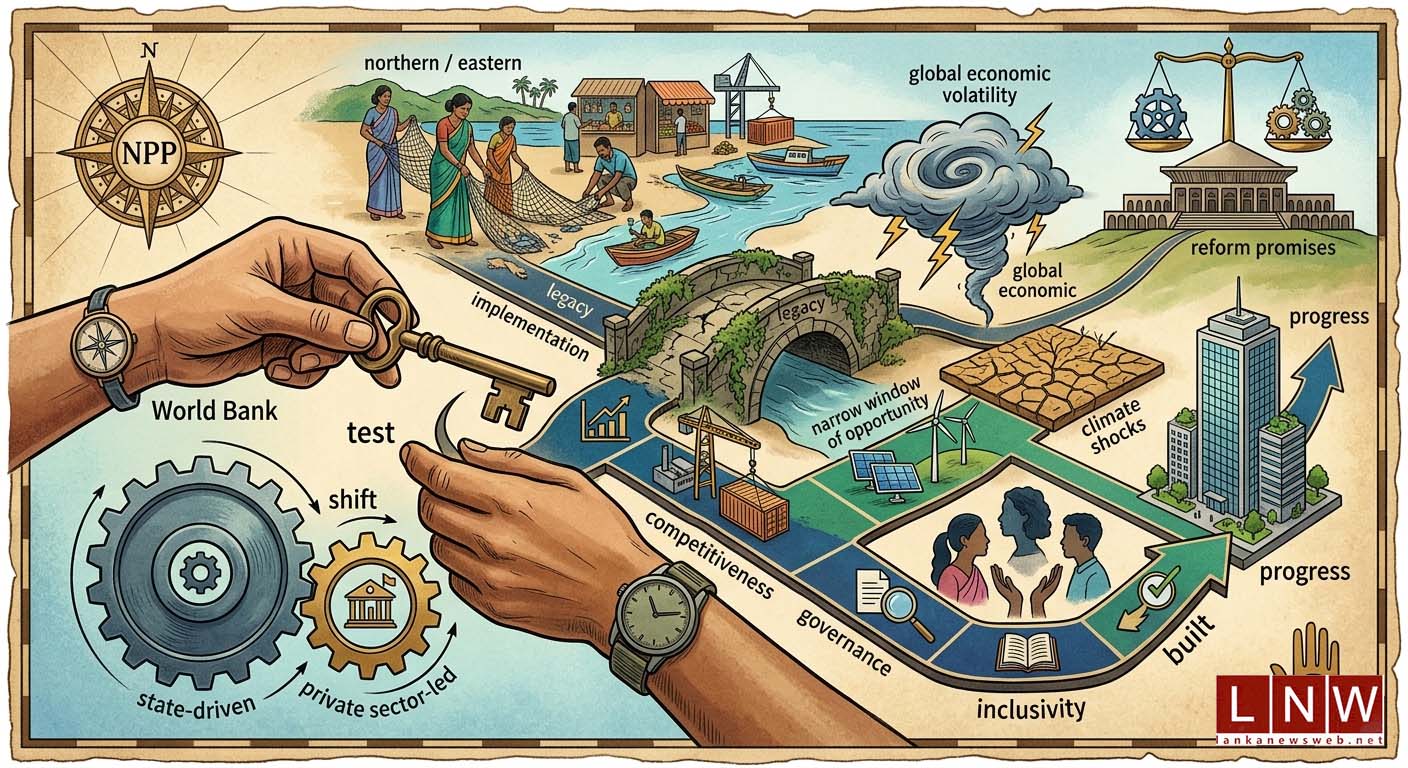
April 05, Colombo (LNW): Sri Lanka’s new partnership with the World Bank Group presents a defining test for the reform agenda of the National People’s Power (NPP) government, led by President Anura Kumara Dissanayake. At stake is not just economic recovery, but whether a new political leadership can fundamentally change how foreign assistance is deployed.
The Country Partnership Framework (CPF) outlines a comprehensive strategy to drive growth, create jobs, and strengthen resilience. With commitments of up to $1 billion in concessional financing from the World Bank and an additional $1 billion in investments mobilised through the International Finance Corporation (IFC), the initiative aims to leverage both public and private sector resources.
Unlike previous governments, which often relied heavily on state-driven development models, the NPP administration has signalled a pivot toward private sector-led growth. IFC Vice President Sarvesh Suri emphasised that Sri Lanka’s future growth will depend on a competitive and innovative private secto —a message that aligns closely with the Government’s stated priorities.
This shift is evident in the CPF’s four strategic pillars. Efforts to simplify regulations and digitise government services are designed to improve the ease of doing business, a long-standing bottleneck for investors. Similarly, planned investments in the Port of Colombo and renewable energy aim to enhance competitiveness while reducing operational costs for businesses.
However, the real test lies in implementation. The NPP government has inherited a legacy of uneven aid utilisation, where funds were frequently diverted toward politically motivated projects or delayed due to bureaucratic inefficiencies. To break from this pattern, the current administration must ensure that projects are selected based on economic viability and social impact rather than short-term political gains.
The launch of the REVIVE project a $100 million initiative targeting the Northern and Eastern Provinces offers an early indication of this new approach. By focusing on tourism, fisheries, and small business development in historically underserved regions, the project aims to create 3,000 jobs and benefit over 260,000 people. This targeted, region-specific strategy contrasts with past approaches that often concentrated investment in already developed areas.
Another notable aspect of the CPF is its emphasis on inclusivity. Women, youth, and marginalised communities are explicitly identified as beneficiaries, reflecting a broader shift toward equitable growth. This is particularly significant given criticism that previous aid programs failed to distribute benefits evenly across society.
Yet challenges remain. Achieving a 7 percent growth rate will require not only effective use of World Bank funds but also broader structural reforms, including improvements in governance, institutional capacity, and policy consistency. External risks from global economic volatility to climate shocks continue to pose additional uncertainties.
The NPP government now faces a narrow window of opportunity. If it can translate this ambitious partnership into measurable outcomes, it could redefine Sri Lanka’s development trajectory. Failure, however, would reinforce longstanding doubts about the country’s ability to convert international support into sustainable progress.