
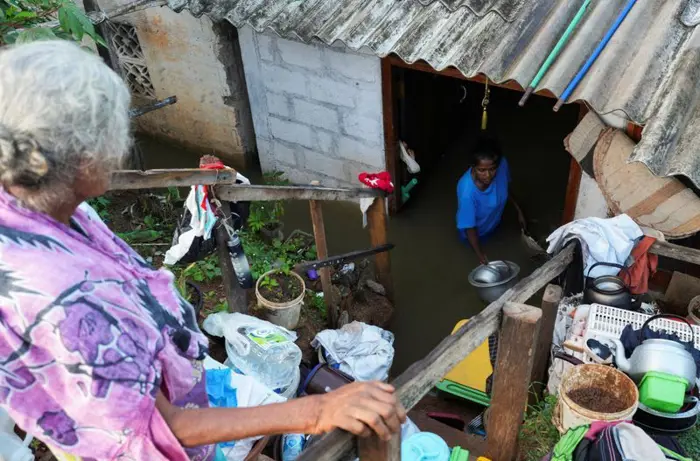
Sri Lanka’s post-disaster recovery from Cyclone Ditwah is losing momentum, with tens of thousands still unable to return home despite an expanded humanitarian response, according to the United Nations Office for the Coordination of Humanitarian Affairs.
More than 149,000 people remain displaced weeks after the cyclone, highlighting a shift from emergency response to a more complex, prolonged recovery phase. While initial displacement figures peaked at over 233,000, the decline has been uneven, with many affected families now living in temporary or informal arrangements rather than organised shelters.
Humanitarian efforts under the national priority plan have reached over 291,000 individuals across all districts, supported by dozens of aid organisations. However, the nature of displacement is evolving. Instead of large-scale camps, families are increasingly scattered staying with relatives or in makeshift housing making assistance delivery more difficult and less visible.
Shelter remains a critical concern. Although the number of official safety centres has dropped significantly, hundreds of families still depend on them, particularly in vulnerable districts such as Badulla, Nuwara Eliya, and Kegalle. Authorities are now transitioning some communities to tent-based accommodation, a move that underscores the absence of long-term housing solutions.
A key bottleneck is the slow pace of resettlement approvals. The National Building and Research Institute is struggling to keep up with demand for hazard assessments required before families can safely return or rebuild. Without these clearances, reconstruction remains stalled, prolonging uncertainty for affected communities.
Meanwhile, the Government has attempted to streamline compensation through updated guidelines, consolidating multiple relief schemes. Financial assistance has also been extended to the agricultural sector, with significant grants allocated for replanting key crops such as tea, rubber, and coconut.
Despite these efforts, funding constraints continue to hamper recovery. A substantial gap remains in the overall humanitarian budget, leaving critical sectors like health, nutrition, and early recovery under-resourced.
The disasters scale affecting over 2.2 million people and causing widespread destruction—means recovery will likely stretch over months, if not years. As the immediate crisis fades, the challenge now lies in sustaining support and ensuring that displaced populations are not left behind in a slow and uneven rebuilding process.