
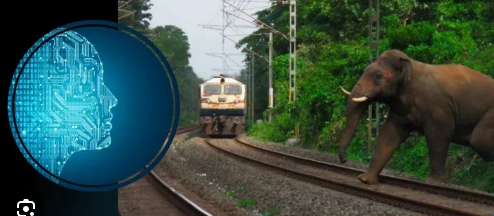
When a passenger train struck a herd of elephants near Habarana in February 2025, the footage that followed made international headlines. One elephant was filmed standing guard over an injured youngster lying beside the tracks, the tips of their trunks curled together. Three calves were among the six killed. For Damsith Wimalasena, a Sri Lankan technologist and University of Cambridge graduate, it was a confirmation of what he had been working to prevent.
Damsith, who was described by his college as an “extraordinary student” of the University of Cambridge, is the founder of the Coexist Initiative, an AI-powered collision avoidance platform being developed to stop trains killing elephants on Sri Lanka’s rail network. Still in its early stages, the system is being designed to mount LiDAR sensors onto locomotive cockpits, with the goal of detecting elephants at distances of up to 500 metres and giving operators the critical seconds needed to brake. The platform plans to use machine learning algorithms to classify animals in real time, while the movement data captured would help wildlife authorities map elephant crossing corridors and shape conservation planning.
The core insight, according to Damsith, is that this technology does not need to be invented from scratch. The sensor and software architectures he is drawing on have already been validated at scale by car manufacturers for automotive collision avoidance. Adapting them for the railway context would significantly reduce both cost and development time.
The problem he is trying to solve is vast. Sri Lanka records the highest annual elephant mortality of any country in Asia, with an average of 370 elephants and 125 people killed each year due to the broader human-elephant conflict. Since 2010, nearly 5,000 elephants have been killed across the island. The Sri Lankan elephant population has declined by almost 65 per cent since the nineteenth century, and the subspecies is classified as endangered by the IUCN. Railway collisions represent a small but deeply significant share of those losses. Train-related fatalities account for roughly five per cent of all elephant deaths, yet they draw disproportionate public attention because they are considered almost entirely preventable. The annual toll continues to fluctuate, with 24 elephants killed on the tracks in 2023 and 9 in 2024.
It is a recognition that Damsith arrived at early. Beyond Coexist, he has been consistently involved in the AI/ML space, building and ideating across multiple ventures. His broader ambition is to bridge the gap between cutting-edge AI and machine learning and on-the-ground impact, particularly as the technology approaches a point of singularity. His selection as a United Nations Millennium Fellow placed him among roughly five per cent of more than 52,000 applicants from 170 countries. He serves as a World Economic Forum Global Shaper and formerly led Cambridge University Entrepreneurs, one of Europe’s largest student-run entrepreneurship communities. Lucy Cavendish College featured his work in an official college profile and in the College’s Annual Review.
A 2024 census estimated Sri Lanka’s wild elephant population at between 6,000 and 7,000, and 386 elephants were killed that same year. Conservationists warn that at current rates; a sustainable breeding population may not survive. For Damsith, the Coexist Initiative is an attempt to intervene at the point where the crisis is at a critical juncture.
Written By
Asiri Sameera Fernando
University of Wayamba