
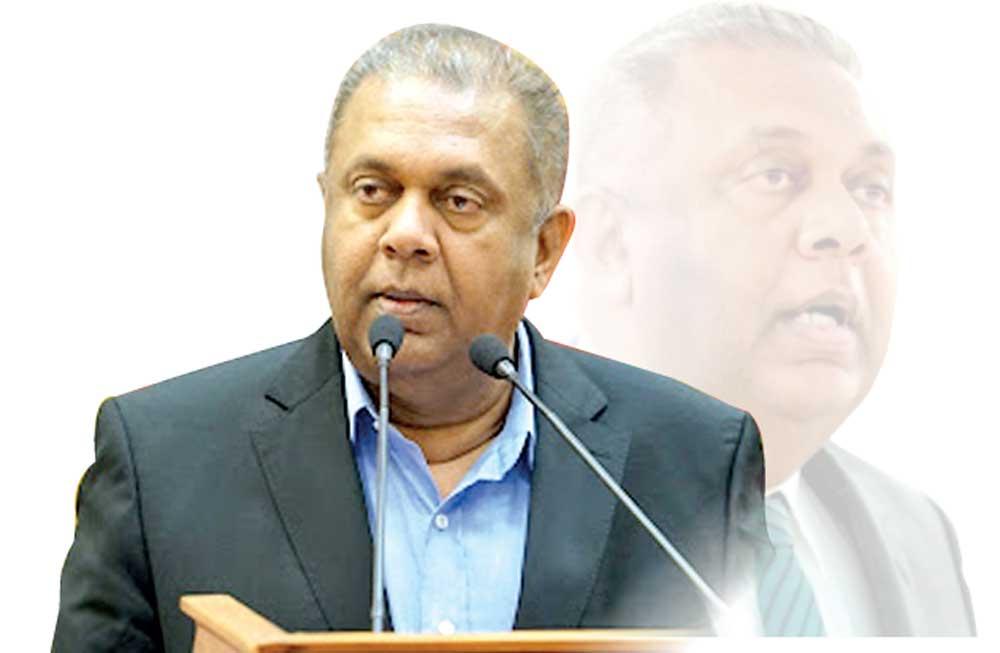
by Krishantha Prasad Cooray
If all hadn’t been overturned – delivering an unrecognisable landscape five years ago – it is quite likely that I would have made a phone call early this morning. And when answered, I would have said, ‘Happy birthday Mr Seventy!’
I would probably then have heard this response from the other end of the line: ‘Wrong number, Mr Cooray!’
Thereafter we both would have laughed heartily.
‘Why don’t you drop by now?’ would have been the probable invitation. And I would go. And I would have seen Mangala, the inimitable aging and ageless young man, wearing a pair of shorts, looking quite the innocent child, sipping a glass of ice water.
A friendly and hospitable gentleman, he would have asked, ‘what would you like to drink, what would you like to eat?’ There would be endless questions such as these.
‘I would like a cup of black coffee.’
It would be duly delivered.
And he would speak of growing old, people over the age of 70 and what happens when one reaches that age. I can picture it all. An hour would pass without either of noticing the time passing. We would talk about this and that, laughing through it all. Finally, we would agree to meet in the evening and I would leave.
Indeed, had Mangala not passed away on the 24th of August 2021, there’s no doubt in my mind that we would meet tonight. There would be a stupendous party at his house on Bolgoda Lake which would be duly decorated with innumerable lights.
There would be many colourful people in attendance. People from across the political spectrum, people speaking different languages, people dressed differently, people subscribing to different religious faiths believing in different sets of truths, all enjoying themselves.
Managla, dressed in a colourful shirt would come walking through the lights, blowing smoke rings from a Vienna Cigar he is chewing on, smiling and laughing. From that moment there will be intense debate, unforgiving humour and conversation about politics, art, economy, life, freedom, democracy and other such things that were part of his universe. Time would pass. The party would be signatured by the colourful personality that is Mangala Samaraweera.
If the party ended with the clash of ideas, Mangala would start another day with a pleasant and uncluttered frame of mind, having erased all the contradictions and disagreements.
They say birds of a feather flock together, but on the trees he perched on there was ample room for all birds.
Mangala was an optimist. He didn’t dwell on the negatives. He was a man who didn’t give in to emotions, but would rather take things lightly and yet act with utmost responsibility. He believed that every single human being should be happy and enjoy the right to be free. He respected the choices, the likes and dislikes of everyone.
The progressive and free-thinking Mangala delighted me. I was drawn to Mangala, the man who abhorred racism and religious fundamentalism. He was open in both his personal and public life, quite in contrast to the traditional political creatures of his time. He obeyed his conscience at all times and stood for the same unconditionally. His philosophy was his conscience.
A free-thinker, Mangala never abandoned his principles even if it were to cost his dearly. He fought to uphold these. He tenaciously defended his choices and decisions and yet, if it became clear that he was wrong, he was honest enough to acknowledge error and correct course.
Mangala was a pragmatist. He didn’t tolerate ideas that simply could not be implemented. For him, those who offered such suggestions were but ‘Idea-dasas’ which literally means ‘Slaves to ideas.’
He was an uncompromising liberal and this is why he remained opposed to racism, communalism and extremism until the very end.
He spoke his mind and this earned the wrath of many, but Mangala simply responded with logic and tried not to descend to personal attacks. He was not afraid of letting ends justify means, but he acknowledged that moral complexity and was never ‘holier than thou’. He would smile with his worst critics and detractors. The more there was critique, the more honest he became and the stronger too.
He was someone who lived on an island but whose politics were, in a sense, continental. He loved light and not the dark. He respected the rights of human beings. He respected diversity of all kinds and firmly believed that Sri Lanka should not be contained by its national boundaries but instead engage with the rest of the world. He was an amazing man who spent an entire lifetime defending the liberal principles he had embraced.
Theodore Roosevelt’s daughter is reported to have said that her father ‘always wanted to be the corpse at every funeral, the bride at every wedding and the baby at every christening.’ Mangala was never like that, he never sought to be the centre of attention.
Mangala believed his friends at all times. He was such a delightful and trustworthy human being that those who became his friends, never abandoned him.
His death indeed added new validity to his ideas that had been rejected – those that had scorned him and his ideas for decades only realised what they had lost when he died. In other words, the Mangala who left was more powerful than the Mangala who had lived. He devoted the last quarter of his life not to traditional politics but the ideologies of radical youth. He gifted his dying breath to give new life to that new and fresh ideology.
Mangala is a rare book that is yet to be fully read. I am still reading that book. It is a colourful and insightful text that cannot really be ever fully reviewed. But it is one that still brings a smile and a laugh, as I keep reading it years later.
I began this note assuming the what-may-have-been had Mangala been still alive. The truth is that Mangala is no more. I didn’t get a call from 07 7757 6495. When I dialled the number out of habit, I found that it was disconnected. “The phone number you dialed is not in use” a voice said. Though he may not be at the other end of the line, his memory, legacy and laugh speak to us still.