LISTEN TO STORY
WATCH STORY
By: Isuru Parakrama
April 26, World (LNW): The attempted shooting near the White House Correspondents’ Dinner on April 25, 2026 has once again thrust US President Donald Trump into the centre of a deeply polarised national conversation.
While the incident itself appears to have been the act of a lone individual with no clear ideological motive, it inevitably raises a broader and more enduring question: why does Trump provoke such intense dislike among large sections of the public?
At first glance, the facts surrounding the incident offer little support for the notion that anti-Trump sentiment directly fuels acts of violence. The suspect, a well-educated and seemingly stable individual, had no known ties to extremist networks or overt political motivations. Yet the symbolic weight of such an incident cannot be divorced from the climate in which it occurs—a climate shaped, in no small part, by Trump’s own political style and legacy.
A Presidency Built on Confrontation
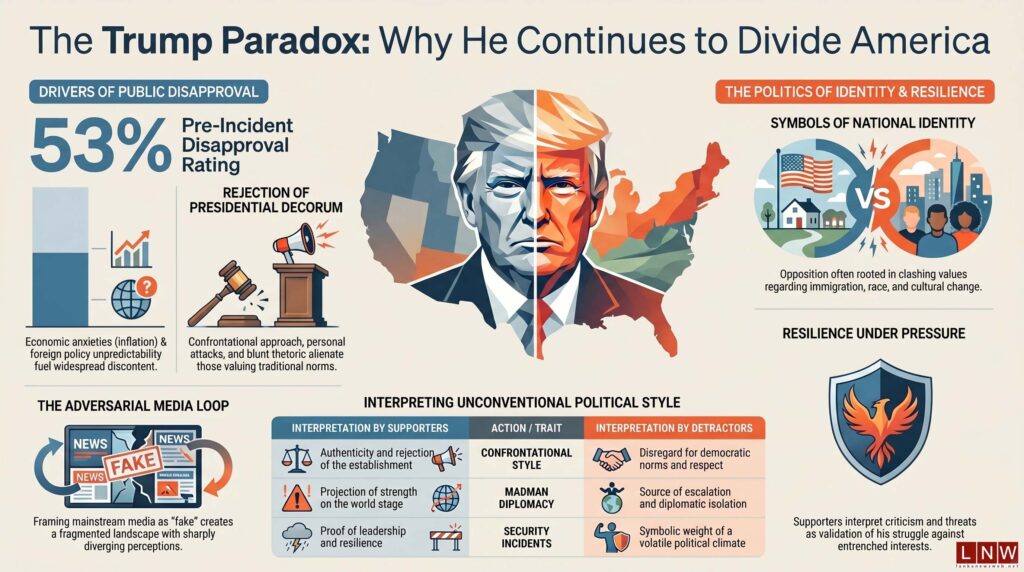
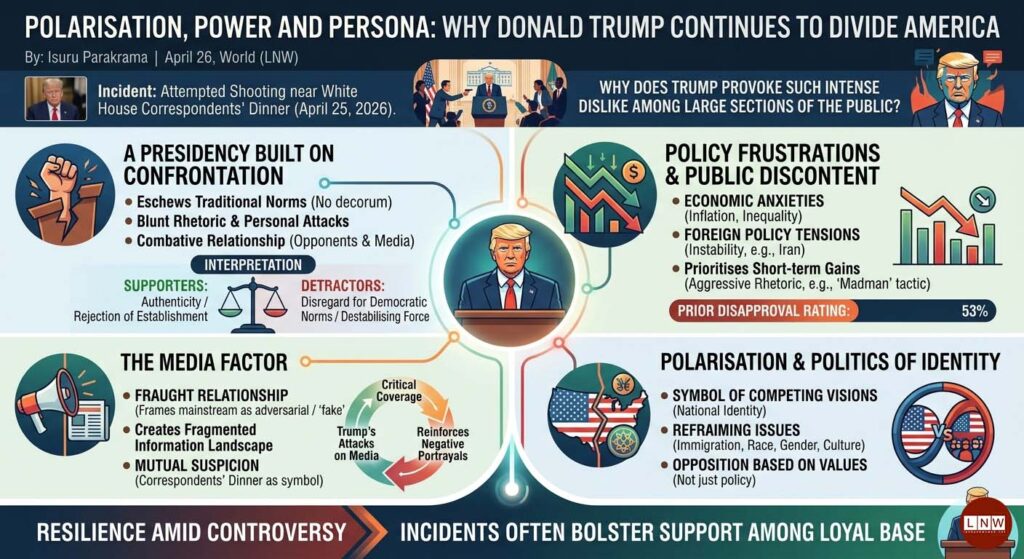
One of the central reasons for Trump’s unpopularity amongst critics lies in his confrontational approach to governance and communication. From his earliest days in politics, Trump has eschewed the traditional norms of presidential decorum, opting instead for blunt rhetoric, personal attacks, and a combative relationship with both opponents and the media.
His presence at the Correspondents’ Dinner—an event he had previously criticised—underscored this tension.
For supporters, this style represents authenticity and a rejection of establishment politics. For detractors, however, it signals a disregard for democratic norms and institutional respect. This divergence in interpretation has only deepened the divide between those who view Trump as a disruptor of a broken system and those who see him as a destabilising force.
Policy Frustrations and Public Discontent
Beyond personality, substantive policy disagreements also underpin Trump’s high disapproval ratings, which stood at 53 per cent prior to the incident. Economic anxieties, particularly in relation to inflation and inequality, have eroded confidence among segments of the electorate. Similarly, foreign policy tensions—such as those involving Iran—have contributed to perceptions of instability and unpredictability.
Critics argue that Trump’s approach often prioritises short-term political gains over long-term strategic coherence. His use of aggressive rhetoric on the international stage, sometimes described as a “madman” tactic, may project strength but also raises concerns about escalation and diplomatic isolation.
The Media Factor
Trump’s fraught relationship with the press has further amplified negative perceptions. By consistently framing mainstream media as adversarial or “fake,” he has both energised his base and alienated those who rely on traditional journalism as a cornerstone of democratic accountability. The Correspondents’ Dinner itself symbolises this uneasy relationship—a gathering meant to celebrate press freedom, now overshadowed by mutual suspicion.
This antagonism has created a feedback loop: critical coverage fuels Trump’s attacks on the media, which in turn reinforces negative portrayals amongst his opponents. The result is a fragmented information landscape where perceptions of reality diverge sharply along political lines.
Polarisation and the Politics of Identity
Perhaps the most significant factor driving dislike for Trump is the broader context of political polarisation in the United States. Trump has become more than a political figure; he is a symbol of competing visions of national identity. Issues such as immigration, race relations, gender diversity, and cultural change have been reframed through his rhetoric, often in ways that critics argue are divisive.
For many Americans, opposition to Trump is not merely about policy disagreements but about values and the direction of the country. Conversely, his supporters often view criticism of Trump as an attack on their own social and cultural position.
This mutual reinforcement of identity-based politics makes consensus increasingly elusive.
Resilience Amid Controversy
Ironically, incidents like the April 2026 shooting attempt often bolster Trump’s standing amongst supporters. His calm response and praise for law enforcement reinforced an image of resilience and leadership under pressure. Historically, such moments have produced short-term increases in approval ratings, as public sympathy coalesces around a leader perceived to be under threat.
This dynamic complicates the narrative of widespread dislike. While Trump remains deeply unpopular amongst certain groups, he retains a loyal base that interprets both criticism and threats as validation of his struggle against entrenched interests.
A Divisive Figure in a Divided Era
Ultimately, the question of why people dislike Donald Trump cannot be answered in isolation from the broader political environment. His personality, policies, and communication style all contribute to negative perceptions, but they do so within a society already canvassed by deep division.
The April 2026 incident serves as a stark reminder of the tensions that define contemporary American politics. Yet it also highlights a paradox: even as Trump is widely criticised, he remains a central and enduring figure, capable of commanding attention, shaping discourse, and mobilising both fervent support and equally intense opposition.
In this sense, Trump is less an anomaly than a reflection of the era he inhabits—one in which politics is not merely contested, but deeply personal, profoundly polarised, and increasingly difficult to reconcile.