
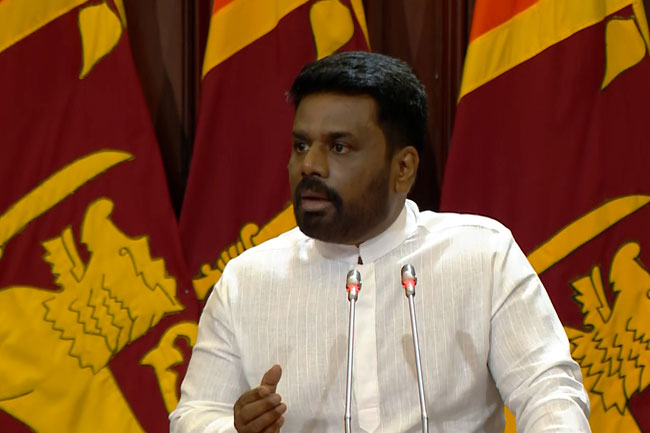
President Anura Kumara Dissanayake has instructed officials to promptly introduce all necessary reforms, including amendments to existing laws, to eliminate the drug menace from the country.
The directives were issued during a meeting of the “Ratama Ekata” National Steering Council held this morning (May 7) at the Presidential Secretariat, convened to review ongoing efforts to combat narcotics, according to the President’s Media Division (PMD).
The President also instructed relevant authorities to expedite the destruction of seized narcotics under proper legal procedures to prevent them from re-entering society, while also accelerating legal action against offenders.
He stressed that swift implementation of these measures is essential to strengthen public confidence and support the success of the “Ratama Ekata” national initiative through collective participation.
During the meeting, officials reviewed the progress of anti-narcotics operations carried out under the programme, noting that narcotics-related raids had increased by 80 percent since its launch.
Authorities revealed that since the operation began on October 30, 2025, law enforcement agencies have seized 5,437.457 kilogrammes of cannabis, 1,936.325 kilogrammes of heroin, 1,991.414 kilogrammes of crystal methamphetamine (“Ice”), 271.724 kilogrammes of cocaine, 1,574,895 narcotic pills, and 629,988 illicit cigarettes. A total of 168,460 suspects have also been arrested.
The meeting also reviewed progress on legal reforms required to strengthen anti-drug efforts. Officials stated that steps have been taken to submit the Rehabilitation (Amendment) Bill No. 54 of 2007 to the Cabinet in due course.
Discussions further focused on rehabilitation strategies and the expansion of related facilities. It was revealed that 25 families most severely affected by narcotics in each Divisional Secretariat division had been selected for attitude development programmes.
President Dissanayake emphasized the importance of implementing such initiatives through local religious institutions and maintaining continuous community engagement, including the involvement of members of the Maha Sangha and other religious leaders.
He also noted that anti-drug awareness campaigns should go beyond one-time programmes and include ongoing follow-up mechanisms to evaluate effectiveness and monitor progress within communities.
The President additionally sought updates on efforts to establish a separate court for narcotics-related cases, speed up Government Analyst reports, and accelerate legal proceedings.
He also stressed the need for an urgent programme to fast-track legal and rehabilitation processes for inmates imprisoned on drug-related charges in order to reduce prison overcrowding.
The Inspector General of Police briefed the meeting on investigations involving Buddhist monks recently arrested over narcotics-related offences, while officials also updated the President on programmes being jointly implemented by the Ministry of Education and the Women and Children’s Bureau to prevent schoolchildren from being drawn into drug use.
The President was further informed about community-based initiatives planned in connection with the International Day Against Drug Abuse and Illicit Trafficking, observed annually on June 26.