
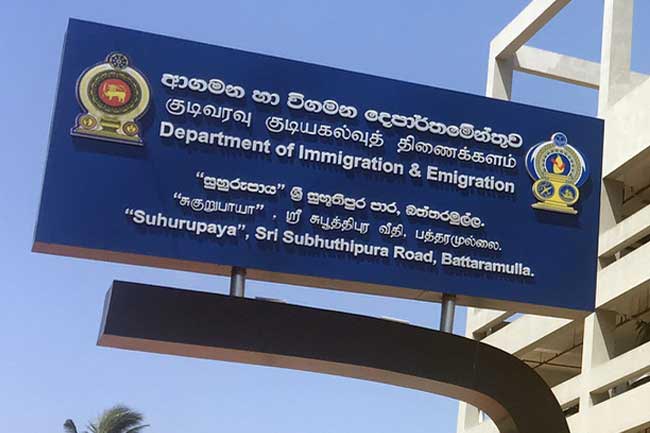
Sri Lanka’s anti-corruption investigators have launched an escalating financial crimes investigation after uncovering what officials believe was a carefully orchestrated software procurement fraud within the Department of Immigration and Emigration.
At the center of the probe is a controversial Rs. 9.83 million government payment approved for a digital security platform known as the “User Management Module,” which investigators now allege was never delivered, installed, or operational despite official documentation declaring the project complete.
The Criminal Investigation Department’s Financial Crimes Investigation Division arrested the department’s IT and Border Control Controller, K. Herath, after forensic investigators reportedly found no evidence that the software system had ever existed inside the department’s network infrastructure.
According to investigators, the suspect submitted formal operational certifications confirming that the software had been successfully developed and integrated into the agency’s digital systems. Those declarations allegedly triggered the release of public funds before any independent technical inspection was conducted.
Authorities say the payment, totaling Rs. 9,831,250, was processed through the department’s procurement framework before irregularities linked to state technology contracts prompted a forensic review.
The software was reportedly intended to function as a central security management platform responsible for controlling staff access permissions, maintaining audit logs, and strengthening cybersecurity protections tied to sensitive immigration databases.
However, CID forensic specialists examining departmental servers, procurement records, and deployment histories allegedly discovered no installation files, software builds, integration logs, or operational evidence connected to the project.
Investigators now suspect that falsified implementation reports and fabricated technical approvals may have been used to create the appearance of a completed software deployment, ultimately enabling the release of government funds for a system that may never have existed.
The suspect was taken into custody on May 14, 2026, and later produced before the Kaduwela Magistrate’s Court under charges filed through the Prevention of Money Laundering Act and the Public Property Act.
Legal experts note that offences prosecuted under the Public Property Act are treated as serious crimes involving misuse of state resources and frequently carry stringent bail restrictions as well as mandatory prison sentences upon conviction.
Investigators are currently conducting a broader review of procurement contracts, supplier agreements, internal communications, payment authorizations, and digital server activity to determine how the transaction progressed through official approval channels.
Authorities are also examining whether additional government officials, private contractors, or outside intermediaries may have participated in the alleged scheme or benefited financially from the payment process.
The scandal has intensified scrutiny over vulnerabilities in public-sector technology procurement, particularly within institutions responsible for managing highly sensitive national security and border-control databases.
Critics argue that many government technology contracts escape proper oversight because financial approvals often rely heavily on internal technical certifications issued by senior departmental officers themselves.
Officials involved in the inquiry say investigators are now focused on tracing the complete financial pipeline connected to the payment while identifying potential failures in oversight, compliance, and procurement accountability systems.
The case is expected to become one of the most closely monitored financial crime investigations involving Sri Lanka’s digital governance sector in recent years.