
By Adolf
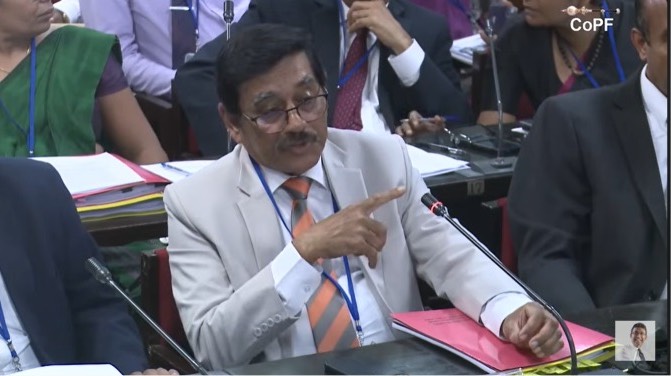
The Parliamentary Committee on Public Finance (CoPF) has expressed strong dissatisfaction with the Central Bank of Sri Lanka (CBSL) over what lawmakers described as significant regulatory and supervisory failures that allowed a massive Rs. 13.2 billion fraud at National Development Bank PLC (NDB) to remain undetected for years.
The matter came under intense scrutiny during a high-profile hearing before CoPF, chaired by MP Harsha de Silva, where Central Bank Governor Dr. Nandalal Weerasinghe and senior officials from the Bank Supervision Department were questioned regarding the circumstances that enabled one of Sri Lanka’s largest known internal banking frauds.
The fraud, allegedly carried out by a low-level employee attached to NDB’s transaction reconciliation unit, is believed to have continued over nearly a decade. Investigators suspect the individual exploited weaknesses in the bank’s reconciliation processes involving the LankaPay electronic fund transfer system, gradually siphoning funds while concealing discrepancies within the bank’s accounts.
Committee members questioned how such a substantial and growing balance could remain hidden within NDB’s financial statements under the category “Other Financial Assets/Receivables” without attracting regulatory concern. Lawmakers noted that the balance had reportedly fluctuated between Rs. 1.5 billion and Rs. 4 billion before eventually expanding to Rs. 13.2 billion.
CoPF members argued that such unusual movements should have triggered immediate attention from the Central Bank’s off-site supervision mechanisms. Several members suggested that the failure to identify these anomalies pointed to broader weaknesses within the regulatory framework.
A key point of contention arose when Director of Bank Supervision R.R.S. De Silva Jayatillake informed the committee that NDB had participated in preparing the initial scope of the forensic investigation. This prompted sharp criticism from Chairman Harsha de Silva, who questioned whether an institution under investigation should have any role in defining the parameters of the inquiry.
“Is the accused being asked to draft the scope of the investigation?” he asked, raising concerns about the independence and credibility of the process.
Governor Weerasinghe defended the procedure, stating that while NDB had provided preliminary input, the Central Bank retained full authority over the final terms of reference and investigative mandate.
The CBSL has engaged Deloitte India to conduct the forensic investigation. According to officials, a six-member specialist team is currently carrying out detailed examinations, with an interim report expected shortly and a final report scheduled for completion by July 18.
The committee also raised concerns regarding potential conflicts of interest. Questions were posed about whether links between a current NDB board member and Deloitte’s local affiliate could create perceptions of undue influence over the investigation.
Central Bank officials assured lawmakers that Deloitte India had provided clear guarantees that its forensic team would operate independently of any local affiliate involvement and that appropriate safeguards were in place to preserve the integrity of the investigation.
Further criticism emerged over the Central Bank’s approval of NDB’s previous debenture issuances aimed at strengthening Tier 2 capital. Committee members argued that regulators appeared to have relied excessively on information supplied by the bank without independently verifying the underlying financial position.
CBSL officials maintained that their approval process focused primarily on compliance with capital adequacy requirements and applicable regulatory standards rather than a detailed audit of financial statements. However, CoPF members rejected that explanation, insisting that regulators must exercise greater vigilance when approving instruments issued to the investing public.
The hearing also highlighted concerns about Sri Lanka’s broader financial regulatory architecture, particularly as the country seeks to strengthen governance standards under ongoing reform commitments. International institutions, including the International Monetary Fund (IMF), have repeatedly emphasized the importance of stronger operational risk management, internal controls and anti-money laundering frameworks across the financial sector.
At the conclusion of the session, CoPF directed the Central Bank to submit all approval and correspondence relating to NDB’s capital-raising activities for further parliamentary examination. The committee indicated that accountability for regulatory shortcomings and failure would remain a key focus once the forensic investigation is completed.
