LISTEN TO STORY
WATCH STORY
June 15, Colombo (LNW): Sri Lanka is expected to experience warmer and somewhat drier weather in the months ahead as El Niño conditions continue to develop, although experts say the country is unlikely to face the most severe consequences associated with the global climate pattern.
Climate specialists have indicated that any substantial effects linked to El Niño are not expected to become fully apparent until early next year. Officials note that Sri Lanka’s geographical position within the Indian Ocean, combined with the influence of its central mountainous region, helps retain atmospheric moisture and provides a degree of natural protection against extreme climatic shifts.
Meteorological authorities have nevertheless cautioned that temperatures are likely to remain above seasonal averages during July and August. Rainfall levels may also decline in several parts of the country as the weather phenomenon gains strength, raising concerns about water availability and agricultural productivity.
The potential implications of El Niño were recently reviewed at a high-level discussion attended by senior government officials and chaired by President Anura Kumara Dissanayake.
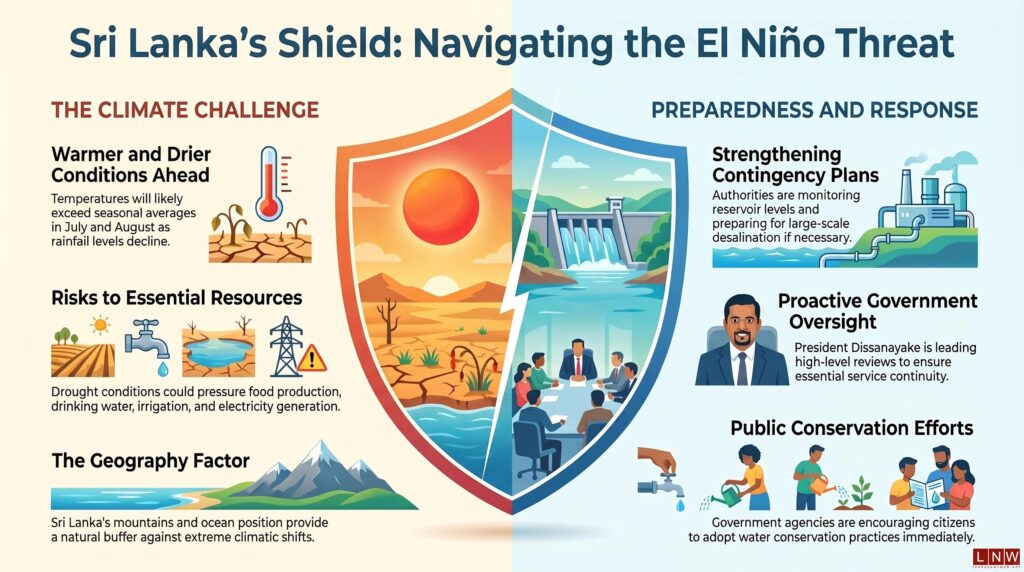
The meeting focused on possible challenges to food production, drinking water supplies, irrigation systems and electricity generation, particularly if prolonged dry conditions emerge.
Disaster management officials warned that while current forecasts do not point to a severe crisis, authorities must remain prepared for less favourable scenarios. A prolonged drought could place significant pressure on reservoirs, rivers and groundwater resources, especially in regions already vulnerable to water shortages.
Officials noted that contingency plans are being strengthened to safeguard essential services. In a worst-case scenario involving the depletion of major freshwater sources, emergency measures such as large-scale desalination and the distribution of treated seawater could be considered to meet public demand.
Government agencies are also expected to increase monitoring of weather patterns and reservoir levels in the coming months, while encouraging the public to adopt water conservation practices. Experts stressed that although Sri Lanka may avoid the harshest impacts seen elsewhere in the region, early preparedness remains essential to minimise potential disruptions to livelihoods and the economy.