LISTEN TO STORY
WATCH STORY
By: Isuru Parakrama
June 16, World (LNW): Children across the globe are increasingly bearing the brunt of climate change, with a new report from UNICEF warning that billions are now living under the shadow of severe environmental threats ranging from extreme heat and drought to flooding and disease outbreaks.
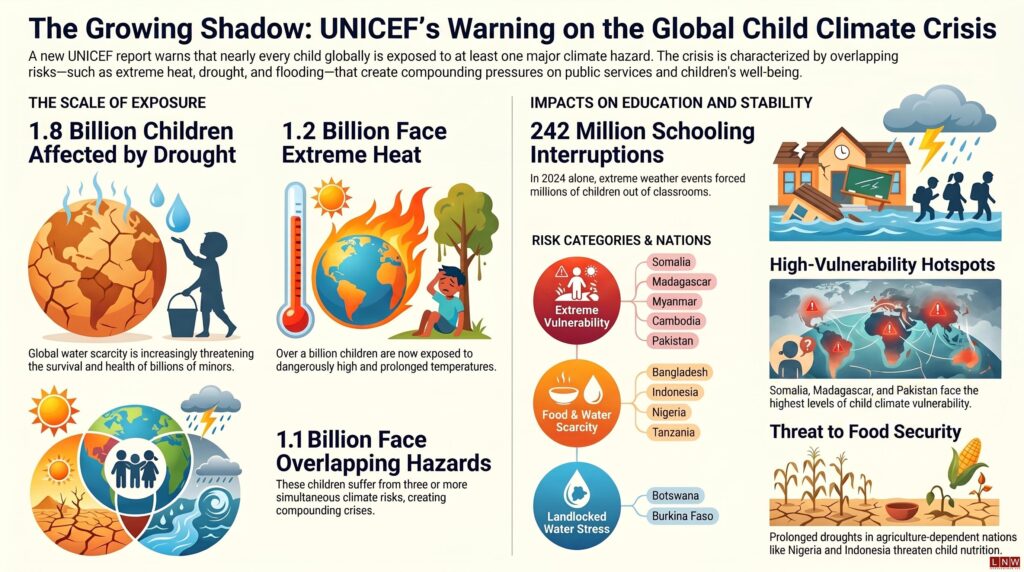
According to the organisation’s latest assessment, nearly every child worldwide is exposed to at least one major climate-related hazard. The report estimates that around 1.8 billion children are affected by drought conditions, while approximately 1.2 billion face prolonged exposure to dangerously high temperatures.
UNICEF cautioned that young people are among the most vulnerable groups when it comes to climate-related disasters, as they often suffer the greatest consequences from disruptions to health services, education, nutrition and access to clean water. The agency has called on governments to accelerate investments in climate-resilient infrastructure, disaster preparedness and community adaptation programmes to better protect future generations.
The study examined a wide range of environmental and public health risks, including floods, storms, air pollution and mosquito-borne diseases such as malaria. Researchers also analysed factors such as healthcare availability, sanitation, water access and social support systems to assess the overall vulnerability of children.
One of the report’s most alarming findings is that an estimated 1.1 billion children are exposed to three or more overlapping climate hazards. Experts warn that the combination of multiple risks can create compounding crises that place immense pressure on public services and emergency response systems.
UNICEF researchers noted that the challenge extends far beyond individual disasters. In many regions, children are simultaneously confronting heatwaves, water shortages, disease outbreaks and extreme weather events, creating a cycle of vulnerability that becomes increasingly difficult to address.
The report estimates that hundreds of millions of children are exposed to tropical storms and river flooding, while vast numbers remain at risk from malaria, particularly in parts of Africa where climate conditions continue to favour the spread of disease-carrying mosquitoes.
Climate-related disruptions are also taking a significant toll on education. During 2024 alone, approximately 242 million children in dozens of countries experienced interruptions to their schooling as a result of extreme weather events and environmental emergencies.
Among the countries identified as facing the highest levels of child climate vulnerability were Somalia, Madagascar, Myanmar, Cambodia and Pakistan, where climate pressures intersect with economic and social challenges.
The report further highlighted the growing strain on agriculture-dependent nations such as Bangladesh, Indonesia, Nigeria, Pakistan and Tanzania, where prolonged droughts threaten food security and livelihoods.
Meanwhile, landlocked countries are expected to face mounting challenges from water scarcity, desertification, flash flooding and heat stress. Nations such as Botswana and Burkina Faso could see worsening water shortages in the years ahead, underscoring the urgent need for coordinated international action to safeguard children from the accelerating impacts of climate change.