
By: Staff Writer
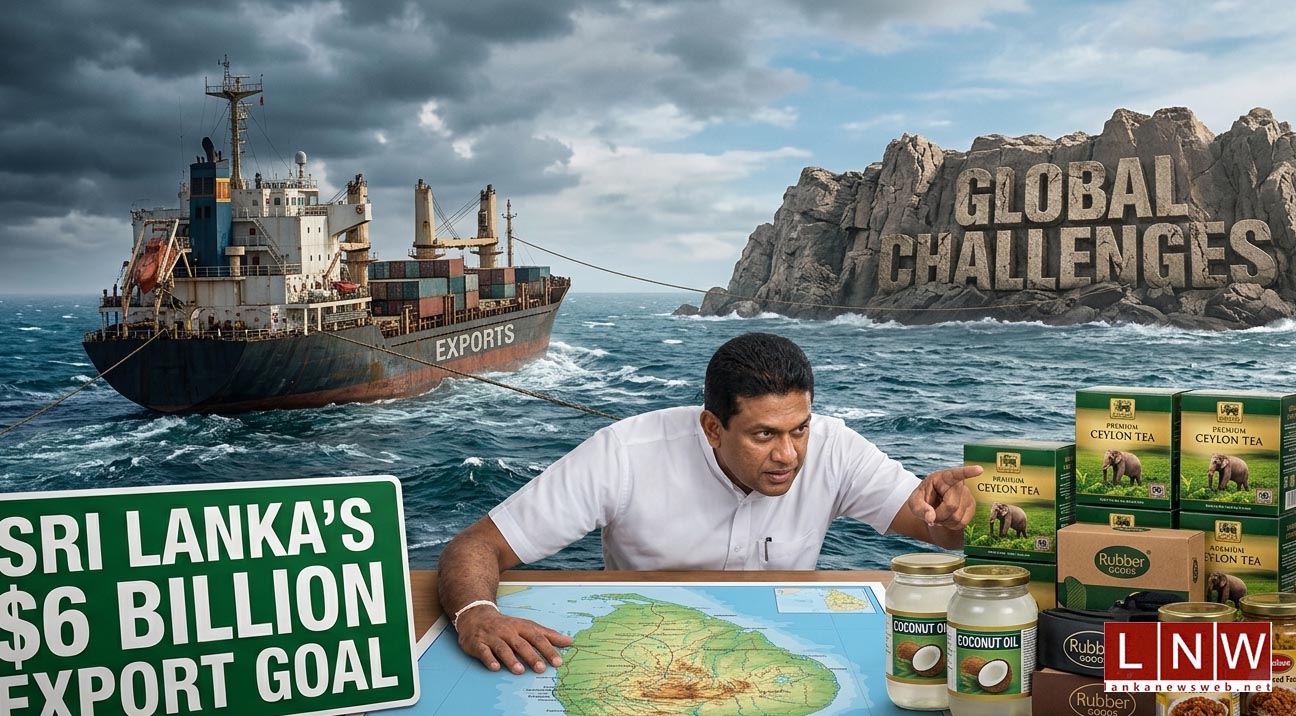
June 30, Colombo (LNW): The Government’s plan to transform Sri Lanka into an export-oriented economy reflects a clear recognition that sustained economic recovery depends on stronger foreign exchange earnings rather than debt-funded growth. President Anura Kumara Dissanayake’s target of generating up to $6 billion from the coconut, food and beverage, rubber and tea sectors is undoubtedly ambitious, but whether it can be achieved within the proposed timeframe remains an open question.
The strategy rightly prioritises value addition instead of relying on exports of raw commodities. Producing higher-value coconut products, processed foods, premium rubber goods and branded tea can significantly improve export earnings while increasing local employment. The Government has also acknowledged the importance of maximising net dollar inflows by reducing dependence on imported raw materials a policy shift that many exporters have long advocated.
However, global market conditions present challenges that extend well beyond domestic policy reforms.
Tea exports continue to face uncertainty due to geopolitical tensions affecting shipping routes and logistics costs, particularly in the Middle East. Rising freight charges and payment issues in traditional markets such as Iran have reduced competitiveness despite sustained international demand for Ceylon Tea. Meanwhile, rubber exporters operate in an increasingly competitive global market where countries with larger plantation bases and lower production costs continue to expand their market share.
The coconut and food processing sectors also face stiff competition from regional producers that benefit from larger-scale production, lower input costs and well-established international supply chains. Simply increasing production capacity may not be enough unless Sri Lankan exporters can differentiate their products through quality, branding, innovation and compliance with increasingly stringent international food safety and sustainability standards.
omestically, exporters continue to grapple with familiar constraints. Delays in VAT refunds affect cash flow, regulatory approvals often remain time-consuming, labour shortages persist across manufacturing industries, and research innovations are slow to reach commercial production. These operational inefficiencies increase production costs and weaken Sri Lanka’s competitiveness against regional rivals.
The Government’s proposal to provide incentives for investment, simplify regulations and encourage industrial development in the Northern Province represents a positive step. Nevertheless, investors typically seek long-term policy consistency, predictable taxation, reliable infrastructure and efficient public administration before committing significant capital. These institutional reforms often take years rather than months to produce measurable results.
Sri Lanka’s export ambitions are achievable only if policy implementation matches the scale of the targets being announced. Expanding exports requires more than incentives—it demands stronger supply chains, higher productivity, improved logistics, investment in technology, skilled labour and consistent economic policies that survive political cycles.
The President’s vision offers an important direction for the country’s economic future. Yet transforming four export sectors into multi-billion-dollar earners will require sustained reforms, private sector confidence and favourable global market conditions. Success will ultimately depend not on the ambition of the targets, but on the Government’s ability to deliver lasting structural change.
As speculation mounts over a possible change in leadership at Sri Lanka Telecom PLC (SLT-MOBITEL), a series of historical allegations concerning Independent Non-Executive Director Chandrasiri Kalupahana have resurfaced, prompting renewed debate among employees, shareholders and governance observers ahead of the company’s Annual General Meeting.
Several concerns relate to Kalupahana’s tenure as Group Chief Internal Auditor of SLT. One of the most frequently cited issues involves a foreign training programme scheduled to take place in Malaysia from April 22 to April 29, 2018.
The programme, organised by the Foundation Institute under the title “International Program on Management Auditing for Public Sector Internal Auditors,” reportedly received approval for three participants, including Kalupahana and two Internal Audit Accountants.
According to documents cited by critics, approval was granted for expenditure amounting to Rs. 540,000, and payment was reportedly made to the organisers. However, allegations suggest that the programme was later cancelled due to personal reasons attributed to Kalupahana, resulting in none of the approved officers attending. Critics claim the company incurred a financial loss of Rs. 540,000 as a consequence.
Separate allegations concern a private visit to Singapore between April 8 and April 13, 2018. Company procedures reportedly require employees travelling overseas on private leave to obtain prior approval from Human Resources and clearance from relevant investigation units before departure. Critics allege that the required approvals were not obtained before the trip took place.