
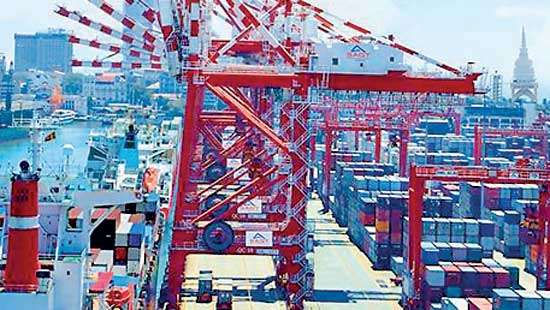
Several of the world’s largest container shipping lines have quietly begun exploring investments in Sri Lanka’s strategic port assets, signalling renewed international confidence in the island’s maritime sector while also highlighting growing regional competition for transshipment business.
Industry sources say Maersk, CMA CGM, MSC and COSCO have all expressed interest in acquiring stakes in either the East Container Terminal (ECT) at the Port of Colombo or Hambantota International Port. The development comes as international carriers increasingly seek direct ownership in key terminals to secure capacity and strengthen their global logistics networks.
The renewed interest follows a report by the Journal of Commerce (JOC), which claimed MSC was in advanced discussions with China Merchants Port Holdings (CMPort) and Sri Lankan authorities to acquire a significant stake in Hambantota International Port. CMPort currently owns 85 percent of Hambantota International Port Group, while the Sri Lanka Ports Authority (SLPA) retains the remaining 15 percent.
However, industry sources familiar with the discussions present a more cautious picture, saying MSC has not yet entered formal negotiations to purchase a stake in Hambantota. While the carrier’s interest is understood to be genuine, sources indicate the process remains exploratory rather than reaching the advanced stage suggested by international media reports.
Interest extends beyond Hambantota. Sources familiar with recent closed-door industry discussions said major shipping lines are also evaluating participation in the second phase of Colombo’s West Container Terminal (WCT-2), including the planned breakwater extension. CMA CGM recently toured the Port of Colombo as part of its assessment of potential investment opportunities.
WCT-2 represents one of Sri Lanka’s largest future infrastructure projects. The proposed development would extend the western breakwater into deeper waters while reclaiming up to 70 hectares of land to construct a 1,200-1,400 metre quay capable of handling 3.5 million TEUs annually. Although detailed engineering is being financed by the Asian Development Bank, the final project cost remains uncertain, with comparable developments estimated at around US$700 million.
The reported interest comes as Colombo’s existing terminals move towards full capacity. The Adani-JKH-led West Container Terminal commenced commercial operations in April 2025 and remains ahead of schedule for full completion by late 2026. In contrast, the ECT has endured years of delays after construction stalled following its initial phase in 2015, with work only resuming in 2022 amid recurring operational interruptions.
Despite the differing construction timelines, both terminals are expected to become fully operational by the end of 2026, each capable of handling approximately three million TEUs annually.
Industry analysts believe the growing attention from global shipping lines reflects Sri Lanka’s continuing strategic importance along the East-West shipping corridor. However, they caution that investment decisions will ultimately depend on the government’s ability to provide policy certainty and timely project execution. Delays or indecision, they warn, could encourage shipping companies to redirect investment towards competing regional hubs that are moving faster to expand capacity.