
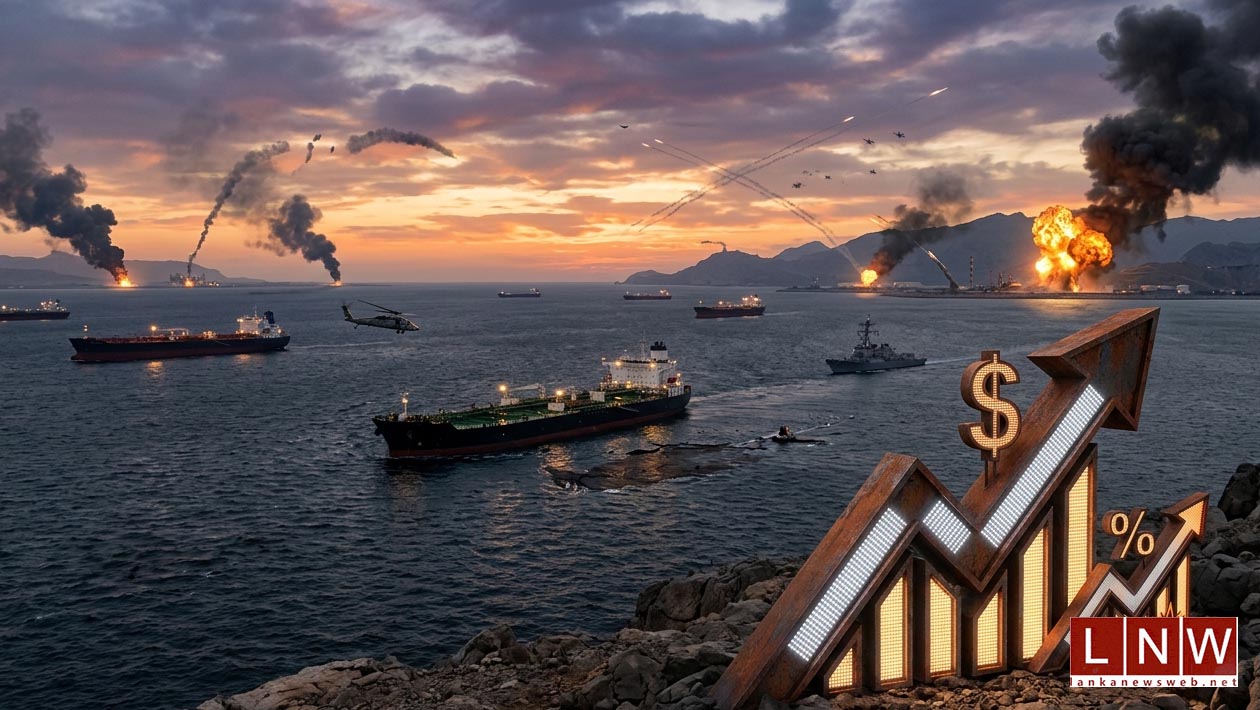
July 13, World (LNW): Global oil prices climbed sharply on Monday as renewed military exchanges between the United States and Iran heightened concerns over the security of shipping through the Strait of Hormuz, one of the world’s most important energy transit routes.
Brent crude rose by more than four per cent to trade at US$79.11 a barrel in early trading, while US West Texas Intermediate (WTI) crude also gained just over four per cent to reach US$74.36 a barrel. The latest increase reflects growing unease among investors over the potential disruption to global oil supplies.
The price rally followed a fresh round of US military strikes on Iranian targets. According to US Central Command, American forces carried out precision attacks on multiple locations across Iran on Sunday. In response, Iran’s Islamic Revolutionary Guard Corps said it had launched attacks on US military installations in Kuwait and Bahrain, signalling a further escalation in hostilities.
The strategic Strait of Hormuz remains at the centre of the crisis. Although US President Donald Trump stated that the waterway remains open to commercial shipping, Iranian authorities have maintained that they closed the passage after intercepting a vessel they claimed had deviated from an authorised route.
The uncertainty has already affected maritime traffic. Ship-tracking data indicated that only six vessels passed through the Strait on Sunday, the lowest daily figure recorded in five weeks. Before the conflict intensified in late February, around one-fifth of the world’s oil and liquefied natural gas exports moved through the narrow waterway, making any disruption a significant concern for global energy markets.
The latest military developments have also cast fresh doubt over the future of the interim agreement reached between Washington and Tehran last month, which had been intended to reduce tensions, restore safe navigation through the Strait and create space for further negotiations aimed at ending the conflict.
Despite an increase in global oil production during June following the agreement, supply remains well below levels recorded before the outbreak of the war, according to the International Energy Agency, highlighting the continuing impact of the conflict on energy markets.
Market analysts said investors are closely monitoring developments, with some suggesting the latest exchange of strikes represents a serious deterioration in relations, while others believe the conflict has not yet reached a point where the ceasefire framework has completely collapsed. Even so, traders warned that any prolonged disruption to shipping in the Strait of Hormuz could trigger further volatility in global oil prices in the days ahead.