
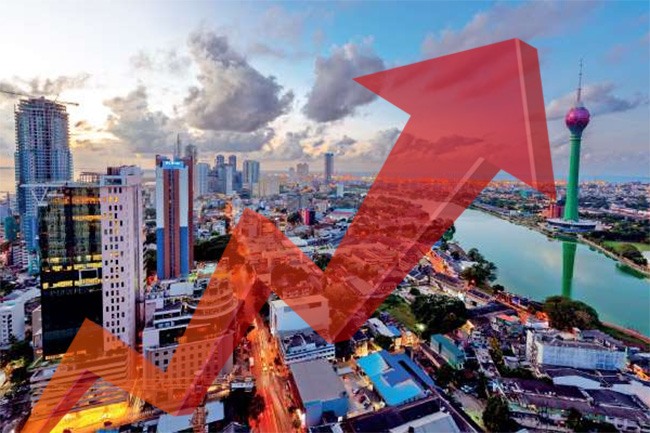
Sri Lanka’s construction industry is increasingly depending on Government-led infrastructure and reconstruction projects to sustain activity, as higher material prices, expensive borrowing and sluggish retail demand threaten to weaken the private-sector foundation of the recovery.
CT Smith Securities’ analysis of Central Bank of Sri Lanka data indicates that construction remains one of the fastest-expanding sectors, with real GDP growth of 16.3% in the first quarter and 13.9% in the second. The construction PMI New Orders Index also continued expanding through July, supported by a steady inflow of new projects.
However, the headline growth figures conceal a widening divide between public infrastructure activity and private-sector demand.
Herath said expressway mobilisation, road rehabilitation, cyclone rebuilding and renewable-energy projects should support construction during the second half of the year. Yet he expects overall growth to moderate, with many private projects taking time to adjust to sharply higher construction costs.
The execution of public investment has become a critical factor. CT Smith Securities’ note on Tokyo Cement said only about one-fifth of the Government’s Rs. 1.4 trillion capital expenditure allocation had been used during the first half of the year, although utilisation had reached approximately 28% by end-July. A larger share is expected to be spent in the second half, but full utilisation remains unlikely.
This under-execution creates a structural weakness. Public capital allocations may continue to rise, but delays in procurement and implementation prevent the construction industry from receiving the full benefit of planned spending when it is needed.
Herath noted that capital expenditure rose 32% year-on-year between January and July, indicating that fiscal pressures alone do not explain the slow implementation. Procurement and project execution bottlenecks remain significant obstacles.
The consequences are visible across construction-related companies. CT Smith Securities said Tokyo Cement was seeing early signs of softness in retail demand, with bulk cement purchases rising to 14% of sales in the first quarter of FY27 from 12% a year earlier. The shift suggests that large projects are becoming more important while household and smaller retail purchases remain subdued.
Input costs are also climbing due to higher raw-material import costs, currency depreciation and global supply-chain disruptions. Fuel and transport expenses have added further pressure, although these costs are expected to moderate over the medium term.
The cable industry faces similar challenges. In its ACL Cables note, CT Smith Securities identified slower construction credit and higher borrowing costs as headwinds for cable demand. The company raised selling prices in the June quarter for the first time in about two years to recover higher copper and input costs, meaning revenue growth was driven mainly by pricing rather than volumes.
Copper prices remain above $14,000 a tonne, with current input costs estimated to be about 14% higher than the levels at which first-quarter margins were earned.
Nevertheless, institutional demand provides some protection. National grid upgrades, including capacity enhancements to Colombo’s transmission and distribution network and the Kerawalapitiya Port second underground transmission cable project, are expected to cushion the slowdown.
The broader warning is that public infrastructure can sustain construction activity, but cannot fully replace a healthy private investment cycle. Unless borrowing costs ease, material prices stabilise and capital expenditure execution improves, Sri Lanka’s construction recovery may increasingly reflect Government mobilisation rather than broad-based economic expansion.