
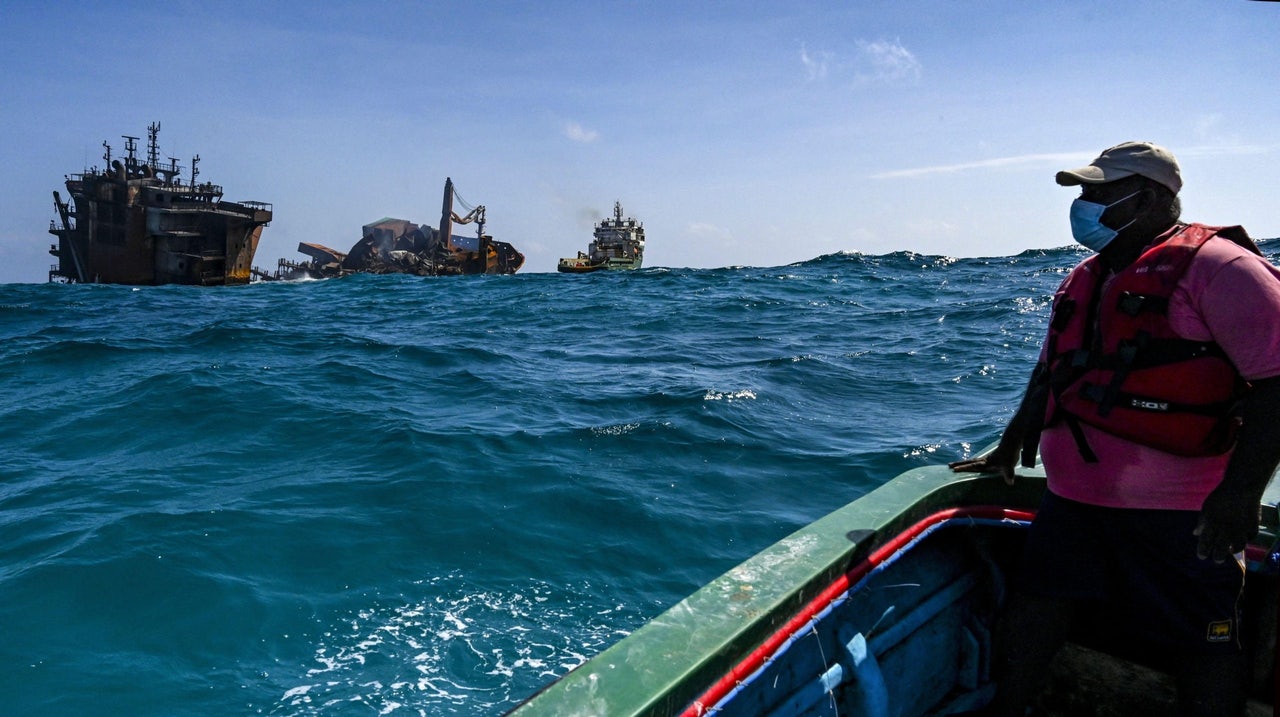
The MV X-Press Pearl compensation saga has developed into a complex legal and institutional controversy, with the failure to recover almost the entire US$1 billion court-ordered payment now accompanied by allegations concerning the conduct of subsequent Supreme Court proceedings.
The latest development came in September 2026 when the Medical and Civil Rights Professional Association of Doctors lodged a complaint with the Commission to Investigate Allegations of Bribery or Corruption against three Supreme Court judges.
The complaint alleges that proceedings concerning enforcement of the compensation order ultimately resulted in approximately US$999 million remaining unrecovered. These are allegations contained in the complaint and have not been independently established; no finding of wrongdoing against the judges has been made.
According to the complaint, the Supreme Court’s July 2025 judgment required the first US$250 million payment by September 2025. Only about US$1 million was subsequently paid. Petitioners had sought action over alleged non-compliance, while the matter was later considered by a three-member bench in January 2026.
The complaint further questions the composition of that later bench and alleges that Justice Yasantha Kodagoda, who had been associated with the original proceedings, was excluded without a lawful explanation. It also challenges the January 26, 2026 proceedings and their consequences for the recovery process.
Separately, an important institutional issue concerns the Compensation Commission created by the Supreme Court.
The Court had appointed retired Supreme Court Justice E.A.G.R. Amarasekera as Chairman and established a mechanism involving MEPA, the Coast Conservation Authority, relevant ministries, the Attorney General’s Department and independent specialists in marine environment, coastal environment, fisheries, marine biology and environmental law.
Its mandate was extensive: assess actual environmental harm, identify victims, quantify losses and determine compensation, with payments ultimately made through the Secretary to the Treasury. The judgment also required transparency and accountability and placed auditing responsibility with the Auditor General.
That structure makes the present dispute over the handling of earlier payments particularly significant.
Dr Ajantha Perera has alleged that MEPA obtained money directly from the shipping company and its insurer for purposes including plastic-pellet collection, while fishermen subsequently complained that they had not received money allegedly intended for them.
The Supreme Court record shows that fisheries compensation had already been paid before the 2025 judgment, with Rs.3.07 billion recorded as received for direct and indirect fisheries claims.
Consequently, three separate accountability questions now converge: the recovery of the court-ordered US$1 billion, the accounting of money already received, and the legality of institutional dealings with the polluter and its insurers.
Until the Treasury, MEPA, Attorney General’s Department and relevant legal authorities provide a complete, reconciled account, the X-Press Pearl compensation saga will remain as much a transparency crisis as an environmental one.