
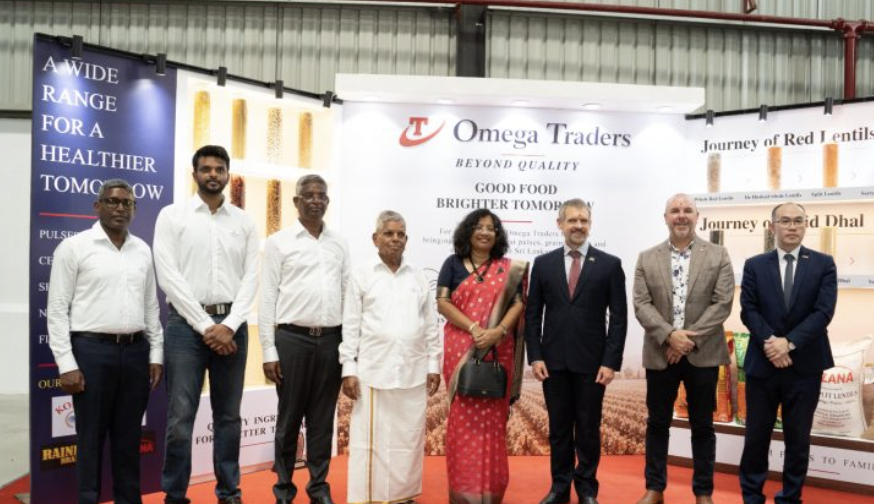
The inauguration of Omega Traders’ new dhal-processing facility in Wattala has opened a wider question for Sri Lanka’s food economy: how much value can the country capture from commodities it must continue importing?
Sri Lanka remains heavily dependent on imported lentils and other pulses. Central Bank agricultural data show that dhal imports increased from 163,881 metric tonnes in 2024 to 180,225 tonnes in 2025, before declining during the first two months of 2026. The January-February 2026 volume was 32,295 tonnes, compared with 35,135 tonnes in the same period of 2025.
The foreign-exchange implications are significant, although official statistics do not publish one consolidated annual dollar figure for dhal alone in the cited Central Bank tables. Dhal is grouped with lentils, onions, potatoes, leguminous products and other vegetables. That entire import category was valued at around US$300 million in both 2024 and 2025.
Australia occupies an important position in this supply chain. The Sri Lanka Export Development Board lists lentils among the principal products Sri Lanka imports from Australia. In 2024, Sri Lanka imported US$194.47 million worth of goods from Australia, with lentils identified as the leading import product. By 2025, total imports from Australia had risen to about US$222 million.
This makes the new Omega Traders facility economically significant because it places domestic manufacturing between the international supplier and Sri Lankan consumer.
The factory adds 150 metric tonnes of processing capacity per eight-hour day. Its modern machinery is designed for cleaning, sorting and processing dhal, while advanced colour-sorting equipment and an in-house laboratory strengthen quality control.
That capacity can help Sri Lanka retain a greater portion of the economic value generated after the commodity enters the country.
The investment also represents an important experiment in combining two supply chains.
The first is the established international supply chain, particularly Australian agricultural production, which provides imported lentils. The second is a proposed domestic agricultural chain based on Sri Lankan-grown black matpe, which Omega Traders intends to process for its Orid Dhal operation.
That second element could prove particularly important.
If local farmers can supply increasing quantities of suitable black matpe, the factory could become a link between domestic agriculture and modern food manufacturing. Farmers would gain an industrial buyer, while the processor would obtain locally produced raw material. Consumers would receive a locally processed product, and a greater share of the value created could circulate within Sri Lanka.
Australian High Commissioner Matthew Duckworth highlighted precisely this complementary relationship, arguing that agricultural production in Australia and processing capabilities in Sri Lanka can work together through an integrated supply chain.
The project also marks Omega Traders’ 45th year in Sri Lanka’s food commodity industry and expands its manufacturing footprint.
The wider economic effects could include jobs, transport, warehousing, packaging, distribution, maintenance, laboratory services and demand for agricultural inputs.
However, the investment should not be portrayed as an immediate solution to Sri Lanka’s foreign-exchange problem. Imported lentils will still require foreign currency. The measurable benefit comes from processing more of that imported commodity domestically and potentially replacing some imported raw material through local agricultural production.
The strategic challenge for Sri Lanka is therefore clear: transform unavoidable food imports into stronger domestic value chains, while simultaneously expanding local pulse production.
If the Omega Traders model succeeds in connecting Australian supply with Sri Lankan processing and farmers, the new facility could become more than a dhal factory—it could demonstrate how an import-dependent food sector can gradually build domestic value addition.