
By: Staff Writer
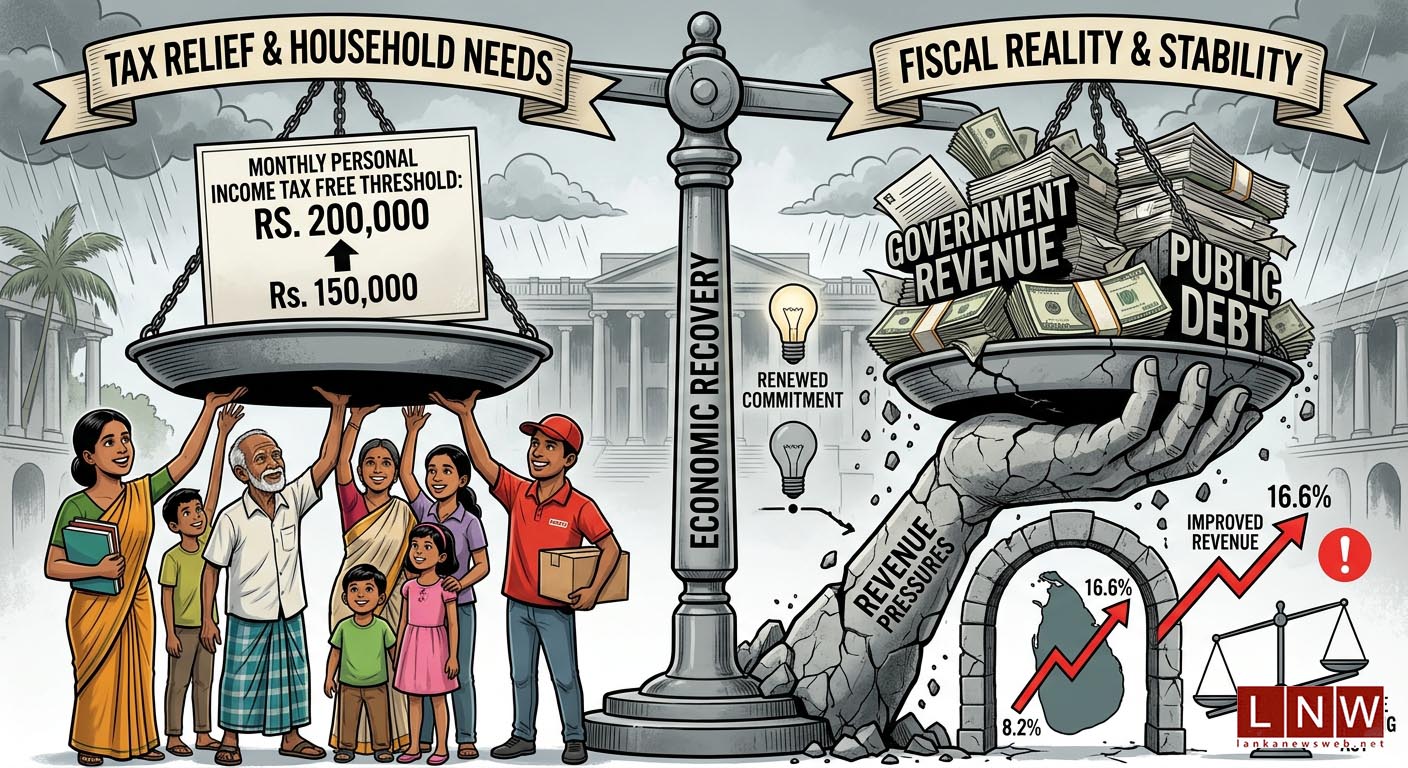
September 28, Colombo (LNW): The Government’s renewed commitment to raise Sri Lanka’s monthly personal income tax-free threshold to Rs.200,000 has revived the debate over whether tax relief can be delivered without undermining the country’s fragile fiscal recovery.
Economic Development Deputy Minister Nishantha Jayaweera told Parliament that the Government remains committed to implementing the increase, which was originally promised in its election manifesto. The announcement followed President and Finance Minister Anura Kumara Dissanayake’s pledge at a public rally that the 2027 Budget would provide tax relief.
The Government has already increased the monthly tax-free threshold from Rs.100,000 to Rs.150,000, equivalent to Rs.1.8 million annually. It has also adjusted tax bands applying to income above the threshold. The proposed Rs.200,000 threshold would therefore represent a significant further reduction in the tax burden on salaried and other individual taxpayers.
The immediate political attraction is clear. Higher take-home income could provide relief to middle-income households struggling with the rising cost of living. It could also strengthen disposable income, potentially supporting consumption and domestic demand.
However, the fiscal implications are considerably more complicated.
Government revenue has improved dramatically, rising from 8.2% of GDP in 2022 to 16.6% in 2025. That improvement has been central to Sri Lanka’s post-crisis fiscal consolidation. But the country continues to carry a heavy public-debt burden and has limited fiscal space.
The Institute of Policy Studies has therefore warned against moving too quickly towards tax reductions. Its assessment is particularly significant because Sri Lanka’s tax structure remains heavily dependent on indirect taxation, with direct taxes accounting for only 40% compared with 60% for indirect taxes.
A higher personal income-tax threshold could reduce direct-tax collections unless the lost revenue is compensated by bringing more taxpayers into the system.
That is precisely where the Government’s broader strategy becomes critical. Deputy Minister Jayaweera says tax rates should eventually be reduced while simultaneously broadening the tax base and improving compliance.
The potential danger is that the first part could be implemented faster than the second.
Sri Lanka still faces uneven tax compliance, a large informal economy, exemptions and difficulties in effectively taxing self-employed and high-income groups. If these weaknesses remain unresolved, tax relief could widen the fiscal gap and increase pressure on consumption taxes, which already disproportionately affect ordinary households.
The IPS has consequently argued that further tax-rate increases are undesirable, but tax cuts are also premature under present conditions.
The Government therefore faces a delicate balancing act. Raising the threshold to Rs.200,000 could fulfil an important election promise and provide genuine household relief. But unless tax administration, compliance and the tax base are strengthened simultaneously, the measure could weaken the very revenue foundation needed to sustain economic recovery.
The real test will not be whether the Government delivers tax relief, but whether it can finance that relief without reopening Sri Lanka’s fiscal vulnerabilities.