
By: Staff Writer
September 28, Colombo (LNW): Sri Lanka’s anti-corruption and law-enforcement campaign cannot be separated from the country’s growing battle against organised narcotics trafficking. The 5th Director General-level talks between the narcotics control agencies of India and Sri Lanka, held in Colombo on September 23, have therefore assumed significance beyond a routine bilateral security meeting.
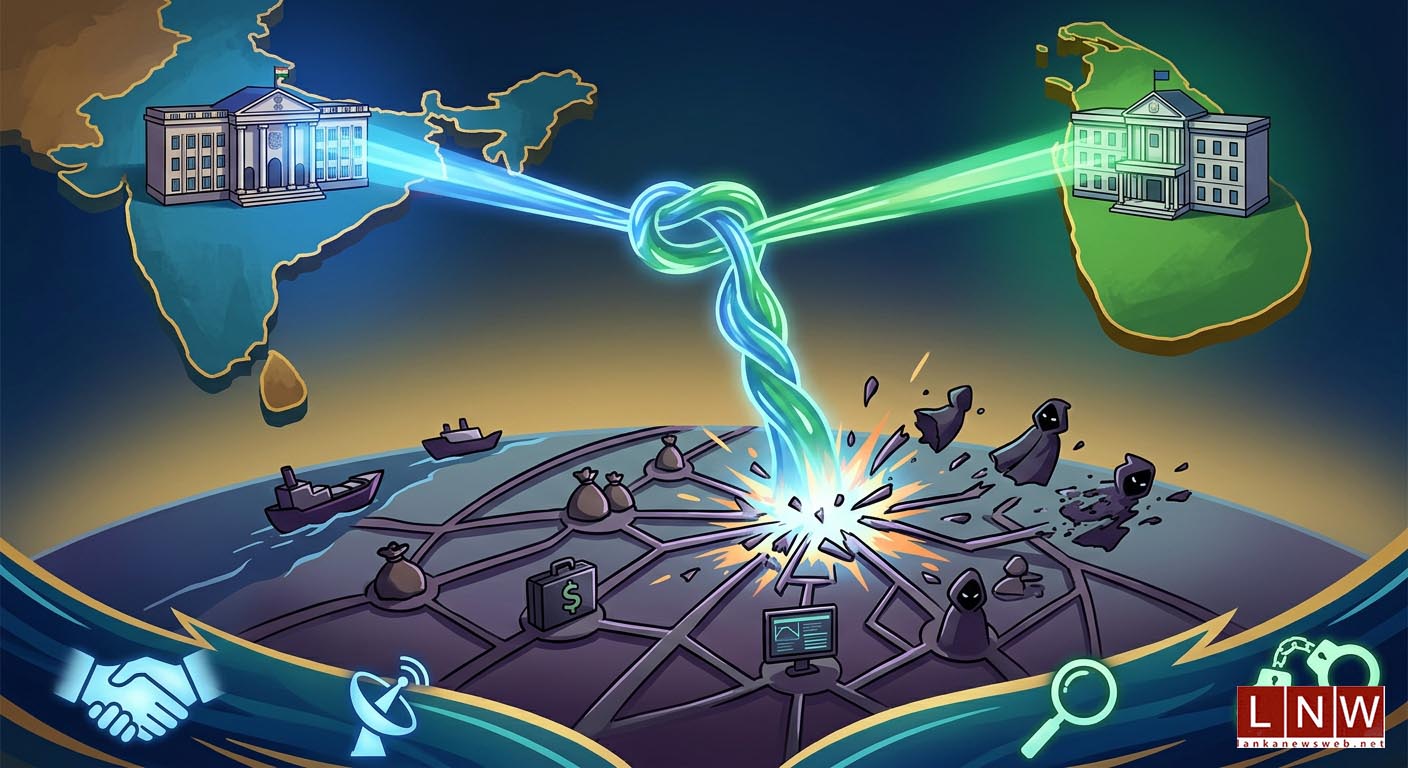
The discussions underline a fundamental reality: drug trafficking has become an increasingly sophisticated transnational business, using maritime routes, criminal networks, financial channels and cross-border connections that cannot be effectively dismantled by one country acting alone.
The talks followed renewed emphasis on bilateral security cooperation during Indian Prime Minister Narendra Modi’s state visit to Sri Lanka in April 2025, particularly on combating illicit drug trafficking. Their importance was reinforced when President Anura Kumara Dissanayake recently sought India’s fullest support in combating narcotics trafficking in the Indian Ocean region during his September 9 meeting in Colombo with Indian Defence Minister Rajnath Singh.
The composition of the delegations demonstrates the breadth of the challenge. India’s delegation was headed by Narcotics Control Bureau Deputy Director General R. Sudhakar and included officials from the Tamil Nadu Police, Indian Coast Guard and Ministry of External Affairs. Sri Lanka’s delegation, led by Police PNB DIG K.D.G.L. Ashoka Dharamasena, brought together representatives from the Attorney General’s Department, Customs, Coast Guard, Government Analyst Department, Special Task Force, Navy, National Dangerous Drugs Control Board, Financial Intelligence Unit and other agencies.
This wide institutional representation is particularly important because narcotics trafficking is not merely a policing problem. It involves criminal intelligence, maritime surveillance, forensic analysis, prosecution, financial investigations and international cooperation.
The talks reviewed emerging trafficking patterns, particularly the use of maritime routes. Both sides also discussed methods of tracing organised criminals and improving operational coordination in intelligence gathering and investigations. Significantly, actionable intelligence concerning trafficking operators, routes and mechanisms was exchanged.
That intelligence-sharing component could become one of the most important pillars of Sri Lanka’s anti-corruption and organised-crime drive. Drug networks thrive where information remains fragmented between agencies. A trafficker intercepted at sea may be only one component of a wider organisation involving financiers, distributors, facilitators and corrupt intermediaries.
Sri Lanka therefore needs to ensure that intelligence received from India is translated into prosecutions and financial investigations rather than remaining confined to operational briefings. The Financial Intelligence Unit’s participation is particularly significant because following the money can expose the wider architecture behind narcotics trafficking.
India’s geographical proximity, particularly through Tamil Nadu and the surrounding maritime region, makes cooperation indispensable. At the same time, Sri Lanka must strengthen its own institutional capacity to prevent its territory and ports from becoming transit points for regional criminal networks.
The agreement to deepen institutional cooperation provides an opportunity to create a sustained intelligence-to-prosecution mechanism. Its success, however, will ultimately be measured not by the number of meetings held, but by arrests, asset seizures, successful prosecutions and the dismantling of entire trafficking networks.