
By: Staff Writer
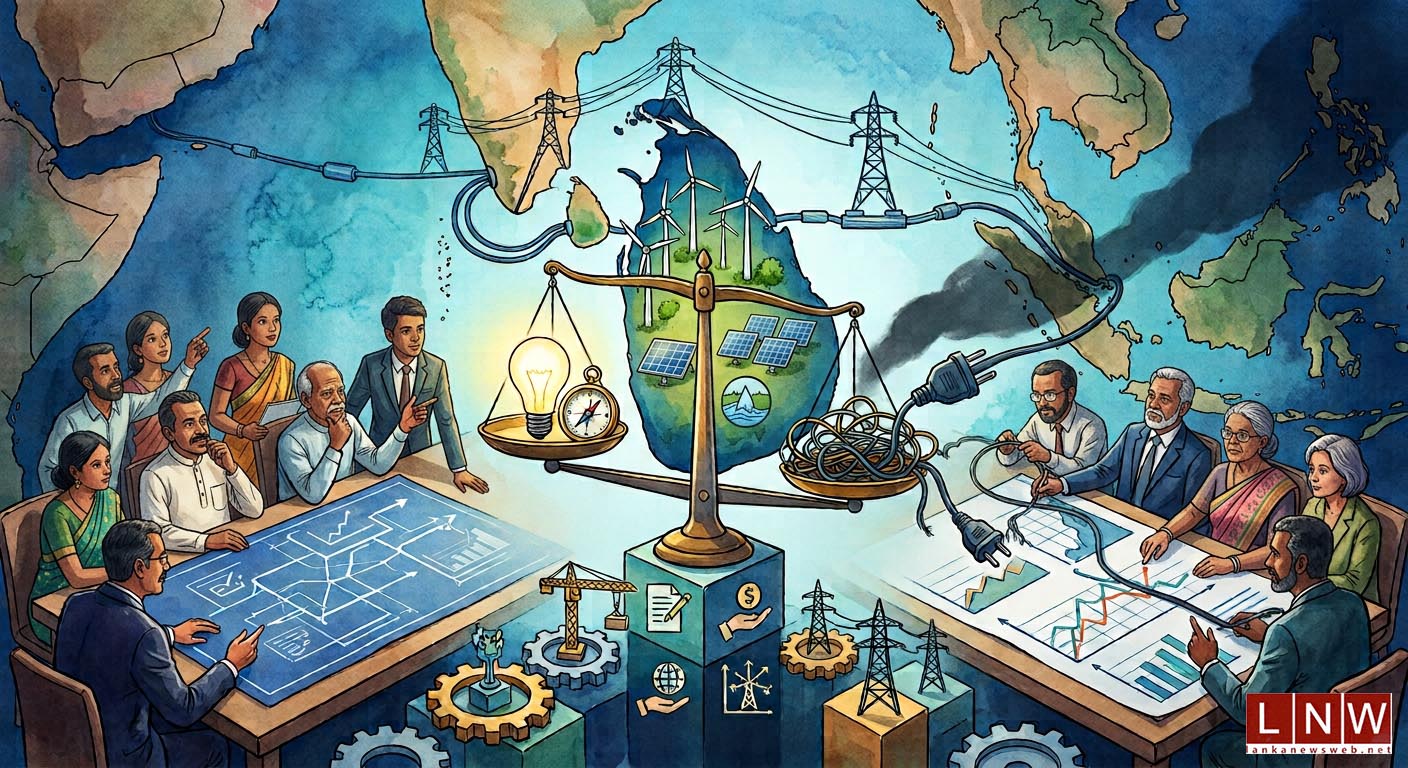
September 28, Colombo (LNW): Sri Lanka’s entry into wider regional electricity connectivity discussions opens an opportunity to rethink the country’s traditional approach to energy security. But beneath the promise of cheaper, cleaner and more reliable electricity lies a critical policy dilemma: regional integration could either strengthen Sri Lanka’s power system or gradually make it dependent on external electricity supplies.
The proposed ADB-backed Pan-Asia Power Grid Initiative seeks to create a much broader electricity trading architecture connecting South Asia towards Southeast Asia. Sri Lanka and India are participating in the discussions, even though their own bilateral grid interconnection project has faced years of technical and economic uncertainty.
The attraction is understandable.
Sri Lanka has a relatively small electricity system compared with India and other potential regional partners. A connected grid could theoretically allow the country to obtain electricity when domestic generation is insufficient and sell surplus power when renewable generation is abundant.
This becomes increasingly relevant as Sri Lanka expands solar, wind and other renewable energy sources. Renewable generation is inherently variable. A regional electricity market could potentially provide an outlet for excess generation while supplying power when domestic renewable output falls.
However, this benefit depends on infrastructure that Sri Lanka has yet to establish at the necessary scale.
The India connection itself demonstrates the problem. Feasibility studies identified submarine cable and HVDC costs as significant obstacles to financial and economic viability. Any regional system would therefore have to overcome not merely engineering challenges but the fundamental question of whether cross-border electricity transactions would generate sufficient economic value to justify enormous capital expenditure.
There is another danger: building transmission capacity before establishing a viable electricity market.
A regional grid requires predictable rules governing who buys electricity, who sells it, how prices are determined and who pays for transmission. Without transparent market mechanisms, Sri Lanka could find itself purchasing electricity under conditions it cannot influence.
Institutional readiness therefore becomes just as important as physical infrastructure.
Sri Lanka would need an independent and technically capable system operator, transparent procurement mechanisms, strong transmission planning and regulatory arrangements capable of dealing with foreign counterparties. Cross-border electricity contracts would also need safeguards against excessive dependence on a single supplier.
The country’s future renewable-energy ambitions make the issue even more complicated. If large quantities of solar and wind power are connected to the national system, transmission bottlenecks could emerge unless grid strengthening and storage develop simultaneously.
Regional interconnection cannot compensate for weaknesses within Sri Lanka’s domestic grid.
There is also a strategic question about energy sovereignty. Electricity imports can provide valuable insurance against domestic shortages, but continuous dependence could discourage investment in domestic generation, storage and transmission. The objective should therefore be to use regional connectivity as a balancing mechanism rather than as a substitute for domestic energy planning.
The Government has not yet taken a final policy decision on joining the proposed regional network. That creates an opportunity to establish the rules before commitments become irreversible.
Sri Lanka should demand detailed studies covering costs, demand projections, system stability, cybersecurity, emergency disconnection, foreign-exchange exposure and import dependency.
The regional grid could become a major pillar of Sri Lanka’s future energy security. But the real test will be whether connectivity creates strategic flexibility or simply a new form of dependency.