
By: A Special Correspondent
October 03, Colombo (LNW): Five years after the X-Press Pearl disaster, Sri Lanka should have been able to point to a transformed marine environmental regulator, innovative and thought leading, applying lessons learned to be best in class.
There has been limited progress. MEPA can point to new procedures, more training and greater attention to hazardous substances. Worthwhile improvements, but at best they amount to incremental change rather than the kind of substantive institutional reform that their handling of the incident should have triggered.
The harder questions exposed by X-Press Pearl remain.
In 2021, MEPA was without question out of its depth, not an opinion formed in the heat of the disaster, but one supported by the Supreme Court’s cold findings four years later.
The Court found that MEPA had failed to respond efficaciously, failed to comply with its statutory duties, missed opportunities to step in, issued inadequate directions, failed properly to reassess the developing emergency and failed to make proper use of the Authority’s collective decision-making structure. The Court also found that MEPA and its then Chairperson had infringed rights protected by Article 12(1).
Those findings should have produced an institutional reckoning, indeed change should have happened long before the Supreme Court gave its view.
But it did not.
The Chairperson in office during the disaster remained until her term expired in 2023. In the intervening period, no published MEPA review set out who failed, why the failures occurred, what internal decisions were wrong and which governance structures were dismantled or redesigned as a consequence.
Leadership instability then continued. By March 2025, incoming chairman Samantha Gunasekara acknowledged that MEPA had been without a chairman for about six months, that work had been held up and that key vacancies remained.
Given Chairman Gunasekera had been on the MEPA Board since 2022, that appointment itself looks far from institutional renewal. It looks like continuity with a few modifications.
The bigger failure, however, is scientific.
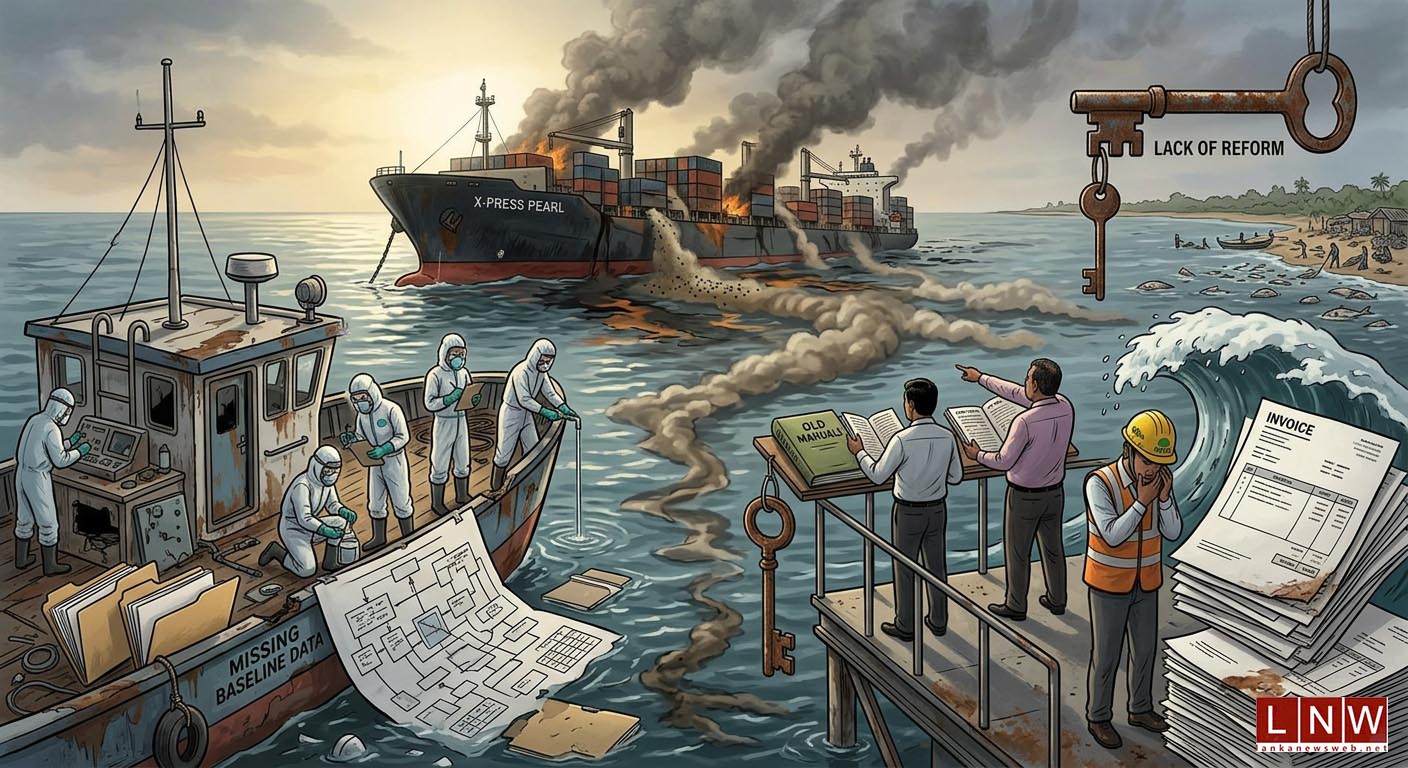
X-Press Pearl exposed a fundamental weakness in Sri Lanka’s ability to measure environmental damage; inadequate pre-incident baseline data.
Without reliable baseline data, a regulator cannot confidently say how much of an observed environmental condition existed before an incident, how much changed afterwards, or how much of that change can properly be attributed to a particular event.
That matters enormously when billions of dollars of environmental damage are alleged.
Instead of the incident becoming the trigger for a permanent, rigorous monitoring system, the opportunity appears to have been squandered.
An expert committee created after the disaster did plan for long-term monitoring. Yet its co-chair, Professor Prashanthi Gunawardene, said in 2025 that the committee had not been convened since November 2022 and that the intended long-term monitoring was still needed.
That should be one of the most troubling facts in the entire X-Press Pearl story.
Sri Lanka suffered a serious marine incident. It discovered that the scientific baseline needed to assess impact was weak. It then came up with a process capable of improving that evidence base — and allowed it to stall. When the MSC Elsa 3 incident occurred last year the ability to assess and attribute became even more complicated and confused.
The consequence is now visible in the debate over MEPA’s damage assessments.
Dr Amelia Wenger’s independent review of MEPA’s Second Interim Environmental Damage Assessment identified significant methodological weaknesses and discrepancies between conclusions and the scientific sources relied upon — methodological weaknesses and discrepancies identified in MEPA’s assessment.
One of the clearest and perhaps most shocking examples concerned reactive nitrogen.
MEPA used an assumption that 60 per cent of reactive nitrogen was deposited into the environment, while the scientific paper cited in support of the analysis gave a figure of less than a third of that.
Wenger also identified the extraordinary inconsistency of an assessment stating that no oil-spill response had been deployed while compensation was nevertheless claimed for oil-spill response costs. She questioned the transfer of economic assumptions from the Baltic Sea to Sri Lankan waters and wider weaknesses in environmental valuation.
These go beyond minor drafting issues, raising questions about methodology, causation, valuation and reliability.
Of course, the Supreme Court did not have Wenger’s independent and external assessment before it, and that matters.
The judgment was necessarily based on the evidential material placed before the Court, which did not include Wenger’s subsequent independent assessment. It had to decide the case on what was before it.
An expert critique of the kind later produced by Wenger been available — questioning assumptions, methodologies and calculations used by MEPA — might have provided the Court with additional material against which to assess the methodology.
Public discussion largely focused on the scale of the compensation, with comparatively less attention given to the judgment’s findings concerning MEPA.
The story became how much would be paid, with much less attention given to the finding that the regulator itself had failed.
The compensation order was not in any way judicial certification of every scientific methodology used by MEPA. The Court necessarily determined the matter on the evidential record before it, and perhaps Wenger’s subsequent work demonstrates precisely why independent expert scrutiny matters so much.
Parliament had already reached a similarly uncomfortable conclusion about the wider environmental protection system. A Select Committee found significant shortcomings in legal and regulatory frameworks, preparedness and coordination, and concluded that the X-Press Pearl had exposed critical gaps in Sri Lanka’s ability to manage maritime pollution incidents.
That report is perhaps the clearest evidence that any reforms in response to X-Press Pearl have at best been incremental rather than transformative. Three years after the disaster, Parliament was still calling for the type of command structures, regulatory oversight, scientific capacity and coordination mechanisms that a genuine post-crisis reform programme should already have delivered.
So what, exactly, has been learned? MEPA can perhaps point to training, new operating procedures and revised contingency arrangements.
But where is the accountability review and the continuous national marine baseline programme?
Where is the sustained long-term expert monitoring and the evidence that scientific assessments are now independently stress-tested before they become the basis of billion-dollar claims?
Where is the confidence that the governance failures identified by the Supreme Court wont simply happen again?
X-Press Pearl gave MEPA the hardest possible opportunity to learn. It exposed weaknesses in emergency response, governance, scientific capability and institutional preparedness in a way no internal review perhaps ever could.
Five years later, there is a strong case that the opportunity continues to be missed.
MEPA was found by the Supreme Court to have failed in significant respects in 2021. The uncomfortable question in 2026 is whether, beneath some new procedures and operational tweaks, the Authority has fully addressed those weaknesses.