
By: A Special Correspondent
July 26, Colombo (LNW): When an environmental disaster occurs in sovereign waters, public grief, ecological disruption, and economic strain create an immediate demand for accountability. The primary objective of the state, civil society, and affected communities is identical: to secure swift, full, and enforceable financial restitution to remediate destroyed ecosystems and compensate those whose livelihoods have been disrupted.
However, translating a devastating loss into actual financial compensation requires a clear distinction between symbolic legal victories and practical asset recovery. In cross-border maritime law, the forum where a lawsuit is filed often determines whether a financial award is actually collected or remains a theoretical victory on paper.
Understanding why pursuing primary civil litigation in an international commercial hub like Singapore serves a state’s long-term economic and environmental interests requires examining cross-border asset execution, global maritime insurance protocols, and forum-selection strategy.
1. The Myth of the Local Judgment vs. The Reality of Asset Execution
The central debate in major maritime disasters often centers on statutory liability caps. Domestic legal frameworks—such as specific admiralty jurisdiction statutes—frequently allow coastal states to claim unlimited liability against vessel owners, bypassing global treaties like the 1976 Convention on Limitation of Liability for Maritime Claims (LLMC).
While claiming unlimited damages in a domestic court provides a strong moral and legal foundation, it faces a fundamental operational challenge: jurisdictional reach over international assets.
- The Asset Disconnect: The vast majority of modern commercial vessels are owned, chartered, and operated by complex, multi-tiered corporate structures registered in major global maritime jurisdictions. If these parent companies, charterers, and corporate entities maintain no physical or capital assets within the coastal state’s territory, a domestic judgment cannot be automatically executed.
- The Enforcement Gauntlet: To collect money awarded by a local court, the state must take that judgment to the courts of the country where the shipowner’s money, property, or parent entities actually reside. Defense lawyers can then challenge the judgment in those foreign courts on grounds of:
- Lack of personal or corporate jurisdiction over the foreign entity.
- Incompatibility with international convention limits recognised in the enforcing state.
- Procedural challenges regarding how evidence and notice were served across borders.
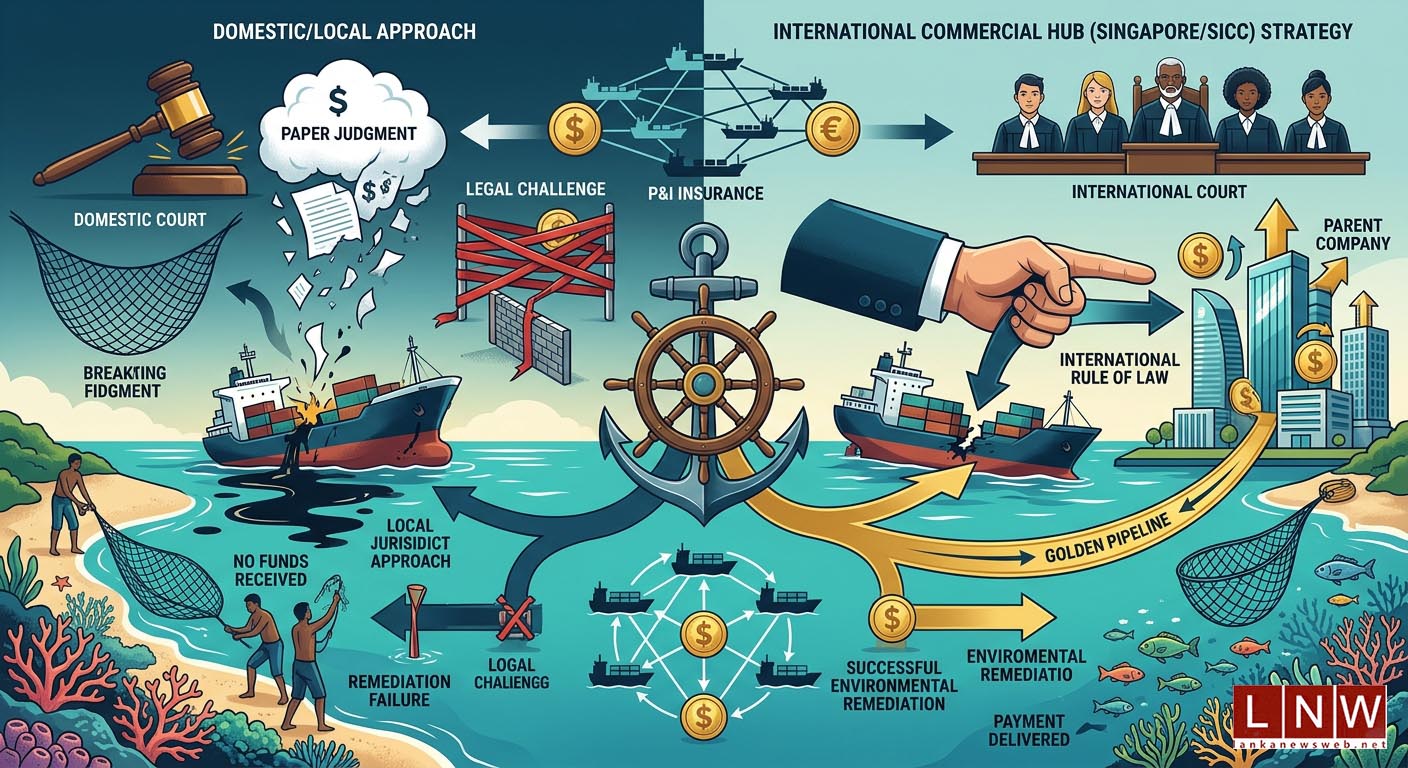
- The “Paper Judgment” Trap: This legal friction often results in a “paper judgment”—a legally valid award issued by a national court that cannot be converted into liquid cash because foreign execution courts grant stays or refuse recognition. Affected communities receive zero financial support while decades pass in appeal courts abroad.
2. P&I Clubs and the Realities of Global Maritime Insurance
Understanding how global shipping is financed and insured is essential for analysing international recovery strategies. Over 90 per cent of global ocean-going tonnage is insured by Protection and Indemnity (P&I) Clubs—mutual insurance associations composed of shipowners.
GLOBAL P&I INSURANCE FRAMEWORK
P&I Club Mutual Association
├── Underwrites vessel liabilities under strict international rules.
├── Enforces “Pay to be Paid” clauses and strict compliance with LLMC.
└── Challenges foreign judgments that bypass recognised commercial forums.
P&I Clubs do not operate like conventional consumer insurance companies; they adhere strictly to established international maritime law and contractual terms:
- Strict Adherence to Limitation Conventions: P&I Club rules bind insurers to payout caps aligned with global conventions (e.g., LLMC Tonnage Limits). If a domestic court awards damages that vastly exceed these international tonnage limits without binding the insurer within a recognised commercial jurisdiction, the P&I Club is legally structured to resist direct execution.
- The “Pay to Be Paid” Principle: Under traditional maritime law, a P&I Club is only obligated to indemnify a shipowner after the shipowner has paid the claim. If a single-purpose vessel owner (a “one-ship company”) goes bankrupt due to a massive domestic judgment, the insurer may argue that its indemnity obligation never arises, leaving the claimant state with no recourse against the insurer’s billions in capital reserves.
- Direct Commercial Binding: By litigating within a major international commercial court that holds direct jurisdiction over both the shipowner’s corporate parent and the underlying commercial contracts, the claimant state brings the insurers into a forum where procedural manoeuvers to deny coverage are significantly curtailed.
3. Why the Singapore International Commercial Court (SICC) Represents Strategic Alignment
Choosing an international venue like the Singapore International Commercial Court (SICC) is not a concession of legal standing; it is a calculated operational choice that leverages specialised judicial architecture designed specifically for global shipping disputes.
Key Strategic Advantages of the SICC Framework
| Dimension | Domestic Admiralty Court | Singapore International Commercial Court (SICC) |
| Jurisdictional Reach | Limited primarily to territorial waters and local assets. | Direct jurisdiction over primary corporate headquarters and global charterers. |
| Asset Execution | Requires secondary, contested enforcement proceedings abroad. | Direct execution against assets held within a top-tier international financial hub. |
| Insurance Integration | Vulnerable to P&I Club coverage-denial strategies based on forum validity. | Binds primary commercial operators directly within an internationally recognised framework. |
| Procedural Efficiency | Subject to potential backlog and cross-border service challenges. | Streamlined discovery, specialised international judges, and fast-track commercial resolution. |
- Eliminating Secondary Enforcement: When a judgment is handed down by the SICC against Singapore-registered entities, execution is immediate. The state does not need to file a second lawsuit in another country to freeze bank accounts, attach corporate assets, or enforce payments.
- Neutrality and Unappealable Authority: Defence counsel frequently attempt to challenge domestic court decisions in international arenas by raising procedural objections. Litigating in a globally recognised, neutral commercial forum neutralises these defense tactics, leaving the shipowners and insurers with no credible grounds to claim procedural unfairness or delay execution.
- Specialised Technical Expertise: Complex maritime environmental disasters involve intricate chemistry, multi-layered charter party contracts, salvage logs, and complex oceanographic data. Specialised commercial forums possess dedicated evidentiary frameworks designed to evaluate expert scientific testimony efficiently without getting bogged down in years of preliminary procedural disputes.
4. Pragmatism in Sovereign Environmental Recovery
True environmental justice is measured by funds delivered to restore ecosystems, clear coastlines, and support fishing families—not by the size of an uncollectible number on a court document.
In high-stakes international maritime disputes, venue selection is a tool of statecraft. By aligning legal strategy with the mechanics of global asset location, corporate registration, and maritime insurance, a nation shifts from reactive litigation to strategic enforcement. Choosing a forum with direct leverage over responsible parties remains the most practical path to ensuring that international shipping entities meet their financial obligations in full.