
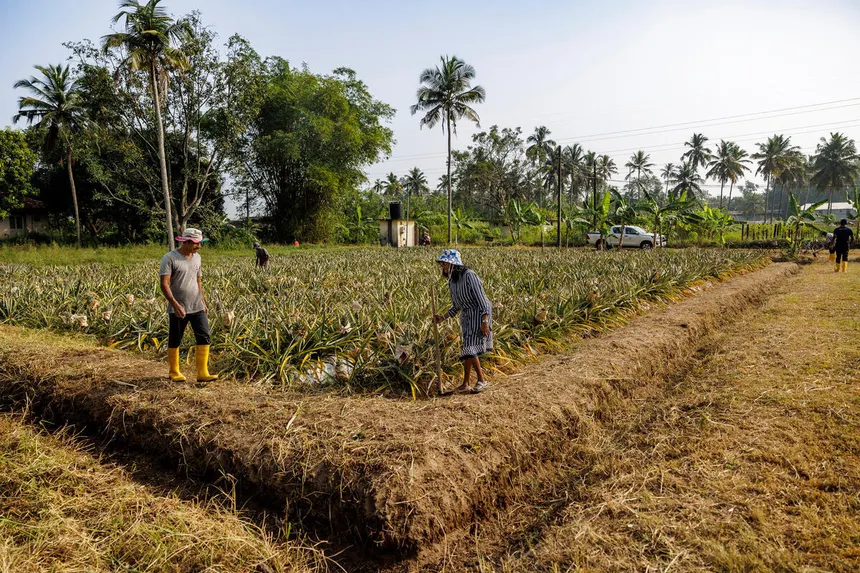
November 12, Colombo (LNW): The Government has unveiled an ambitious commercial agriculture initiative to bring 5,039 hectares of underutilised land into productive use through large-scale fruit cultivation, with the ultimate aim of expanding Sri Lanka’s presence in international agricultural markets.
The programme, launched under the second phase of the Mahaweli Water Security Investment Programme, is designed to convert previously neglected upland areas into commercially viable agricultural zones while promoting environmentally sustainable farming practices.
According to the Ministry of Agriculture, Livestock, Land and Irrigation, the project will prioritise fruits with export potential, including mangoes, guavas, bananas, papayas and passion fruit. The rehabilitation of minor irrigation tanks will also form part of the initiative, helping to improve water availability for cultivation.
Implementation arrangements and the proposed development activities were discussed at meetings held in Anuradhapura on Wednesday (11), with Minister of Agriculture, Livestock, Land and Irrigation K.D. Lal Kantha participating in the discussions.
The meetings, conducted at the National Institute of Post-Harvest Management and the C Bank premises in Anuradhapura, brought together relevant stakeholders to examine the project’s implementation framework and the steps required to develop the identified agricultural lands.
A key feature of the programme is its emphasis on providing farmers with opportunities to earn income before newly planted fruit trees reach commercial maturity. To address this initial period, growers will be encouraged to cultivate additional crops such as chillies, groundnuts, watermelons, green gram and sesame between fruit trees.
This intercropping approach is expected to help farmers maintain a regular source of income while making productive use of available land during the early stages of orchard development.
Water management is another central component of the project. The newly developed agricultural areas are expected to receive water through solar-powered, demand-based pressurised pipe distribution systems. The arrangement is intended to improve irrigation efficiency, reduce unnecessary water consumption and support more climate-conscious agricultural practices.
Until the North Central Province Main Canal Project is completed, the Commercial Agriculture Development (CAD) programme will depend on existing water resources within selected minor tank systems to facilitate upland cultivation.
In addition to developing new agricultural areas, the programme is expected to upgrade approximately 2,000 hectares of existing commercial farmland. These improvements are intended to modernise cultivation practices, enhance production standards and improve the overall quality of agricultural output.
The initiative represents an effort to move beyond traditional cultivation methods by linking land development, irrigation improvements and export-oriented production within a coordinated agricultural strategy.
The Ministry expects the programme to strengthen productivity and improve the competitiveness of locally produced fruit in overseas markets. Its longer-term success, however, will depend on effective water management, access to suitable agricultural inputs, farmer participation and the ability to meet international quality and market requirements.
By bringing unused land into commercial production while modernising existing farms, the Government aims to create a stronger agricultural base capable of generating higher incomes for farmers and contributing more substantially to Sri Lanka’s export earnings.