
By: Isuru Parakrama
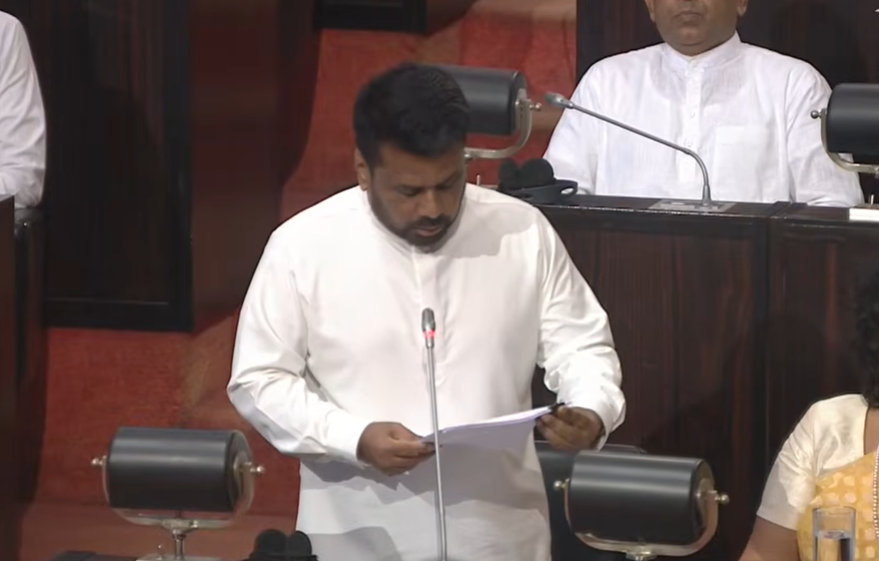
November 12, Colombo (LNW): President Anura Kumara Dissanayake, in his capacity as Minister of Finance, Planning and Economic Development, presented Sri Lanka’s 2027 Budget in Parliament today (12), framing it as a shift from economic stabilisation to expansion, investment and transformative development.
The Budget carries Rs. 2 trillion in capital allocations, with the government targeting sustained 7 per cent annual economic growth.
The Appropriation Bill for 2027 was first read on October 07, while Prime Minister Dr. Harini Amarasuriya presented it again today before the President began the Second Reading speech at about 1.40 p.m. The Second Reading debate runs from November 13 to November 20, with the vote scheduled for 6:00 p.m. on November 20.
The Committee Stage debate will run for 19 days, from November 21 to December 14. The Third Reading vote is scheduled for 6:00 p.m. on December 14. The Cabinet approved the proposals before presentation, and this is the NPP government’s third Budget and Sri Lanka’s 81st Budget Speech.
Fiscal and debt position
The President said the government will maintain a primary surplus of 2.3 per cent of GDP while keeping the overall deficit at 5 per cent. Government expenditure is projected at 13.6 per cent of GDP, with public investment at 4 per cent.
He said public debt is expected to fall to 87 per cent of GDP by 2032, better than the earlier IMF-programme target of 95 per cent. The government also said it has sufficient liquidity to meet foreign-debt obligations over the next two years, with debt-service needs projected at $2.986 billion in 2027 and $3.674 billion in 2028.
A committee has been appointed to assess Sri Lanka’s future engagement with the IMF after the current Extended Fund Facility ends in March 2027, including whether a successor arrangement is needed.
Infrastructure and connectivity
The Budget allocates a record Rs. 487 billion for roads and railways. Major proposals include Rs. 30 billion for the Kurunegala–Galewela section of the Kurunegala–Dambulla Expressway and an additional Rs. 27 billion for the Ruwanpura Expressway, whose construction is to begin on December 01.
Other transport measures include:
- Rs. 10.63 billion for rural bridge development and reconstruction.
- Flyovers at the Kandy Multimodal Transport Centre access road, Alawwa and Muththettugala.
- Expansion of Bandaranaike International Airport to handle a projected 16 million passengers by 2032, plus a new Rs. 400 million car park and an Rs. 800 million domestic terminal.
- Rs. 6 billion to rehabilitate and extend Ratmalana Airport’s runway from 1,400 metres to 1,771 metres.
- Public-private investment proposals for 29 of 61 tanks at the Trincomalee Petroleum Terminal.
Energy, climate and industry
The government allocated Rs. 26.5 billion to strengthen the national power grid and improve resilience against nationwide outages. It also plans a 30 MW battery-storage system at Norochcholai and floating solar projects with a combined potential of 500 MW.
Rooftop-solar households installing battery storage will receive Rs. 25,000 per kilowatt, up to Rs. 250,000 for systems of up to 10 kW, under a Rs. 3.5 billion scheme. The 10 per cent Port and Airport Development Levy on imported solar batteries will be removed.
Fuel-security measures include a Rs. 22.34 billion jet-fuel pipeline from Muthurajawela to Bandaranaike International Airport, storage capacity for 45 days of supply, and a Rs. 16.33 billion Kolonnawa-to-harbour pipeline project intended to cut unloading time from 96 to 48 hours.
Digital economy and innovation
The Budget allocates Rs. 28.5 billion for digital transformation, described as Sri Lanka’s largest-ever digital-sector allocation. This includes Rs. 10 billion for digital startups and new ventures, plus a Rs. 10 billion Digital Entrepreneurship Fund.
Other measures include:
- Broadband access for 750,000 selected students.
- Removal of taxes on new communication towers for five years to expand rural broadband by 2030.
- A Digital Economy Authority, Digital Economy Council, Digital Economy Act and Cyber Security Authority planned for 2027.
- An AI Excellence Centre at Wijerama Mawatha.
- GovPay and QR-based payment systems to promote cashless transactions.
Jobs, enterprise and trade
A Rs. 5 billion Samurdhi-bank loan scheme will support rural entrepreneurs at a 4 per cent concessionary interest rate, provided they employ at least five Aswesuma beneficiaries. A separate Rs. 12.5 billion programme will offer women-led households group loans of up to Rs. 1 million at 3 per cent interest.
The government also announced an interest-free loan scheme for fisheries, Rs. 7.5 billion for home-stay tourism, and concessional loans of up to Rs. 2 million at 3 per cent for eligible home-stay operators.
On trade and investment, the President announced a special incentives package, a National Single Trade Window with Rs. 1.99 billion allocated, and a National Single Investment Window with Rs. 100 million allocated. Sri Lanka will also pursue expansion of its India free-trade agreement and explore a new agreement with China.
Education and welfare
Teacher-training allowances will rise from Rs. 10,500 to Rs. 20,000 monthly from April 2027, while Dhamma-school teachers’ annual payment will increase from Rs. 7,500 to Rs. 12,500. Students at private universities will continue receiving interest-free state-bank loans, with their monthly allowance rising from Rs. 6,250 to Rs. 10,000 from April 2027.
Education reforms for Grades 2 and 6 are to begin next year. The Budget also provides Rs. 750 million to renovate universities affected by Cyclone Ditwah, including Peradeniya, and Rs. 2.05 billion for staff housing at the University of Vavuniya.
Disaster-relief context
The speech also addressed the Rs. 500 billion supplementary estimate presented to fund disaster recovery and economic revival, with total provisions exceeding Rs. 700 billion. The President said the additional spending will not increase the Rs. 3.74 trillion debt ceiling.
Relief measures include Rs. 25,000 for eligible households to clean and restore homes, Rs. 50,000 monthly for three months from January for 17,648 affected households, and Rs. 25,000 rental support for displaced families. Farmers will receive Rs. 150,000 per hectare for cereal crops and Rs. 200,000 per hectare for selected vegetable crops, while livestock, poultry and fisheries support packages were also announced.
Parliament will now debate the Budget from tomorrow, with the first major test coming at the Second Reading vote on November 20. The final vote is due on December 14.