
By: A Special Correspondent
November 16, Colombo (LNW): Five years after the MV X-Press Pearl disaster, the legal dispute surrounding the vessel has evolved into a complex confrontation involving environmental accountability, international maritime law, scientific evidence and the limits of national judicial authority. While Sri Lanka continues to pursue compensation following a landmark Supreme Court judgment, questions concerning the assessment of environmental damage, the legal basis of the award and the country’s approach to international litigation remain central to the dispute.
The latest developments have once again brought the matter into public discussion. On November 07, 2026, the Centre for Environmental Justice (CEJ) sent a 14-day letter of demand to Attorney General Parinda Ranasinghe Jr., requesting an explanation of the steps taken to implement the Supreme Court’s directions arising from the disaster. The organisation has warned that it may pursue further legal remedies, including contempt proceedings, if it considers the response inadequate.
The intervention is significant, but it also highlights a broader issue: the need to distinguish between the Court’s findings concerning the conduct of Sri Lankan public authorities and the separate questions of civil liability, compensation and enforcement involving the vessel’s owners, former operators and insurers.
These matters are interconnected, but they are not legally interchangeable.
The Supreme Court’s judgment of July 24, 2025 found that the Attorney General’s failure to initiate criminal proceedings against the vessel’s owners and operators, and the decision to pursue civil proceedings in Singapore rather than before the Sri Lankan High Court exercising Admiralty jurisdiction, violated the fundamental rights guaranteed under Article 12(1) of the Constitution.
The Court also issued directions concerning further investigations, possible prosecutions and legislative reform.
However, the constitutional findings concerning the conduct of Sri Lankan authorities should not automatically be treated as a final determination of every disputed issue concerning the vessel’s liability, the scientific valuation of environmental losses or the application of international maritime conventions.
The distinction is particularly important when examining the arguments advanced by X-Press Feeders and the London P&I Club, the vessel’s former operator and protection and indemnity insurer respectively.
The question of proportionality
One of the most significant objections raised by the shipping interests and insurers concerns the scale and methodology of the compensation award.
Following the Supreme Court’s decision, X-Press Feeders and the London P&I Club stated that they could not make the initial payment required under the judgment while continuing to seek engagement with Sri Lankan authorities.
Their position is that the award raises questions concerning the scientific basis of the environmental damage assessment, the proportionality of the compensation and the potential interaction between the ruling and internationally recognised maritime liability arrangements.
The parties have also expressed concern that the judgment leaves open the possibility of further and potentially unlimited compensation obligations.
These arguments do not, by themselves, invalidate a judicial determination. Nevertheless, they raise questions that deserve examination through the appropriate legal processes.
Environmental compensation must be grounded in evidence capable of establishing the nature, extent and financial consequences of the damage. The seriousness of an environmental disaster does not remove the need for a transparent methodology, appropriate scientific assumptions and a defensible calculation of losses.
Equally, any assessment of the award must consider the Supreme Court’s actual findings and the legal reasoning supporting its decision, rather than treating the insurers’ objections as established facts.
The central question is whether the competing positions can be examined through a process that preserves the integrity of the judgment while allowing disputed scientific and legal issues to receive appropriate consideration.
The significance of the original litigation strategy
Another important dimension concerns the choice of jurisdiction for the original civil proceedings.
The decision to pursue proceedings in the Singapore International Commercial Court was initially defended by Sri Lankan legal representatives on grounds that included the location of the relevant corporate entities and the practical enforceability of a judgment.
The Supreme Court judgment itself records the arguments advanced by the Attorney General’s representatives. They maintained that the vessel’s owner and operator were based in Singapore and that pursuing a case in Sri Lanka could potentially produce a judgment that would be difficult to enforce against assets located overseas.
The Government’s legal representatives also argued that the Singapore forum offered a more realistic opportunity to recover damages from the relevant corporate parties.
These arguments form part of the Court’s recorded consideration of the matter. The Court ultimately found that the decision to pursue the proceedings in Singapore was unreasonable and violated fundamental rights.
That judicial finding must be respected. Nevertheless, the underlying enforcement question remains relevant to understanding the complexities of international maritime litigation.
A judgment obtained in one jurisdiction does not automatically guarantee recovery in another. The location of assets, applicable enforcement rules and the legal status of the parties can have significant consequences for the practical outcome of a case.
The issue is therefore not simply whether Sri Lanka should have pursued proceedings domestically or internationally. It is whether the country’s legal strategy adequately considered the relationship between jurisdiction, liability and enforceability.
The Supreme Court’s determination addressed the constitutional responsibility of the relevant public authorities. The wider international litigation continues to involve questions that require consideration under the applicable legal frameworks.
More than US$170 million in reported expenditure
An aspect that deserves greater attention in the public discussion is the expenditure that X-Press Feeders and the London P&I Club say they have already incurred following the disaster.
According to the companies’ published information, more than US$170 million has been spent on wreck removal, environmental remediation, coastal clean-up and compensation-related claims.
The companies state that these activities were undertaken in cooperation with Sri Lankan authorities and included the engagement of international expertise for salvage and environmental response operations.
Their information centre also reports that more than US$7.7 million was paid to the Sri Lankan Government for beach-cleaning activities.
These figures originate from the companies’ own reporting and should be independently reconciled with Government records. Nevertheless, they are relevant to any comprehensive examination of the financial response to the disaster.
They should not, however, be confused with payment of the US$1 billion ordered by the Supreme Court.
Expenditure on salvage, wreck removal, environmental remediation and individual compensation claims may have different legal classifications from the compensation imposed under the judgment. Whether particular payments can be credited against specific liabilities is a separate legal question.
A transparent assessment should therefore identify the expenditure, its recipients, the activities financed and its relationship, if any, to the liabilities established by the Court.
Ignoring these payments would provide an incomplete picture of the response. Treating them as automatic satisfaction of the Supreme Court’s award would be equally inaccurate.
International maritime law cannot be ignored
The dispute also raises important questions about the relationship between domestic environmental law and international maritime liability arrangements.
The London P&I Club has argued that the compensation ordered by the Supreme Court exceeds internationally recognised maritime liability limits and could have implications extending beyond the immediate dispute.
Its position is that compensation arising from maritime incidents should be assessed within the applicable international legal framework, including the relevant conventions and limitation provisions.
The applicability and effect of those provisions must ultimately be determined by the competent courts. They cannot simply be assumed to provide an automatic exemption from liability.
At the same time, international maritime conventions exist partly to establish predictable legal standards for an industry operating across national boundaries. Their purpose and application deserve proper consideration rather than being dismissed merely because a major environmental disaster has occurred.
The challenge for Sri Lanka is to pursue environmental accountability while ensuring that its legal position is supported by the applicable international rules.
For the shipping industry, the corresponding responsibility is to ensure that legitimate liability protections do not become a means of avoiding established obligations or denying appropriate remedies to communities affected by environmental damage.
Neither objective should be sacrificed.
Settlement discussions and the need for clarity
The dispute has also entered a period of renewed engagement between the parties.
Representatives of the insurers’ legal team reportedly visited Sri Lanka on September 29, 2026 and held discussions with senior Government officials, including representatives of the Treasury and the Attorney General’s Department.
According to reporting by The Morning, the discussions concerned the implementation of the Supreme Court judgment and other matters connected with the compensation process.
The negotiations have prompted criticism from environmental lawyer Dr Ravindranath Dabare, who questioned whether the parties could negotiate the manner of compliance when the Supreme Court had already specified its directions.
His concern deserves consideration, particularly in relation to the separation of powers and the authority of judicial decisions.
However, the existence of negotiations does not automatically establish that the judgment is being undermined. Discussions may concern practical arrangements, the resolution of outstanding claims or the settlement of parallel proceedings.
The precise terms and legal implications of the discussions have not been comprehensively disclosed.
The Government should therefore explain the scope of the negotiations, the legal authority under which they are conducted and whether any proposed settlement would require further judicial approval.
The insurers, in turn, should be expected to explain the basis of any proposed financial arrangement, including how it addresses the liabilities and obligations arising from the judgment.
A negotiated resolution should not be judged simply by whether it produces a quick payment. Its legality, financial value, enforceability and consequences for the affected communities must all be considered.
The environmental consequences remain beyond dispute in principle
None of the legal and financial disagreements should obscure the environmental consequences of the disaster.
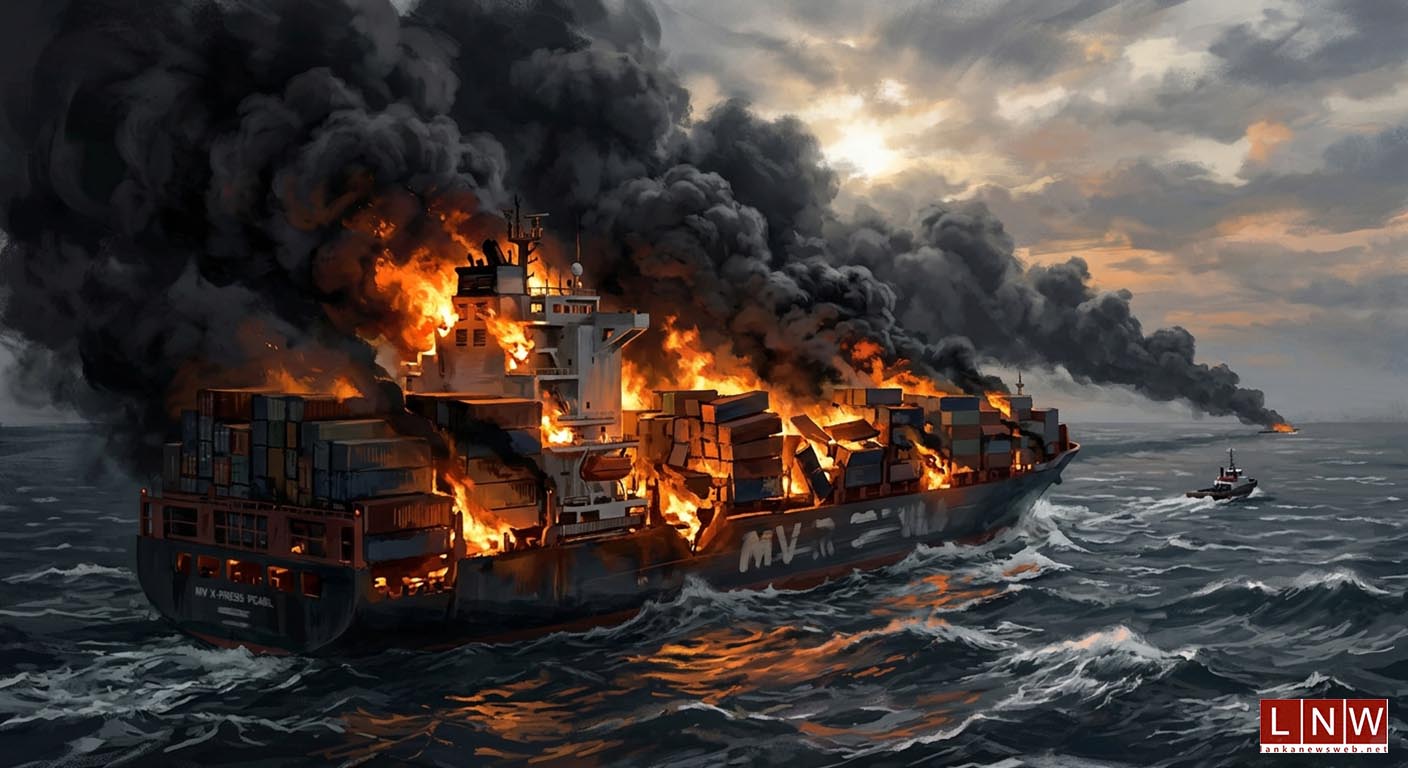
The X-Press Pearl released plastic nurdles and other pollutants into Sri Lankan waters, affecting coastal ecosystems and fishing communities. The vessel’s sinking created a major marine pollution incident, and the consequences required extensive emergency and clean-up operations.
The continued presence of plastic pellets along parts of the coastline has also generated concern.
However, determining the origin of individual pellets recovered years after the incident requires scientific investigation. Not every pellet found on a beach can automatically be attributed to the X-Press Pearl, particularly where other nurdle spills may have occurred.
This is an important distinction between acknowledging the established environmental consequences of the disaster and attributing every subsequent pollution finding to a particular source.
Independent scientific monitoring, transparent sampling and reliable environmental records are necessary to establish the extent of continuing contamination.
The same standards of evidence should apply to all parties involved in the dispute.
A need for accountability on both sides
The latest CEJ intervention has renewed attention on whether the Attorney General’s Department has adequately implemented the Supreme Court’s directions.
The organisation alleges that several investigative and administrative requirements remain insufficiently addressed and has requested a detailed explanation within 14 days of receipt of its letter.
Those concerns deserve a substantive response. If the Court’s directions have not been implemented, the responsible authorities should explain the reasons and identify the steps required to achieve compliance.
At the same time, public discussion should distinguish between the obligations of Sri Lankan institutions and the separate legal responsibilities of the shipping interests and insurers.
The Attorney General’s conduct, the Government’s choice of litigation strategy, the scientific basis of the compensation assessment and the defendants’ legal obligations are different questions requiring independent examination.
A fair process cannot selectively scrutinise one side while treating the other as beyond examination.
The Government should publish accurate information about compensation received, expenditure incurred, outstanding claims and the status of enforcement proceedings. The companies should provide verifiable information concerning their reported US$170 million expenditure and clarify their position on the judgment and any proposed settlement.
Such disclosure would allow the public to assess the competing claims on the basis of evidence rather than political statements or selective reporting.
The wider implications for maritime accountability
The X-Press Pearl dispute is important not only because of the scale of the environmental damage but also because of the precedent it may establish for future maritime incidents.
A system that disregards the environmental consequences of international shipping would be inadequate. Equally, a system in which financial liability is determined without sufficiently transparent scientific evidence or consideration of applicable international law would create uncertainty for all participants in maritime commerce.
Sri Lanka has a legitimate interest in securing appropriate compensation and protecting its marine environment. International shipping companies and insurers have legitimate interests in the consistent application of legal standards, access to due process and the protection of rights available under applicable conventions.
These interests are not necessarily incompatible.
The challenge is to establish a resolution that recognises environmental responsibility while respecting the legal principles governing international maritime operations.
The X-Press Pearl case should therefore not be reduced to a contest in which one side must necessarily be portrayed as entirely right and the other entirely wrong.
The Supreme Court’s judgment must be implemented in accordance with the law. The objections advanced by the defendants must be addressed through appropriate legal processes. The Government must account for its decisions, and the environmental and economic consequences experienced by Sri Lankan communities must remain central to the recovery effort.
Ultimately, the credibility of the entire process will depend on whether the parties can move beyond competing public narratives and establish a transparent, evidence-based and legally sustainable outcome.
For Sri Lanka, that means pursuing accountability without compromising the quality of its legal and scientific case. For the international shipping interests involved, it means engaging with the consequences of the disaster through a process that respects both environmental responsibilities and established legal protections.
The real test is whether the dispute can produce a resolution that is defensible not merely in political terms, but under the scrutiny of courts, scientific experts and the international maritime community.