
By: Staff Writer
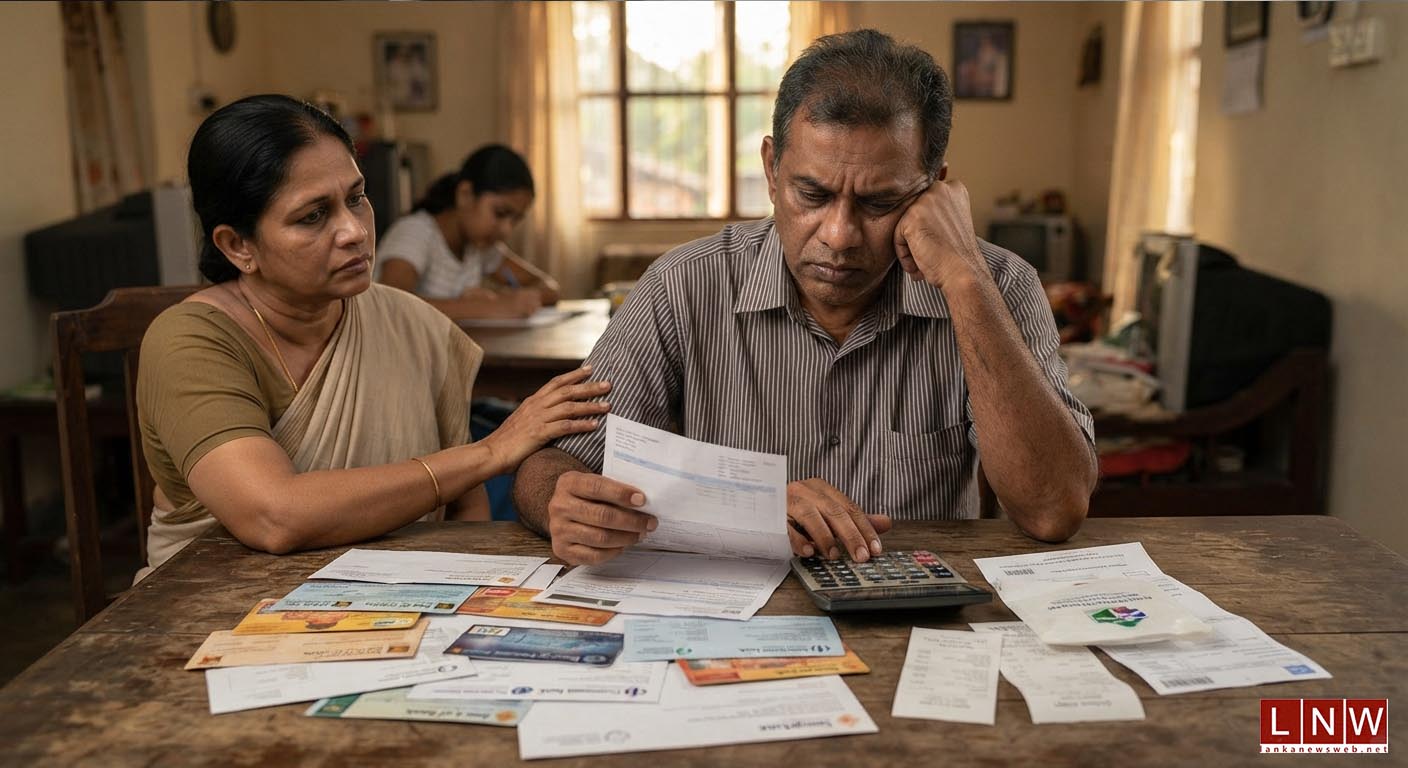
November 17, Colombo (LNW): Sri Lanka’s economic recovery is increasingly being overshadowed by a growing household financial crisis, as salaried professionals, pensioners and elderly citizens struggle to cope with mounting credit card liabilities. Behind the improving financial indicators and banking sector profitability, an alarming number of ordinary families are becoming trapped in a cycle of high-interest borrowing, minimum repayments and escalating penalties.
According to figures cited in the latest Central Bank of Sri Lanka (CBSL) statistics, the country had 2,319,794 active credit cards by the end of September 2026. The supplied data places outstanding credit card liabilities at approximately Rs. 215.04 billion. The number of active cards increased by 153,608 during the first nine months, representing 7.1% growth.
More concerning is the reported expansion of outstanding debt by Rs. 25.33 billion since December 2025, equivalent to 13.35%. If confirmed against the Central Bank’s September statistical release, this would indicate that credit card liabilities are increasing considerably faster than the number of active cards.
The implications extend beyond the banking sector. Credit cards, originally introduced as convenient payment instruments, are increasingly becoming emergency financing facilities for households struggling with food, medicine, electricity, transport and other essential expenses.
The situation is particularly difficult for middle-income employees whose disposable incomes have been reduced by taxation, increased living costs and years of economic instability. Retired public and private sector employees, whose pensions and savings have failed to keep pace with living expenses, are even more vulnerable.
The reported increase in standard annual credit card interest rates to 28%, following monetary policy tightening, adds another dimension to the problem. A borrower who cannot settle the monthly statement may find that a substantial proportion of subsequent payments goes towards interest and charges rather than reducing the original principal.
The danger is that a temporary cash-flow problem can develop into long-term financial distress. Borrowers who repeatedly pay only the minimum amount may remain indebted for years, even when they stop using their cards.
There is also a wider question concerning the responsibility of commercial banks. While banks have a legitimate right to recover money lent to customers, responsible lending requires institutions to assess repayment capacity, disclose the actual cost of borrowing and provide appropriate assistance when customers experience genuine financial difficulties.
The Central Bank’s Credit Card Guideline No. 01 of 2026 seeks to strengthen transparency, responsible issuance and consumer protection. Its implementation arrangements require system and process readiness by December 30, 2026, with the guideline taking effect on January 1, 2027.
However, regulatory improvements alone will not resolve the underlying household debt problem.
The Government and financial regulators must examine whether the rapid expansion of credit card liabilities reflects genuine consumption growth or the increasing dependence of households on expensive short-term credit to survive.
A comprehensive assessment of overdue balances, default rates, average debt per borrower and the proportion of pensioners and salaried workers affected is urgently required.
The real test of economic recovery is not simply the profitability of commercial banks or the expansion of consumer credit. It is whether ordinary citizens can meet their essential expenses without becoming permanently indebted.
Sri Lanka cannot claim a sustainable economic recovery while an increasing number of its working and retired citizens remain financially trapped.