
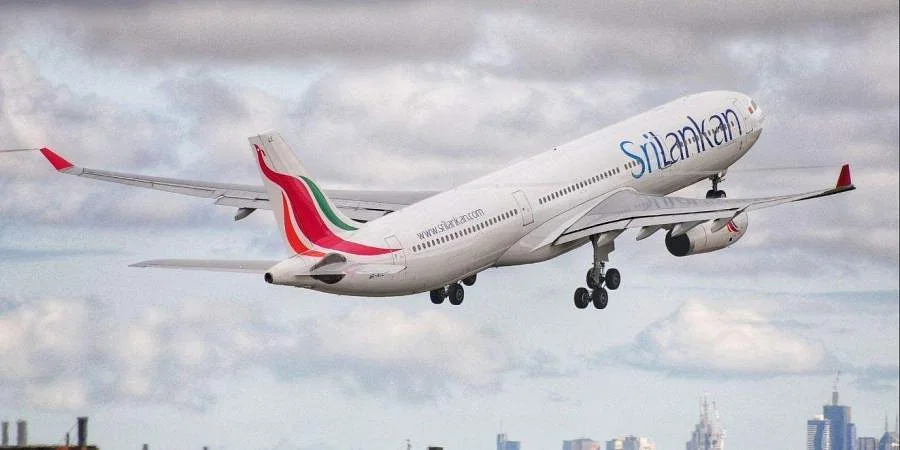
SriLankan Airlines is facing a fundamental financial dilemma as the Government acknowledges that its existing fleet of 23 aircraft is inadequate to generate sufficient revenue to settle the airline’s accumulated debt and interest, raising fresh questions about the sustainability of its present business model and the future direction of the national carrier.
While the airline managed to record an operational profit of US$4 million in 2025, the achievement has done little to resolve its deeper financial difficulties, with the Government conceding that operational profitability alone cannot rescue an airline carrying a substantial legacy debt burden.
Deputy Aviation Minister Janitha Ruwan Kodithuwakku, responding to Opposition MP Chaminda Wijesiri in Parliament on November 18, said the Government was examining SriLankan Airlines’ future by balancing commercial viability against its contribution to the national economy.
The minister’s admission that 23 aircraft were insufficient to repay accumulated debt and interest exposes the central weakness in the airline’s current financial position. An operational profit represents earnings from running the airline before the full burden of financing obligations is considered. Consequently, the ability to operate profitably does not necessarily translate into the capacity to repay loans, service interest or finance future expansion.
SriLankan Airlines must therefore confront two competing realities: its limited operational capacity and the enormous financial obligations inherited from previous years.
The airline’s performance has also been affected by the fuel crisis during recent months, which the Deputy Minister said had disrupted operations and undermined profitability. The Government nevertheless hopes that improved performance during the remainder of the year will enable the airline to end 2026 with at least a modest operational profit.
However, the more pressing question is whether marginal operational profits can provide a meaningful solution to a debt burden that continues to constrain the airline’s financial freedom.
Outstanding loans from the Bank of Ceylon and People’s Bank have been restructured under a five-year repayment arrangement involving semi-annual instalments. As at September 30, SriLankan Airlines owed US$118 million to the Bank of Ceylon and US$138 million to People’s Bank, bringing the combined outstanding balance to US$256 million.
Two instalments under the restructuring arrangement, in September 2025 and April 2026, have already been paid. The airline also maintains a US$70 million overdraft facility with the Bank of Ceylon, further highlighting its reliance on banking support.
The restructuring provides breathing space but does not eliminate the underlying debt. It merely spreads repayment obligations over a longer period, leaving the airline dependent on consistent cash flow, improved revenue and tighter financial discipline.
The Government has appointed a high-level committee to examine strategic options and restructuring possibilities. Its recommendations are expected to determine whether the airline should pursue expansion, operational restructuring, partnerships or other measures.
The challenge is no longer simply keeping SriLankan Airlines flying. It is finding a financially sustainable model capable of reducing debt, strengthening competitiveness and preventing the national carrier from remaining dependent on repeated financial concessions.