
By: Staff Writer
November 22, Colombo (LNW): Sri Lanka’s electricity tariff reductions have delivered relief to consumers, but the latest financial disclosures by the Ceylon Electricity Board suggest that the price adjustments may have created a growing financial imbalance between electricity revenue and the actual cost of supplying power.
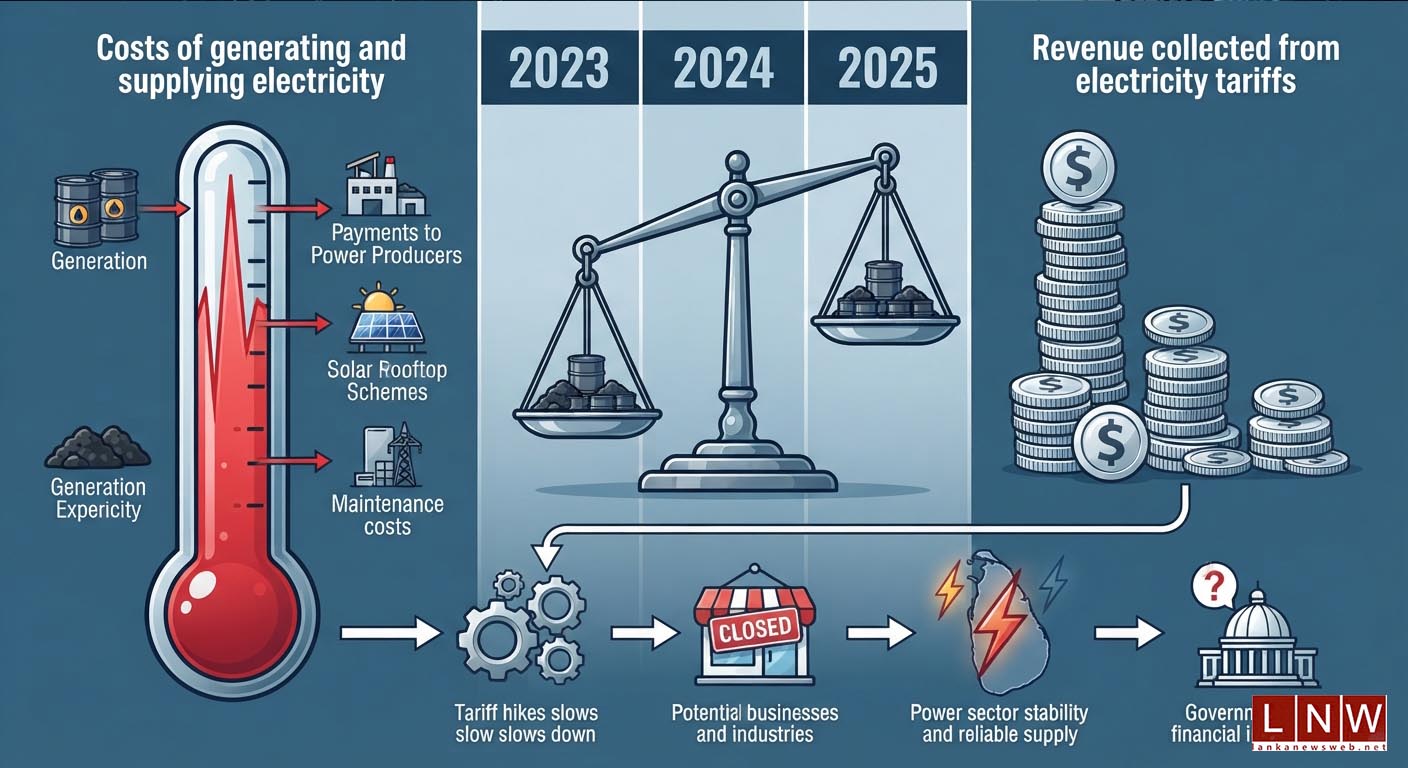
The CEB’s Rs. 38.7 billion loss in 2025, following profits of Rs. 141.6 billion in 2024 and Rs. 57.6 billion in 2023, raises serious questions about the sustainability of electricity pricing decisions and whether the country’s power sector is moving towards another round of financial correction through higher tariffs.
The tariff history illustrates the scale of the policy changes. Electricity prices were increased by 66.2% in 2023, followed by reductions of 14.5% and another 18%. In 2024, tariffs were reduced by 22% and subsequently by 22.5%. In 2025, another 20.8% reduction was followed by a 15% increase.
Such repeated adjustments demonstrate the difficulties of maintaining a stable electricity pricing policy in an economy where consumers remain sensitive to energy costs and the utility faces fluctuations in generation expenses, fuel prices, financing obligations and power purchases.
The Minister has acknowledged that electricity tariff reductions lowered the CEB’s revenue, while higher power purchase costs and payments to rooftop solar producers further increased financial pressure.
Although electricity sales increased in 2025 and financing costs declined, the benefits were insufficient to offset the revenue shortfall.
The consequences of a prolonged financial imbalance could be considerable. Electricity is a fundamental input for manufacturing, tourism, agriculture, transport-related services, commercial establishments and small businesses. Any sudden tariff increase could therefore translate into higher production costs, service charges and consumer prices.
For industries already struggling with taxation, borrowing costs, imported raw materials and weak purchasing power, another electricity tariff adjustment could undermine competitiveness and discourage investment.
The absence of Treasury funding to the CEB during 2024 and 2025 also deserves attention. While the Government avoided directly financing the utility during those years, the institution’s deteriorating financial position raises the question of whether future losses could eventually create pressure for public financial intervention.
In 2023, the Treasury provided Rs. 126.3 billion as an additional investment to cover payments owed by the CEB to the Ceylon Petroleum Corporation, illustrating how electricity sector financial problems can spill over into other state institutions.
The central issue is whether the Government can maintain lower electricity prices while simultaneously improving operational efficiency, reducing expensive generation, managing power purchases and strengthening financial discipline.
Without structural improvements, tariff reductions may offer temporary relief but could ultimately be followed by corrective increases that impose a heavier burden on consumers.
Sri Lanka’s electricity policy therefore requires more than periodic price revisions. It needs a transparent long-term framework that protects consumers while ensuring the CEB remains financially viable.