
By: Staff Writer
November 22, Colombo (LNW): Sri Lanka’s foreign exchange regulatory system has come under serious scrutiny following the discovery of a large-scale scheme in which individuals allegedly transferred millions of dollars overseas through fictitious import advance payments without importing the goods for which the payments were supposedly made. The revelations have exposed significant weaknesses in financial monitoring, inter-agency coordination and enforcement of foreign exchange regulations.
The investigation by the Central Bank of Sri Lanka and the police has uncovered how individuals repeatedly exploited a facility permitting importers to remit advance payments of up to US$50,000 through commercial banks. Under the earlier regulations issued by the Import and Export Control Department of the Ministry of Finance, an importer could obtain the facility simply by presenting an invoice to a commercial bank.
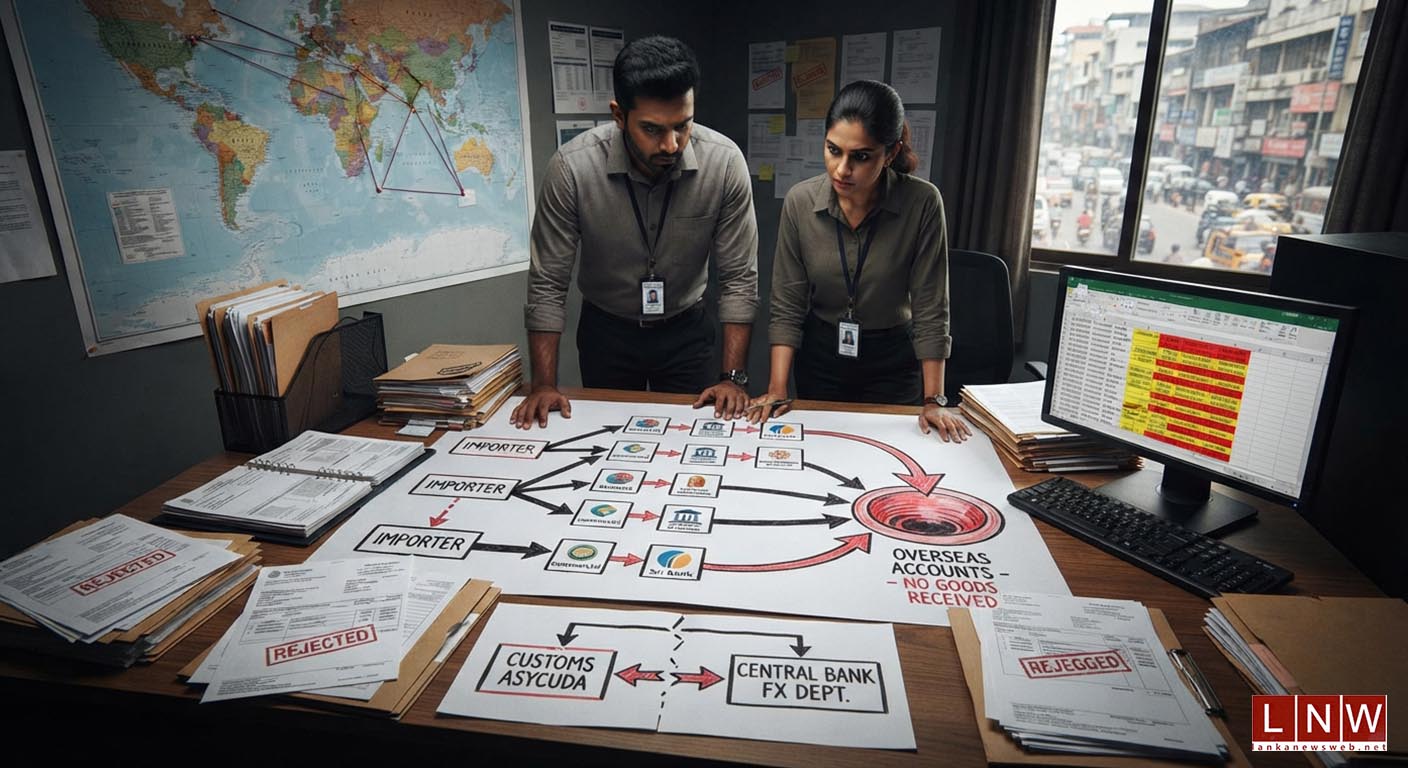
Although the arrangement was intended to facilitate legitimate international trade, investigators discovered that the same individuals allegedly approached different banks and branches under the names of different companies to obtain repeated US$50,000 payments.
The fundamental safeguard was that imported goods had to arrive within 180 days of the remittance. Transactions were recorded in the Customs ASYCUDA system, while Customs was expected to notify the Central Bank’s Department of Foreign Exchange when goods failed to arrive within the stipulated period.
However, this critical monitoring mechanism apparently failed.
According to Central Bank Governor Dr. Nandalal Weerasinghe, Customs had not supplied the required information to the Central Bank for an extended period despite repeated requests. Consequently, authorities remained unaware of the actual scale of transactions involving payments for goods that never arrived.
The scandal became apparent only after authorities received information that certain individuals were repeatedly using the facility. Subsequent investigations revealed numerous transactions involving substantial foreign currency outflows, some of which had not even been recorded in Customs.
The implications extend beyond the immediate financial losses. Every dollar transferred abroad without a corresponding import represents foreign exchange that becomes unavailable for legitimate economic requirements, including essential imports, industrial production and debt-servicing obligations.
The situation is particularly alarming for an economy still struggling to rebuild foreign reserves following its unprecedented financial crisis.
President Anura Kumara Dissanayake disclosed in Parliament in June 2026 that authorities were investigating approximately US$1 billion transferred abroad since 2023 through Telegraphic Transfers as import advances without corresponding goods arriving in Sri Lanka.
The President also alleged that some of the funds were connected to drugs, corruption and organised crime.
Authorities have now introduced stricter regulations requiring Tax Identification Numbers, beneficial ownership disclosures and background checks before approving advance payments. Banks have also been provided with a mechanism to check whether applicants have obtained similar advances through other financial institutions.
Fines have already been imposed on numerous companies.
Nevertheless, the central question remains: how could a facility intended for legitimate imports become an instrument for repeatedly transferring dollars abroad without effective detection?
The investigation must establish not merely who exploited the loophole, but why the institutions responsible for protecting the country’s foreign exchange resources failed to prevent its prolonged abuse.